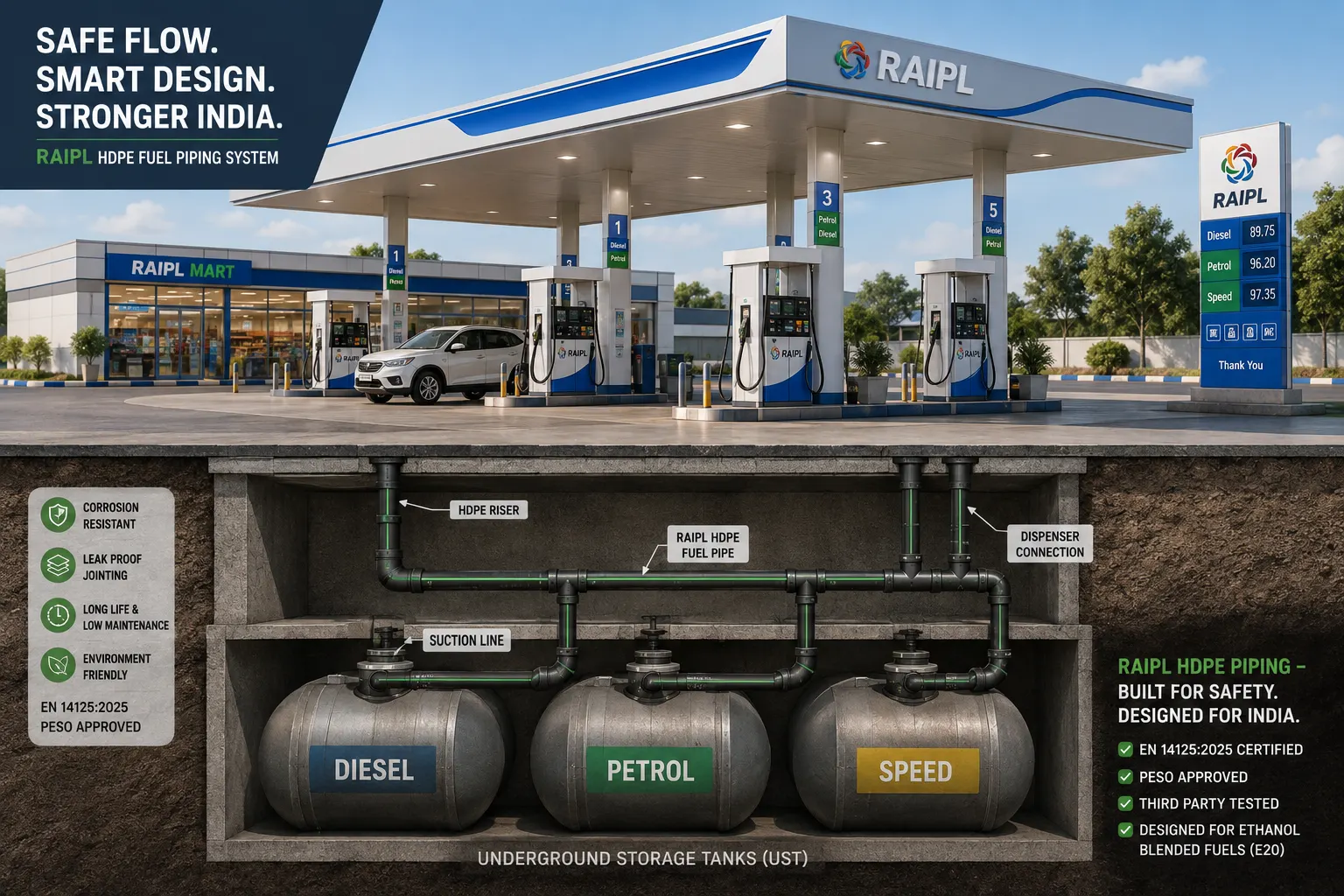
Underground Fuel Piping Is Changing
When people think about modernizing a petrol pump, they usually notice the things above ground:
- New dispensers
- Digital payment systems
- LED signage
- Modern canopies
- Improved lighting
- Better customer facilities
But some of the most important technological changes are happening below the forecourt.
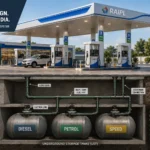
The underground piping connecting fuel storage tanks with dispensing equipment is a critical part of petroleum retail infrastructure.
Historically, metallic piping systems have been widely used for underground fuel transfer.
Today, specialized thermoplastic fuel piping systems—including multilayer HDPE technologies—provide another engineered approach for underground petroleum installations.
So why is HDPE fuel piping attracting attention?
The answer involves much more than replacing metal with plastic.
1. Corrosion Resistance
One of the fundamental differences between HDPE and conventional steel is their behaviour in underground environments.
Steel is a metallic material and corrosion needs to be considered as part of underground system design and protection.
HDPE does not rust like conventional steel.
For buried infrastructure, this is an important material characteristic.
However, corrosion resistance alone does not establish suitability for petroleum service.
The HDPE piping system still needs to be specifically designed and evaluated for fuel applications.
2. Lightweight Construction
HDPE is comparatively lightweight.
This can provide practical advantages during:
- Transportation
- Unloading
- Site handling
- Trench installation
- Pipe positioning
Petrol pump sites can have limited working space, especially during refurbishment projects.
Reducing the weight of individual piping components can therefore make handling easier for installation teams.
3. Flexibility
Steel pipe is relatively rigid.
HDPE provides greater flexibility, which can be useful when routing underground pipework.
Depending on the product and permitted bend radius, a flexible pipe can follow suitable gradual changes in the underground route.
This does not mean HDPE should be bent without limits.
Every piping system has specified bending requirements.
Where sharper directional changes are required, compatible fittings such as 45° and 90° elbows should be used according to the engineering design.
4. Longer Continuous Pipe Runs
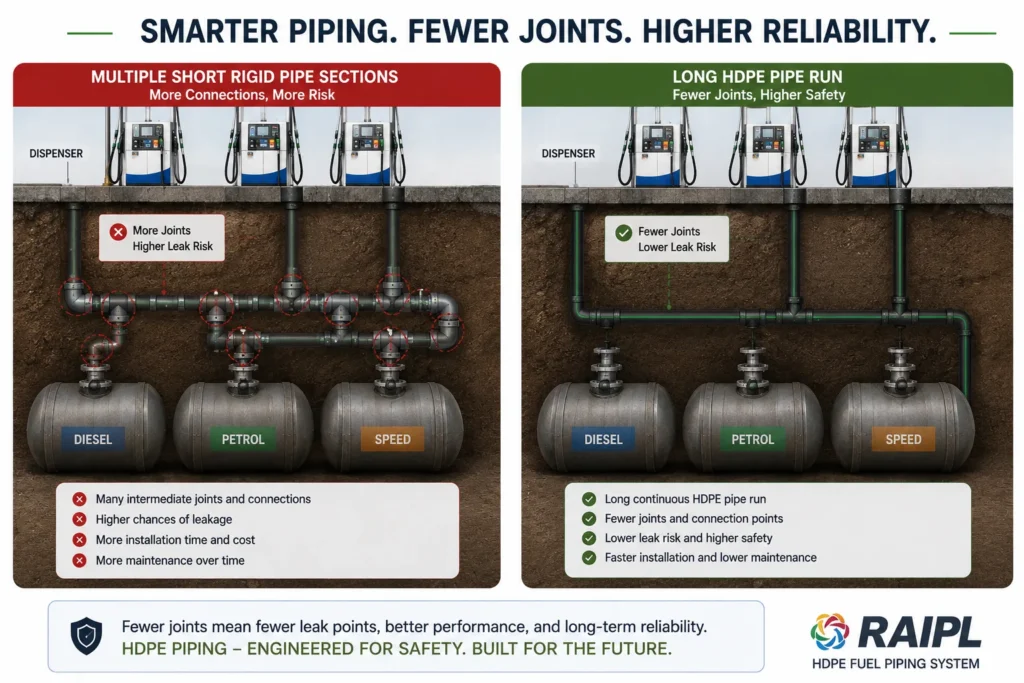
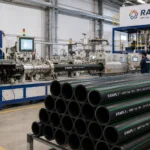
Depending on diameter and product design, HDPE piping can be supplied in relatively long continuous lengths or coils.
This creates an important installation opportunity.
A longer continuous underground run may require fewer intermediate connections than a system assembled from many shorter rigid sections.
For example:
Tank → Long Continuous Pipe Run → Dispenser Area
may require fewer intermediate joints than a route constructed from numerous individual pipe sections.
The actual number of joints always depends on the project layout.
5. Reducing Unnecessary Underground Connections
Every connection within an underground fuel network needs to be properly installed.
Reducing unnecessary connections can simplify certain piping layouts.
Long HDPE pipe runs can potentially reduce intermediate joints where the site design permits.
However, this should never lead to avoiding fittings where they are technically required.
The objective is:
Use the correct number of engineered connections—not simply the fewest possible fittings.
6. Electrofusion Jointing Technology
Compatible HDPE piping systems can use electrofusion fittings.
Common fittings include:
- Couplers
- 45° elbows
- 90° elbows
- Tees
Electrofusion fittings contain integrated electrical heating elements.
After correct pipe preparation and assembly, controlled electrical energy is used to create the fused connection.
A proper electrofusion process includes:
Cut → Measure → Scrape → Clean → Insert → Align → Fuse → Cool → Inspect
Correct installation remains essential.
7. Multilayer Barrier Technology
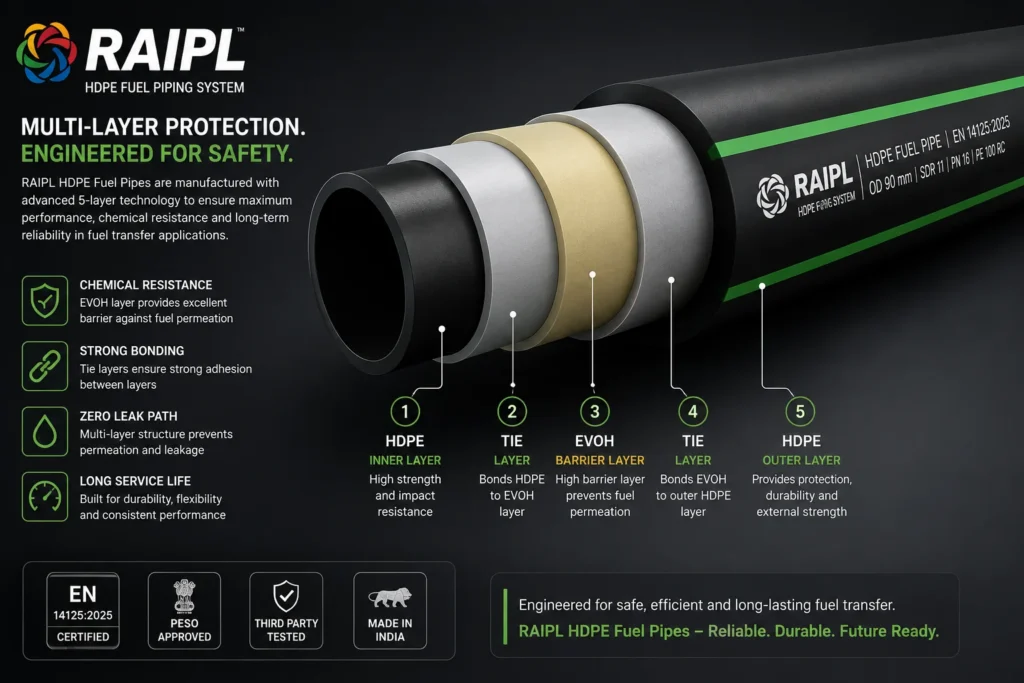
A major technological development in specialized thermoplastic fuel piping is multilayer construction.
An engineered multilayer HDPE fuel pipe can incorporate a structure such as:
HDPE → Tie Layer → EVOH Barrier → Tie Layer → HDPE
Different materials perform different functions.
HDPE
Provides important structural and mechanical characteristics.
Tie Layers
Help bond the different polymer materials together.
EVOH Barrier
Provides additional resistance against hydrocarbon permeation.
This is a fundamental difference between specialized multilayer fuel piping and ordinary general-purpose HDPE pipe.
8. Why Barrier Technology Matters
Petroleum fuels contain hydrocarbons.
With thermoplastic piping, hydrocarbon permeation through polymer materials is an important engineering consideration.
Permeation is different from a conventional leak.
There may be:
- No crack
- No hole
- No visibly damaged fitting
Instead, molecules can potentially migrate through certain polymer materials over time.
A specialized barrier layer provides additional resistance to this process.
This is why multilayer material engineering is important for modern thermoplastic fuel piping.
9. A Complete System of Fittings
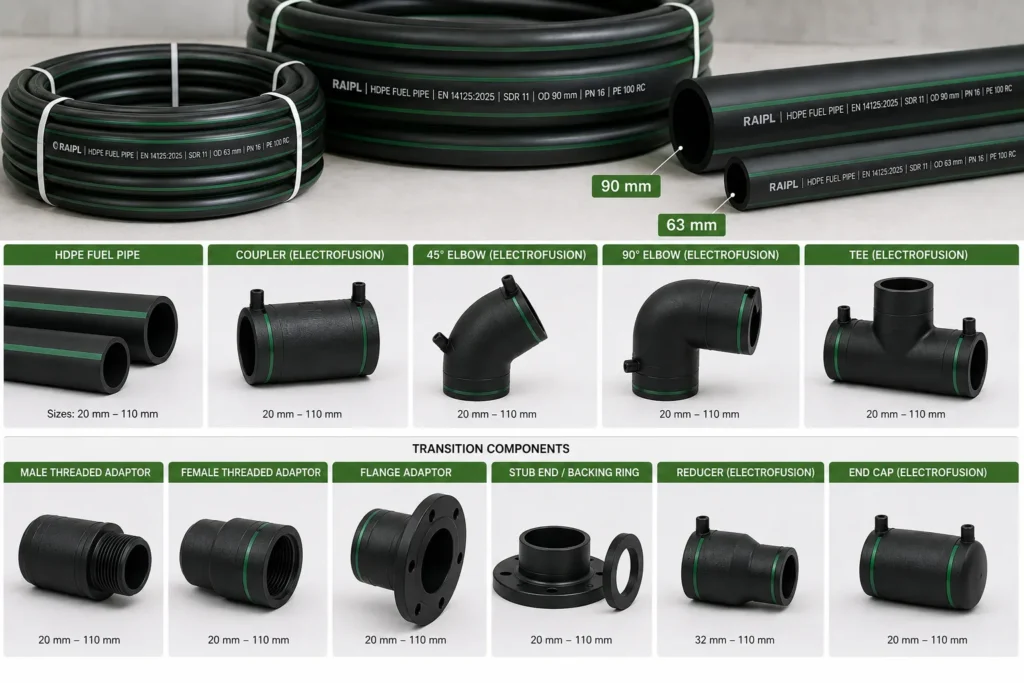
Modern HDPE fuel piping is not simply a roll of pipe.
A complete system can include:
Multilayer Pipe
Electrofusion Couplers
45° & 90° Elbows
Tees
Transition Adaptors
Flange Components
This allows engineers to design a complete underground network using compatible system components.
10. Easier Underground Routing
Every petrol pump has a different underground layout.
The piping may need to travel around:
- Storage tanks
- Dispenser foundations
- Electrical infrastructure
- Drainage
- Civil structures
- Other underground services
The flexibility of HDPE can provide additional routing options within the permitted installation limits.
This can be particularly useful at complex or existing petrol pump sites.
11. No Rusting of the HDPE Pipe Wall
One of HDPE’s straightforward material advantages is that it does not rust like conventional steel.
This removes one metallic corrosion mechanism from the pipe itself.
However, the overall system can still contain metallic components at certain interfaces.
Those components need to be selected and protected according to their own requirements.
A technically accurate statement is therefore:
HDPE pipe does not rust like steel—not that every component in an HDPE fuel piping installation is completely free from corrosion considerations.
12. Potentially Simpler Site Handling
Longer lengths and comparatively low weight can simplify some aspects of installation.
Instead of moving numerous heavy rigid sections, installers may be able to position longer HDPE runs.
This can potentially reduce:
- Individual pipe handling
- Intermediate connection points
- Some installation activities
The actual benefit depends on:
- Pipe diameter
- Coil dimensions
- Site access
- Trench design
- Installation equipment
- Project layout
Proper planning remains essential.
13. Suitable for Modern System Engineering
Modern petroleum infrastructure increasingly relies on integrated systems rather than isolated components.
The underground network needs to work with:
- Storage equipment
- Pumping equipment
- Dispensers
- Containment systems
- Monitoring equipment
- Transition connections
A specialized HDPE fuel piping system can form part of this engineered infrastructure when correctly specified.
14. Standards Have Helped Develop Specialized Fuel Piping
A general-purpose plastic pipe should not simply be placed underground and called a fuel pipe.
Specialized standards provide requirements relevant to the intended application.
For thermoplastic and flexible metal pipework used for underground installations at petrol filling stations, EN 14125 is an important European standard.
This provides a technical framework for evaluating specialized fuel piping systems.
HDPE Fuel Pipe vs Ordinary Plastic Pipe
The increasing use of thermoplastic fuel piping should never create the misconception that any plastic pipe can carry petrol.
A specialized fuel pipe can differ from ordinary pipe in:
- Material selection
- Multilayer construction
- Barrier technology
- Fittings
- Jointing requirements
- Testing
- Certification
- Intended application
The important word is not simply HDPE.
It is:
HDPE Fuel Piping System.
What About Steel?
Steel remains an established engineering material and may still be specified in petroleum infrastructure depending on the project.
The choice should not be presented as:
“Steel is bad and HDPE is good.”
That is an oversimplification.
The correct question is:
Which piping technology best meets the technical, regulatory and project requirements of this particular installation?
Modern multilayer HDPE fuel piping provides an additional engineered option with characteristics that can be attractive for underground petroleum installations.
What Should Petrol Pump Owners Consider?
Before selecting a piping technology, project teams should consider:
Intended Application
Is the product specifically designed for underground petroleum service?
Applicable Standard
Which technical standard applies?
Certification
What certification and supporting documentation are available?
Fuel Compatibility
Which fuels has the system been designed and evaluated for?
Fittings
Is a complete compatible fitting range available?
Installation
Are trained installers and correct tools available?
Testing
What commissioning procedure is required?
Technical Support
Can the supplier provide appropriate project and installation support?
These questions are more useful than comparing pipe materials based only on initial price.
Why Lifecycle Thinking Matters
Underground piping is different from many visible petrol pump components.
A signboard can be replaced.
Lighting can be upgraded.
A dispenser can be serviced.
But reaching an underground pipe can require significant civil work.
That can involve:
- Excavation
- Breaking finished forecourt surfaces
- Operational disruption
- Labour
- Reinstatement work
This is why the original piping decision should consider the complete lifecycle of the infrastructure.
Modernization Is Happening Below Ground Too
The petroleum retail industry is constantly modernizing.
New technologies are introduced in:
- Fuel dispensing
- Automation
- Payments
- Monitoring
- Safety
- Customer experience
Underground infrastructure should also evolve as suitable technologies and standards develop.
Specialized multilayer HDPE fuel piping represents one such development.
It combines established HDPE characteristics with advanced barrier and jointing technology designed for petroleum applications.
The Opportunity for India
India has one of the world’s largest petroleum retail networks.
This creates significant demand for specialized infrastructure.
Historically, advanced underground fuel piping systems used in the Indian market have included products supplied by international manufacturers.
Building equivalent technical capability domestically creates an opportunity to strengthen:
- Indian manufacturing
- Polymer engineering
- Multilayer extrusion capability
- Fitting manufacturing
- Local technical support
- Supply-chain resilience
- Future exports
But localization should never mean reducing technical requirements.
The goal should be:
Global technical standards + Indian manufacturing capability.
RAIPL’s Made-in-India Fuel Piping System
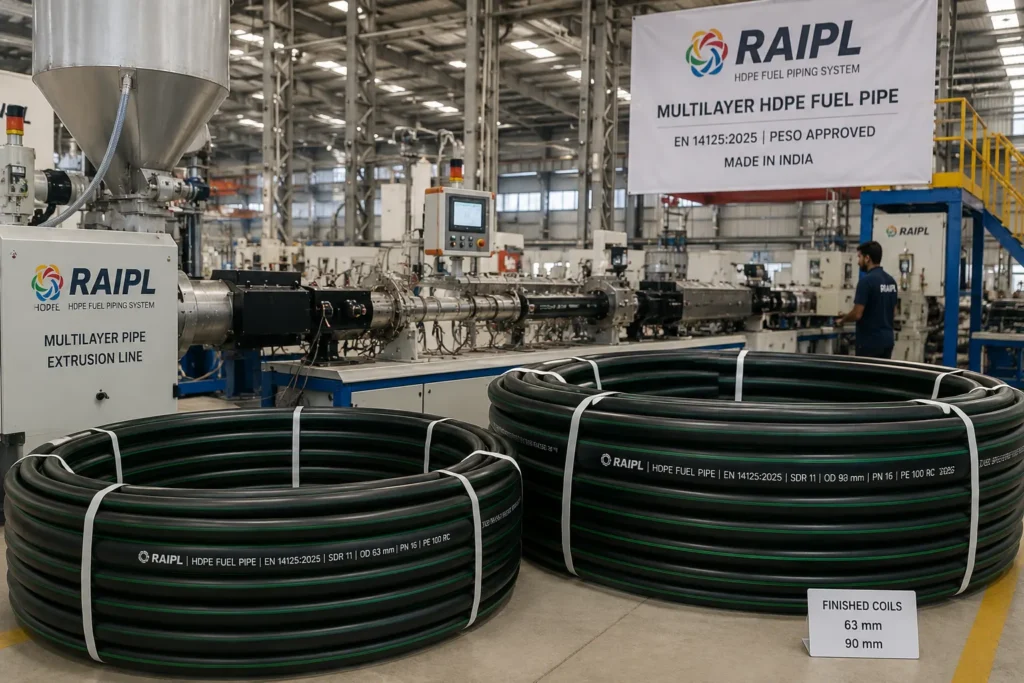
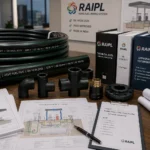
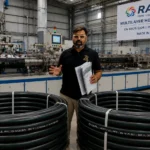
RAIPL (Rahul Arts India Pvt. Ltd.) is developing a complete multilayer HDPE fuel piping ecosystem for underground petroleum infrastructure.
The RAIPL system combines:
- Specialized multilayer HDPE fuel pipe
- HDPE structural layers
- Tie-layer technology
- EVOH barrier technology
- Compatible electrofusion fittings
- Transition fittings
- Flange connection components
- Technical documentation
- Installation guidance
RAIPL’s multilayer HDPE fuel piping system has achieved EN 14125:2025 certification.
The objective is to develop specialized petroleum piping technology within India while maintaining the technical requirements expected from modern fuel infrastructure.
Frequently Asked Questions
Why is HDPE used for underground fuel piping?
Specialized HDPE fuel piping can provide characteristics including corrosion resistance, flexibility, relatively low weight, long continuous lengths and compatibility with engineered fusion jointing systems.
Does HDPE fuel pipe rust?
HDPE itself does not rust like conventional steel.
Is every HDPE pipe suitable for petrol?
No. General-purpose HDPE should not automatically be used for petroleum service. A fuel piping system should be specifically designed and evaluated for its intended application.
Why are multilayer fuel pipes used?
Multilayer construction allows different materials to perform different functions, including structural and specialized barrier roles.
Why is EVOH used?
EVOH can provide a specialized barrier function that adds resistance against hydrocarbon permeation within an engineered multilayer structure.
Are HDPE fuel pipes always better than steel?
No piping technology is automatically best for every project. Selection should be based on engineering, applicable standards, regulations, fuel application and project requirements.
What standard applies to underground thermoplastic fuel piping?
EN 14125 is an important European standard for specified thermoplastic and flexible metal pipework used in underground petrol filling station installations.
The Future of Fuel Infrastructure Is Also Underground
A modern petrol pump is not defined only by what customers can see.
The infrastructure beneath their feet matters too.
Specialized HDPE fuel piping offers engineers another approach to underground petroleum systems through:
Corrosion Resistance
Flexibility
Long Continuous Pipe Runs
Electrofusion Technology
Multilayer Barrier Engineering
and
Complete Compatible Piping Systems
For India, the next step is not simply adopting modern fuel piping technology.
It is also building the capability to manufacture that technology domestically.
That is the direction RAIPL is working toward with its Made-in-India multilayer HDPE fuel piping system.