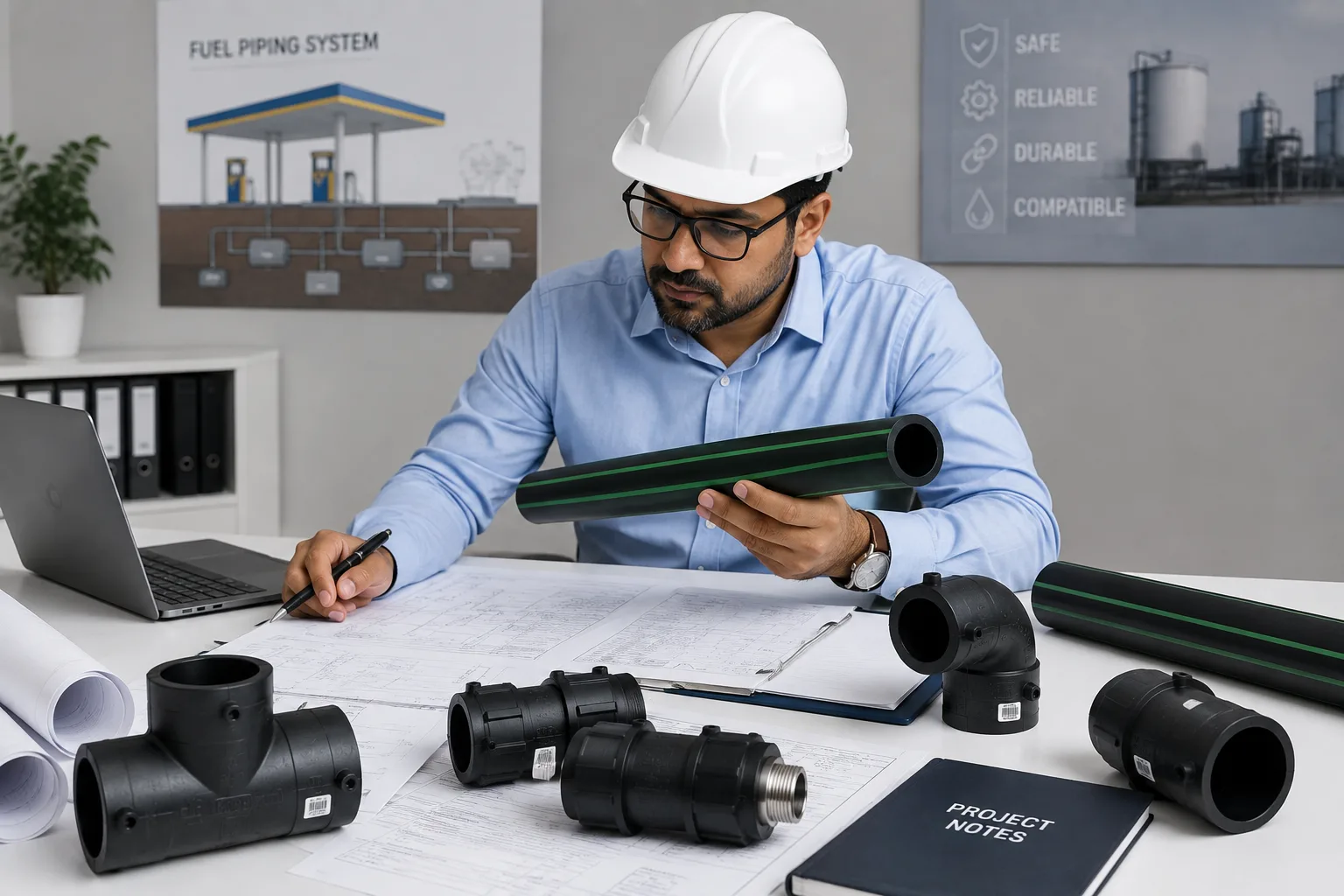
Choosing a Fuel Pipe Is More Than Comparing Price
When a petrol pump project requires underground fuel piping, one of the first questions is often:
“What is the price per metre?”
Price is important.
But for infrastructure that will remain buried underneath a petrol pump forecourt, it should not be the only factor.
The better question is:
“Is this complete piping system technically suitable for the project?”
A responsible evaluation should consider the pipe, fittings, intended fuel, certification, installation requirements and long-term system support.
Here are the most important points buyers should check.
1. Confirm the Intended Application
Start with the most basic question:
What was this pipe actually designed for?
A pipe being made from HDPE does not automatically make it suitable for petroleum service.
HDPE pipes can be manufactured for:
- Water
- Gas
- Drainage
- Industrial applications
- Specialized fuel applications
Each application can have different technical requirements.
For a petrol pump, the pipe should be specifically intended for the relevant underground fuel application.
2. Check the Applicable Standard
The next question should be:
Which technical standard has the system been evaluated against?
For thermoplastic and flexible metal underground piping used at petrol filling stations, EN 14125 is an important European standard.
Do not stop at seeing only the words:
“EN certified”
Ask for the actual standard number and edition.
For example:
EN 14125:2025
The edition matters because technical standards are periodically updated.
3. Review the Actual Certification
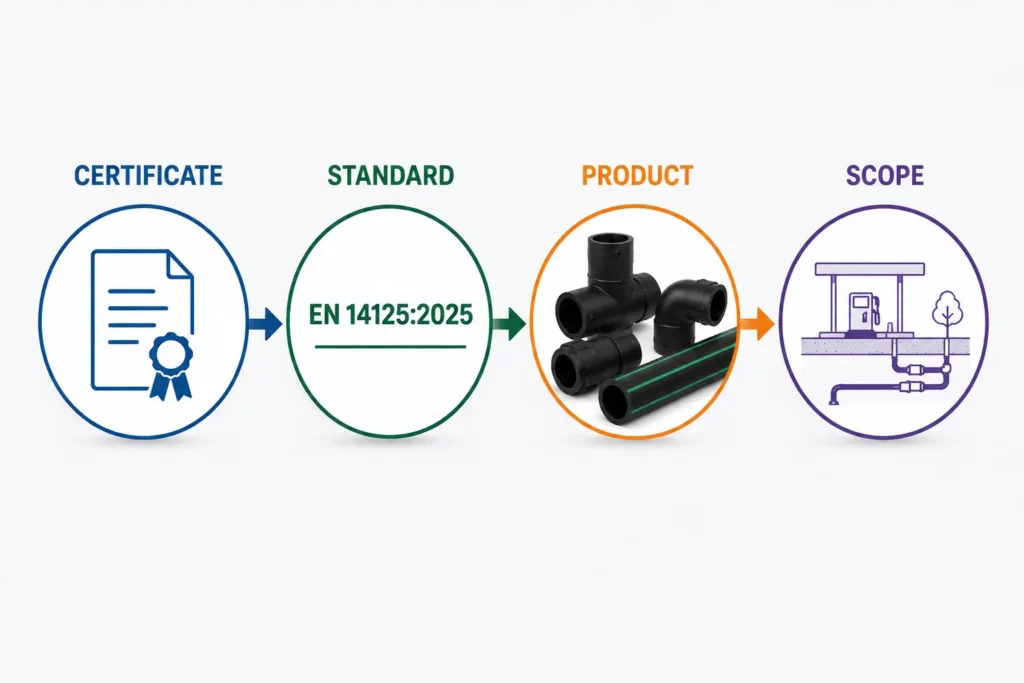
Never make a technical purchasing decision based only on a logo shown in a brochure.
Ask to see the actual certificate.
Then check:
- Manufacturer name
- Product description
- Standard referenced
- Standard edition
- Certificate validity where applicable
- Scope of certification
- Issuing conformity-assessment body
A certificate should relate to the actual product being supplied.
4. Understand the Certification Scope
Two suppliers may both say:
“Our product is certified.”
But the scope of those certifications may not necessarily be identical.
Buyers should understand exactly what has been evaluated.
Questions can include:
- Which product?
- Which sizes?
- Which construction?
- Which fittings?
- Which standard edition?
- Which test requirements?
- Which manufacturing location, where relevant?
Reading the scope is more important than simply seeing a certification mark.
5. Check the Pipe Construction
The external appearance of an HDPE pipe does not tell the full story.
For specialized underground fuel piping, ask how the pipe is constructed.
A multilayer concept can include:
HDPE → Tie Layer → EVOH Barrier → Tie Layer → HDPE
Each material performs a specific role.
HDPE
Provides important structural and mechanical characteristics.
Tie Layers
Help bond materials with different properties.
EVOH Barrier
Provides additional resistance against hydrocarbon permeation.
Ask the manufacturer to explain the construction clearly instead of relying only on phrases such as “advanced technology” or “multilayer pipe.”
6. Ask About Fuel Compatibility
Do not assume every fuel pipe is automatically suitable for every petroleum product or fuel formulation.
Ask:
Which fuels has the piping system been designed and evaluated for?
Fuel compatibility can involve:
- Pipe materials
- Barrier materials
- Fittings
- Seals
- Transition components
- Other fuel-contact materials
As fuel formulations evolve, this becomes increasingly important.
Claims should be supported by suitable technical documentation.
7. Check the Complete Fitting Range
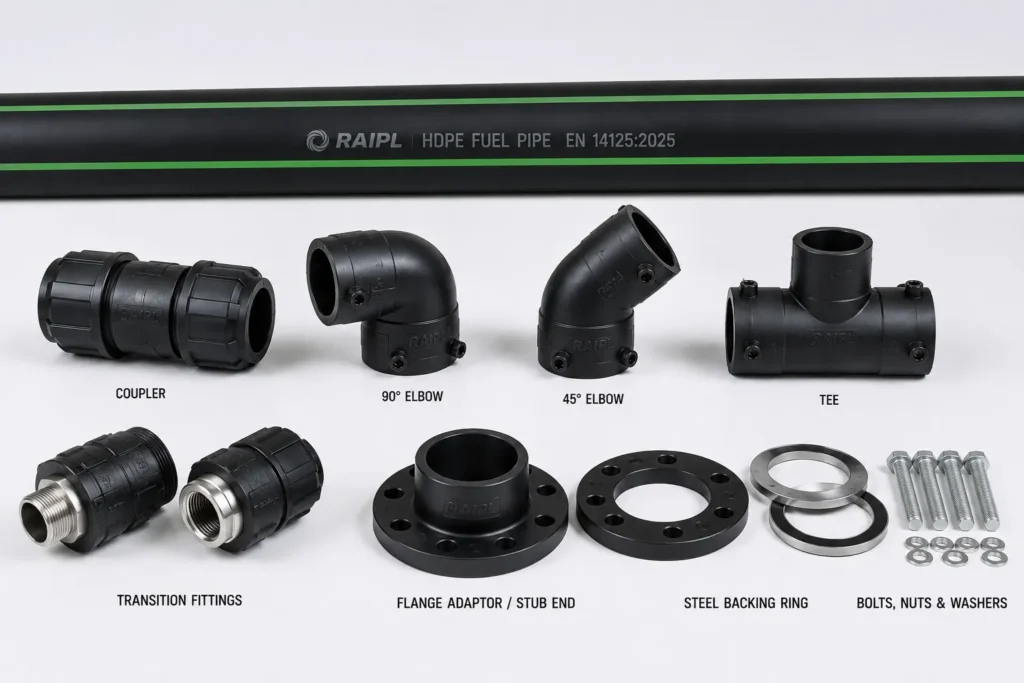
A fuel piping system cannot be built using straight pipe alone.
Before selecting a supplier, review the complete range of compatible fittings required for the project.
These can include:
- Electrofusion Couplers
- Electrofusion 90° Elbows
- Electrofusion 45° Elbows
- Electrofusion Tees
- Male Transition Adaptors
- Female Transition Adaptors
- Flange Adaptors
- Stub Ends
- Backing Rings
- Other system-specific components
If the pipe is available but essential fittings are difficult to source, the project can face unnecessary complications.
8. Confirm Pipe and Fitting Compatibility
Do not select fittings based only on nominal diameter.
For example:
63 mm Pipe + 63 mm Fitting
does not automatically mean the components should be used together.
Compatibility can depend on:
- Dimensions
- Material
- Fusion characteristics
- Intended application
- System design
- Manufacturer requirements
- Certification scope
The safest approach is to use components intended to work together within the specified piping system.
9. Understand the Jointing Method
For compatible HDPE fuel piping, electrofusion can be used to create engineered joints.
Before purchasing the system, understand what is required for installation.
This may include:
- Pipe cutting tools
- Scraping tools
- Alignment clamps
- Electrofusion equipment
- Cleaning procedure
- Fusion parameters
- Cooling requirements
- Installer training
A system that is technically excellent but poorly installed can still create problems.
10. Ask About Installation Support
Specialized fuel piping should not simply arrive at site with no technical guidance.
Ask whether the supplier provides:
- Installation manuals
- Technical guidance
- Installer training
- Jointing procedures
- Site support where applicable
- Commissioning guidance
Technical support can be particularly useful during the first installations of a new system.
11. Check Product Marking
A specialized fuel pipe should have appropriate identification according to the applicable requirements and manufacturer’s system.
Marking can help identify information such as:
- Manufacturer
- Product
- Size
- Relevant standard
- Batch or traceability information
- Manufacturing data where applicable
Clear product identification helps distinguish the intended fuel piping system from general-purpose pipe on a busy construction site.
12. Ask About Traceability
Underground piping can remain in service for many years.
Once installed, most of the product will no longer be visible.
Traceability can therefore be very valuable.
Ask whether the manufacturer maintains records that allow products to be connected with relevant:
- Production batches
- Raw material records
- Quality checks
- Manufacturing dates
- Product identification
- Test documentation
Project-level installation records can add another layer of traceability.
13. Review Technical Test Documentation
Certification can be important, but buyers may also need supporting technical documentation depending on the project.
Ask what test reports are available and whether they relate to the product being supplied.
Avoid relying on documents for:
- A different product
- A different construction
- An unrelated manufacturer
- A different standard without explanation
Technical documentation should match the product and claim being made.
14. Don’t Select by Pressure Rating Alone
Pressure rating is important.
But it does not, by itself, establish that an HDPE pipe is suitable for petroleum service.
A high-pressure water or gas pipe is not automatically a fuel pipe.
Fuel piping can also require consideration of:
- Fuel compatibility
- Hydrocarbon permeation
- Barrier technology
- Joint performance
- Fitting compatibility
- Relevant standards
- Certification
The application determines the requirements.
15. Check Available Pipe Sizes
The correct pipe diameter should come from the engineering design, not simply from what happens to be available in stock.
Pipe sizing can depend on factors including:
- System configuration
- Flow requirements
- Pipeline length
- Equipment
- Project specifications
The manufacturer should be able to provide clear technical information for the sizes offered.
16. Consider Long Continuous Pipe Lengths
One useful characteristic of HDPE piping is the ability, depending on diameter and system configuration, to supply longer continuous lengths or coils.
This can potentially reduce intermediate underground joints in suitable routes.
However, buyers should evaluate:
- Coil dimensions
- Transport requirements
- Site handling
- Installation method
- Minimum bend radius
- Actual project route
The longest possible coil is not automatically the best choice for every site.
17. Ask How the Pipe Should Be Stored and Handled
Correct handling begins before installation.
Pipe and fittings should be stored and transported according to the manufacturer’s requirements.
Poor handling can cause:
- Surface damage
- Contamination
- Distortion
- Damage to fittings
- Installation difficulties
A professional supplier should provide appropriate product-handling guidance.
18. Check Commissioning Requirements
Before choosing the piping system, understand how it will be inspected and tested after installation.
Depending on project requirements, commissioning can involve:
- Visual inspection
- Joint inspection
- Integrity or pressure testing
- Leak verification
- Documentation
- Final acceptance
The required test method, test medium, pressure, duration and acceptance criteria should come from the applicable approved procedure.
19. Verify Regulatory and Project Requirements
Technical certification does not automatically mean a product can be installed in every project without additional approvals.
Requirements may come from:
- Petroleum companies
- Project owners
- Engineering consultants
- Tender specifications
- Regulatory authorities
- Vendor-registration systems
Buyers should confirm these requirements before finalizing procurement.
20. Evaluate the Manufacturer — Not Just the Product
Specialized infrastructure depends on the organization behind the product.
Ask whether the manufacturer has:
- Controlled production capability
- Quality systems
- Technical personnel
- Testing capability
- Product traceability
- Fitting support
- Installation knowledge
- After-sales technical support
Buying fuel piping should be viewed as selecting a system partner, not simply purchasing plastic pipe by the metre.
A Practical Fuel Pipe Evaluation Checklist
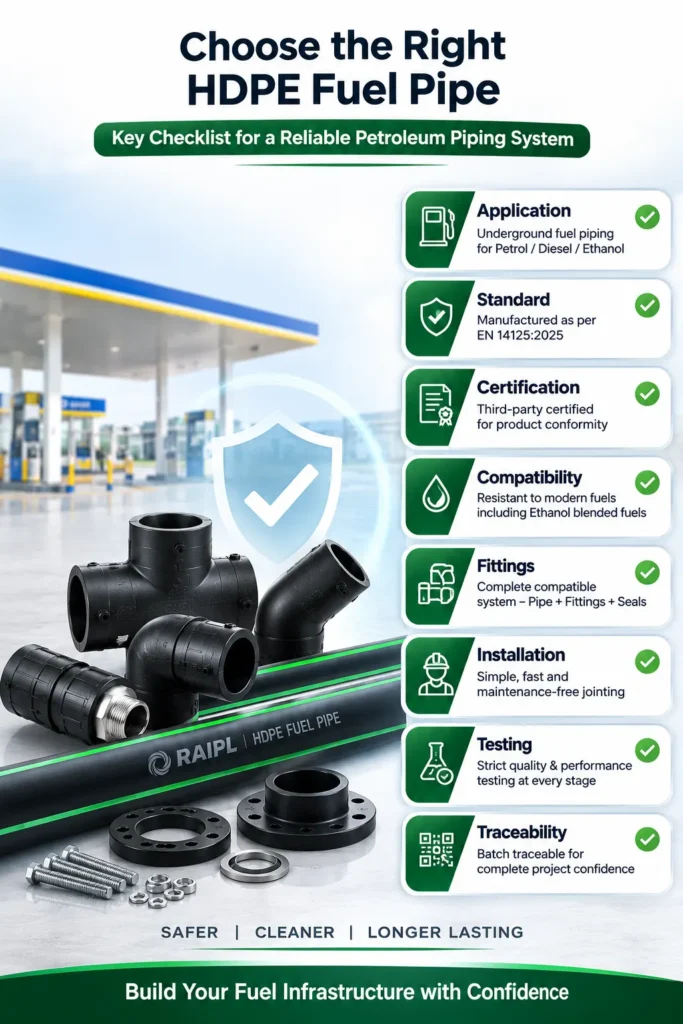
Before final approval, buyers can use this simple checklist:
Application confirmed?
Applicable standard confirmed?
Certificate checked?
Certificate scope reviewed?
Fuel compatibility understood?
Multilayer construction verified?
Compatible fittings available?
Installation procedure available?
Technical test documentation reviewed?
Product traceability available?
Site testing procedure understood?
Project/authority approvals confirmed?
If several answers are still unclear, the technical evaluation is not complete.
Price per Metre vs Total System Value
Two piping systems may have different initial prices.
But the final project cost includes much more than the pipe itself.
Consider:
- Pipe
- Fittings
- Number of joints
- Installation labour
- Installation tools
- Transport
- Technical support
- Testing
- Maintenance considerations
- Future availability of components
This is why comparing only ₹ per metre may not provide a complete view of system value.
The better comparison is:
What does it take to create a complete, compliant and properly installed underground fuel piping system?
Why Local Technical Support Matters
When specialized piping is sourced internationally, replacement components or technical support can sometimes involve longer supply chains.
Domestic manufacturing can provide potential advantages such as:
- Faster communication
- Local technical support
- Shorter supply chain
- Easier availability of components
- Faster project response
These advantages matter only when they are supported by proper product quality and engineering capability.
Made in India and technically engineered should go together.
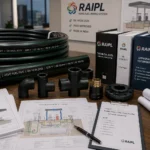
RAIPL Multilayer HDPE Fuel Piping System
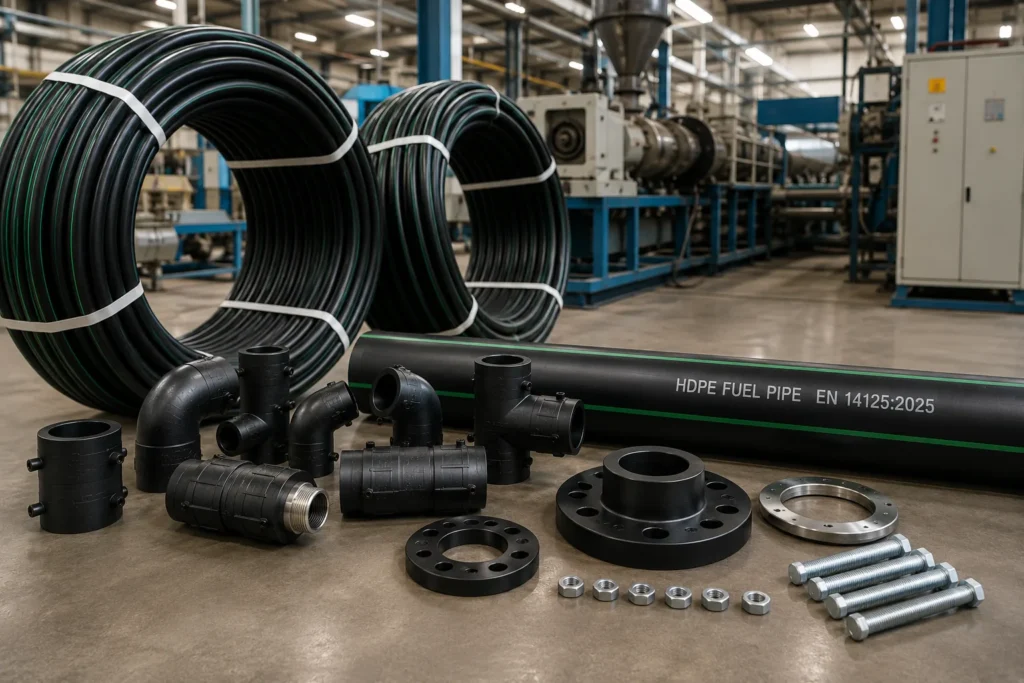
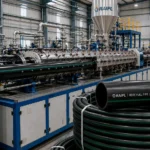
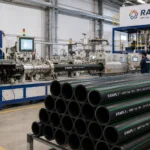
RAIPL (Rahul Arts India Pvt. Ltd.) is developing a complete Made-in-India multilayer HDPE fuel piping ecosystem for underground petroleum applications.
The RAIPL system combines:
- Specialized multilayer HDPE fuel pipe
- EVOH barrier technology
- Compatible electrofusion fittings
- Transition components
- Technical documentation
- Product traceability
- Installation guidance
- Quality-control processes
RAIPL’s multilayer HDPE fuel piping system has achieved EN 14125:2025 certification.
The objective is not simply to compete on price per metre.
It is to provide customers with an engineered underground petroleum piping system backed by local manufacturing and technical capability.
Frequently Asked Questions
What is the first thing to check when selecting a fuel pipe?
Confirm that the product is specifically intended for the petroleum application required by the project.
Is EN certification enough?
The actual standard, edition, certificate scope, product description and supporting documentation should be reviewed. Project-specific approval requirements may also apply.
Should I buy fuel pipe based on price per metre?
Price is one consideration, but the complete system—including fittings, installation, testing, technical support and applicable requirements—should also be evaluated.
Can I use fittings from another HDPE system?
Compatibility should not be assumed based only on material or nominal diameter. Verify the requirements of the complete piping system.
Why does traceability matter?
Once the pipe is underground, traceability records can help identify the installed products and connect them with relevant manufacturing and quality information.
Is a high-pressure HDPE pipe automatically suitable for petrol?
No. Pressure capability alone does not establish fuel compatibility or compliance with petroleum piping requirements.
Select the System, Not Just the Pipe
Underground fuel piping is an infrastructure decision.
The pipe may disappear from sight after construction, but it remains part of the petrol pump for years.
That is why procurement should look beyond:
Diameter + Price + Availability
and evaluate:
Application + Standard + Certification + Fuel Compatibility + Pipe Construction + Fittings + Installation + Testing + Support
A technically informed buying decision at the beginning can help create a better-engineered underground fuel piping system.
RAIPL’s goal is to provide that complete system approach through Made-in-India multilayer HDPE fuel piping technology.