
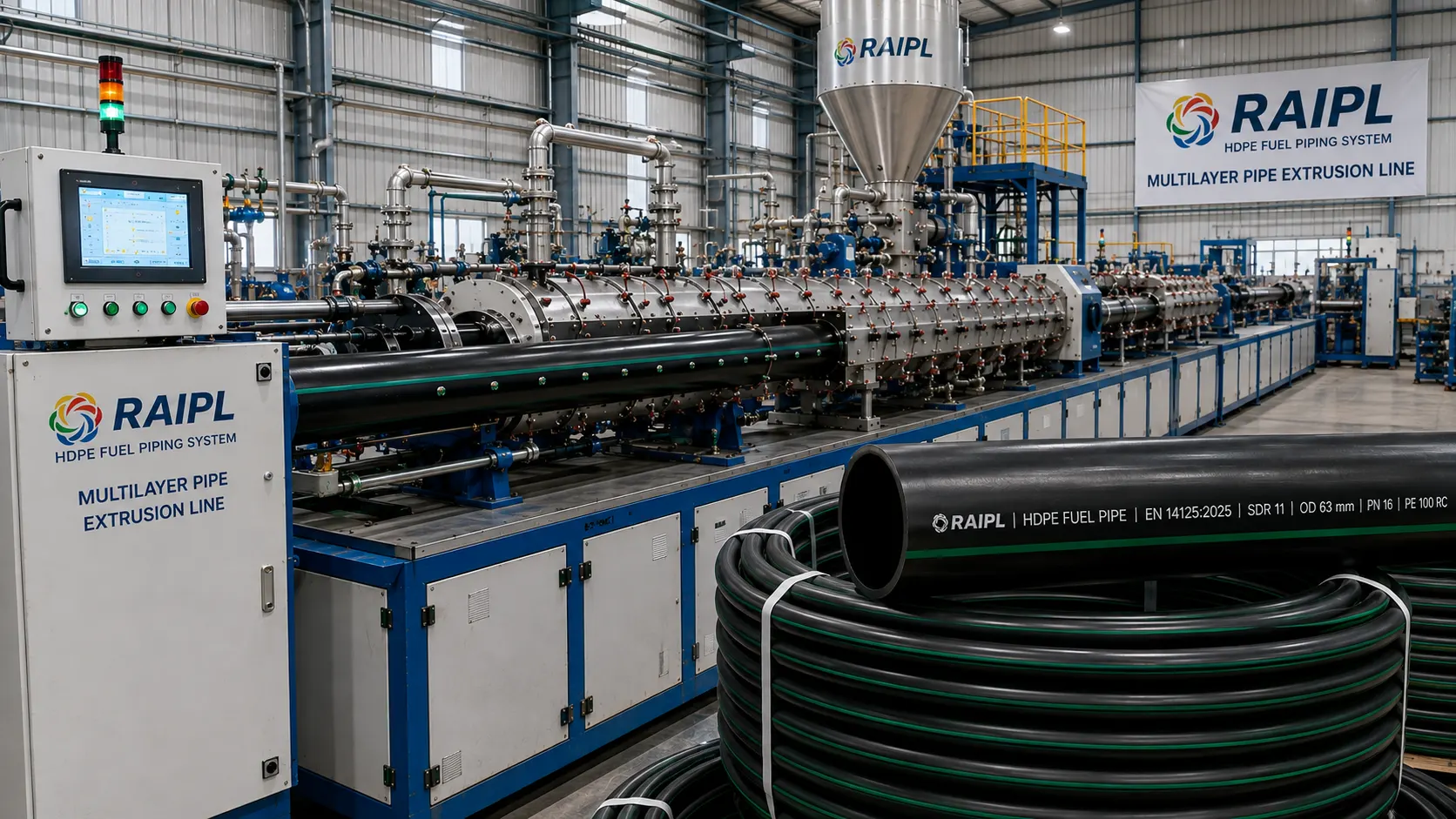
How Does the HDPE Fuel Pipe Manufacturing Process Work?
HDPE fuel pipe manufacturing is a specialized process that combines different polymer materials into an engineered multilayer pipe for underground petroleum applications. Unlike conventional single-material HDPE pipe production, multilayer fuel pipe manufacturing requires controlled processing of HDPE, tie-layer materials and barrier technology through multiple extrusion streams.
From the outside, the finished product may look like a simple black HDPE pipe, but its internal construction and manufacturing process are significantly more specialized.
A simplified production process is:
Raw Materials → Material Feeding → Multiple Extruders → Multilayer Die → Calibration → Cooling → Marking → Coiling → Quality Control
Each stage has an important role.
Step 1: Selecting Raw Materials for HDPE Fuel Pipe Manufacturing
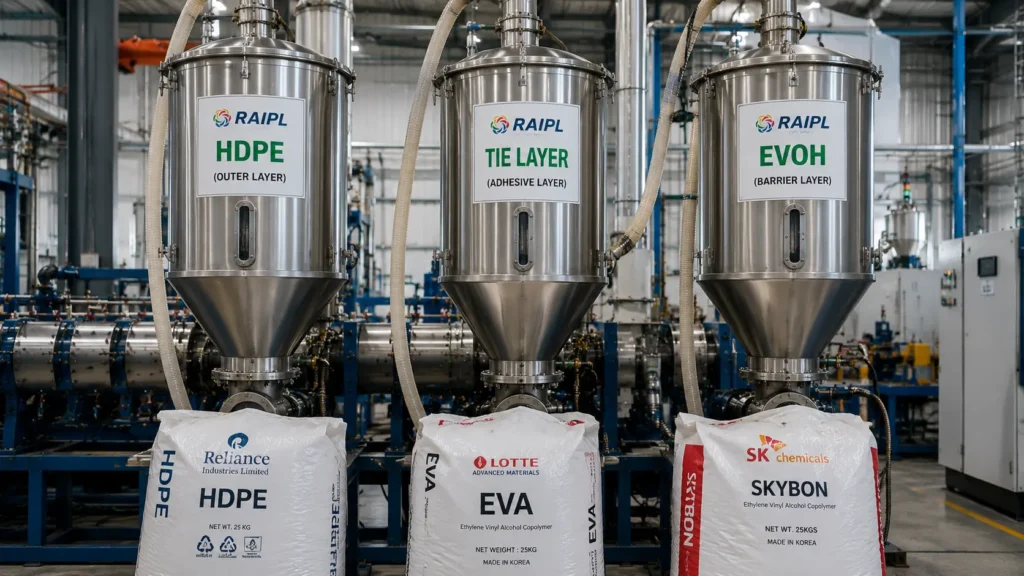
The manufacturing process begins with the correct raw materials.
Depending on the approved product design, these may include:
- HDPE resin
- Tie-layer material
- EVOH barrier resin
- Approved additives where applicable
The quality of the finished pipe depends heavily on material consistency.
That is why material identification and controlled storage are important.
In a multilayer fuel pipe, these materials are selected for different functions. HDPE provides the primary structural properties, specialized tie layers help bond dissimilar polymers together, while the EVOH barrier layer provides additional resistance to hydrocarbon permeation. The effectiveness of the finished pipe therefore depends not only on the individual materials but also on how consistently they are combined during multilayer extrusion.
Step 2: Raw Material Handling
Different polymer materials need different handling conditions.
Proper storage helps protect materials from:
- Contamination
- Moisture
- Incorrect mixing
- Foreign particles
Each material should be clearly identified before entering production.
This helps maintain consistency between manufacturing batches.
Step 3: Feeding the Multilayer Extrusion System
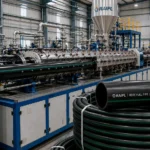
Unlike a conventional single-material HDPE pipe, a multilayer pipe needs multiple material streams.
Separate feeding systems supply the required polymers to the relevant extruders.
For example, one extrusion stream may process HDPE while others process tie-layer and barrier materials.
The goal is to deliver the correct quantity of each polymer continuously.
Step 4: Melting and Processing the Polymers
Inside the extruders, the polymer materials are heated and processed under controlled conditions.
Important production parameters can include:
- Temperature
- Extrusion rate
- Screw speed
- Material pressure
- Production speed
The exact settings depend on the material system and approved manufacturing process.
Stable processing is important for maintaining consistent pipe construction.
Step 5: Creating the Multilayer HDPE Fuel Pipe Structure
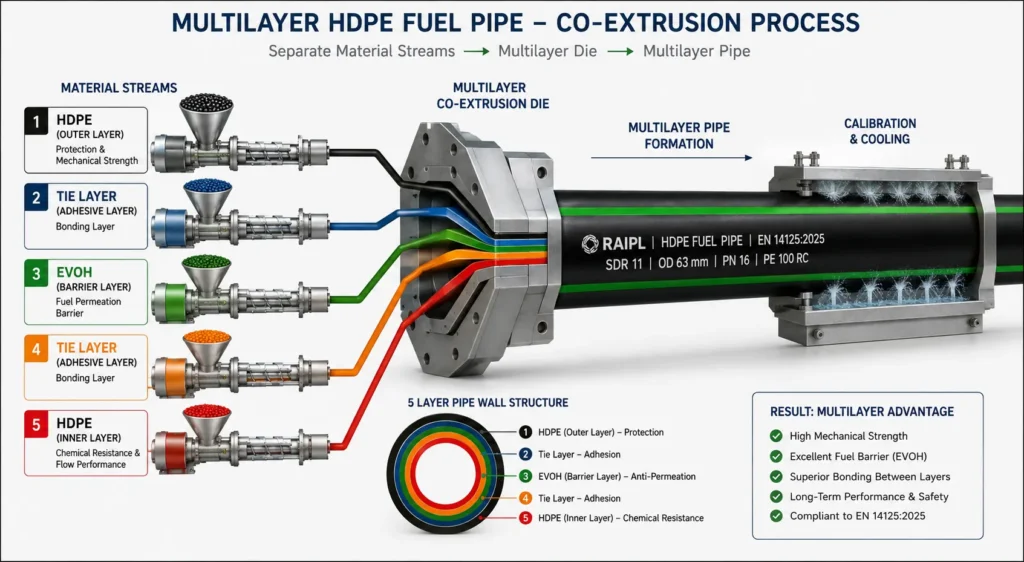
The separate polymer streams are brought together through specialized multilayer tooling.
This is where the required pipe-wall structure is formed.
A simplified construction can be represented as:
HDPE → Tie Layer → EVOH Barrier → Tie Layer → HDPE
For a detailed explanation of how each layer performs a different function, see our guide to multilayer HDPE fuel pipe technology.
Each layer needs to remain properly positioned around the pipe circumference and along its length.
This stage is one of the key differences between multilayer pipe manufacturing and ordinary single-layer pipe extrusion.
Why Layer Control Is Important
A multilayer fuel pipe depends on the different materials performing their intended functions.
If one layer becomes inconsistent, the engineered structure may no longer match the intended product design.
Manufacturing therefore needs to control:
- Layer position
- Layer continuity
- Material distribution
- Pipe dimensions
- Bonding between layers
This is why specialized multilayer extrusion requires precision.
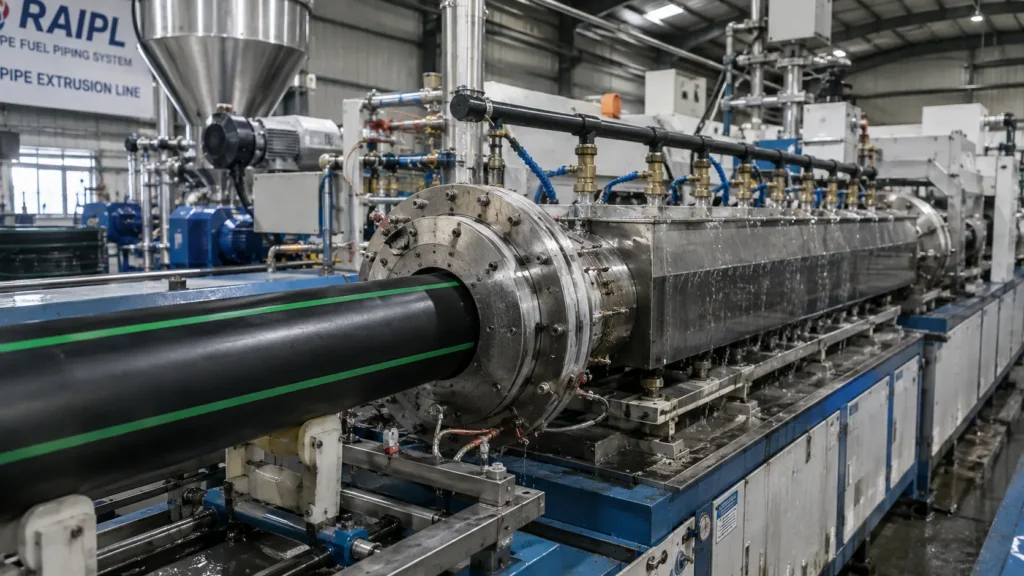
Step 6: Pipe Formation
As the combined polymer stream exits the die, it takes the shape of the pipe.
At this stage, the material is still hot and needs to be stabilized.
The pipe then moves into the calibration and cooling section of the production line.
Step 7: Calibration
Calibration helps maintain the required outside diameter and geometry.
Dimensional consistency is important because the finished pipe must connect correctly with compatible fittings.
A poorly controlled diameter can affect:
- Joint preparation
- Fitting insertion
- Electrofusion compatibility
- Overall system performance
For this reason, dimensional control continues throughout production.
Step 8: Cooling
The pipe is then gradually cooled.
Controlled cooling helps stabilize the polymer structure and maintain the intended pipe dimensions.
Cooling needs to be managed consistently because uneven cooling can affect geometry.
The pipe continues through the production line as it becomes dimensionally stable.
Step 9: Dimensional Checks
During production, dimensional measurements can be taken to verify that the pipe remains within the approved manufacturing specification.
Checks may include:
- Outside diameter
- Wall dimensions
- Roundness
- Other product-specific parameters
The exact inspection requirements depend on the quality plan and product specification.
Step 10: Surface Inspection
The external surface of the pipe should also be inspected.
Manufacturing personnel can check for visible issues such as:
- Surface defects
- Irregular shape
- Contamination
- Damage
- Marking issues
The objective is to identify problems before the pipe reaches the finishing stage.
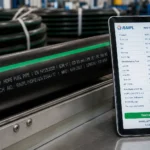
Step 11: Product Marking
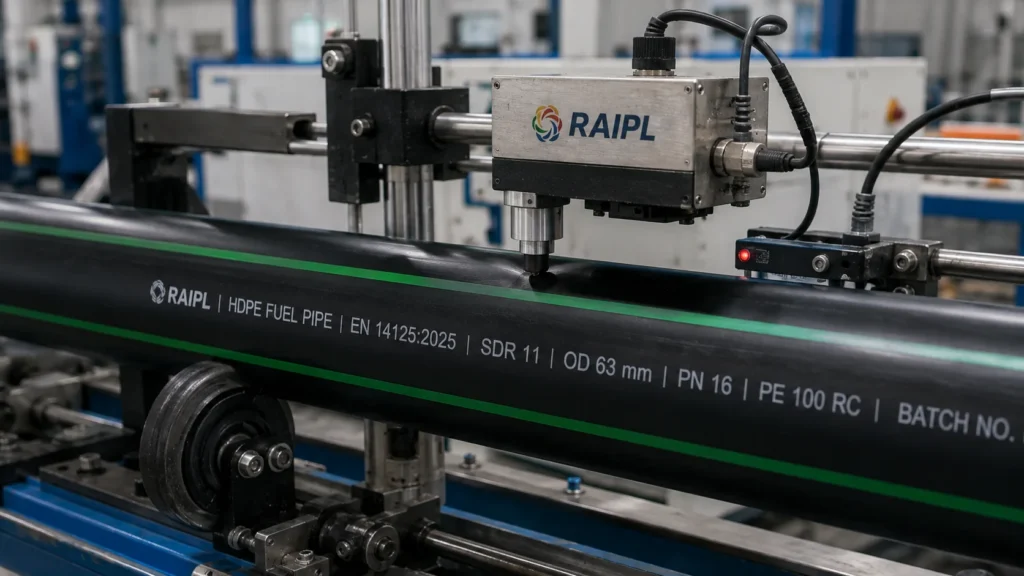
A specialized infrastructure product needs clear identification.
The pipe can be marked with information relevant to the manufacturer’s approved system and applicable requirements.
This may include:
- Manufacturer
- Product identification
- Size
- Standard reference where applicable
- Batch information
- Manufacturing data
Marking supports traceability.
For buyers, engineers and site teams, understanding these markings is important for verifying the product delivered to site. See our guide on how to read HDPE fuel pipe markings for a detailed explanation of size, standard, batch and traceability information.
Why Traceability Starts in the Factory
A good traceability system connects the finished product with its production history.
A simplified traceability chain can look like:
Raw Material Batch → Production Batch → Pipe Marking → QC Record → Delivery
This creates a documented link between the material entering the factory and the pipe supplied to the customer.
For underground petroleum infrastructure, that information can be valuable for years after installation.
Manufacturing records are only the beginning of the product lifecycle. Batch identification, pipe marking, delivery records, electrofusion joint records and installation documentation can extend this information from the factory to the petrol pump. Read our detailed guide on fuel pipe traceability to understand how this information can be maintained throughout an underground piping project.
Step 12: Haul-Off and Production Control
A haul-off unit helps pull the pipe through the production line at a controlled speed.
Production speed needs to remain coordinated with:
- Extrusion output
- Pipe dimensions
- Cooling
- Layer distribution
Stable line speed contributes to consistent pipe production.
Step 13: Coiling
Depending on size and product configuration, finished HDPE fuel pipe can be supplied in long coils.
Coiling can provide practical advantages for underground installation because longer continuous lengths may reduce the need for unnecessary intermediate joints.
However, coils need to be formed and handled correctly to avoid damaging the finished pipe.
Step 14: Finished-Coil Inspection
Before release, the finished product can undergo another inspection.
Checks can include:
- Overall pipe condition
- Coil condition
- Marking
- Dimensions
- Traceability
- Packaging
The product should match the approved specification before it is released for dispatch.
Quality Control Is Not One Final Test
A common misunderstanding is that quality control happens only after the pipe has been manufactured.
In reality, good quality control begins much earlier.
It includes:
Raw Material Control
Process Control
Dimensional Control
Layer Control
Product Inspection
Traceability
Quality is therefore built into the process rather than inspected only at the end.
Why Raw Material Control Matters
Changing a raw material without proper technical evaluation can affect product performance.
Manufacturers therefore need systems to identify and control the materials used in production.
This is particularly important in multilayer piping where different polymers perform different functions.
Each material needs to correspond with the approved pipe design.
Why Process Stability Matters
A production line should not produce a good pipe only occasionally.
The goal is repeatability.
A controlled manufacturing process should be capable of producing the intended structure consistently from one production batch to another.
This requires monitoring and controlling the key process parameters.
Why Multilayer HDPE Pipe Manufacturing Is More Complex
A conventional single-material pipe primarily focuses on controlling one polymer stream.
A multilayer fuel pipe involves several materials at the same time.
Each material can have different:
- Processing characteristics
- Temperature requirements
- Flow behaviour
- Bonding requirements
The manufacturer needs to bring all of these together into one stable structure.
That is what makes multilayer extrusion a specialized manufacturing process.
Manufacturing the Pipe Is Only One Part of the System
A finished pipe still needs compatible fittings.
These can include:
- Electrofusion couplers
- 90° elbows
- 45° elbows
- Tees
- Transition adaptors
- Flange components
The pipe and fittings together form the underground fuel piping system.
This means product development should consider both the straight pipe and the connection ecosystem.
Testing Supports Manufacturing Quality
Manufacturing control should be supported by appropriate product testing.
Depending on the applicable quality plan and standard, testing can help evaluate:
- Dimensional performance
- Material behaviour
- Mechanical performance
- Fuel compatibility
- Fittings
- Joint performance
- Other relevant characteristics
Testing and production control should support each other.
EN 14125 and Manufacturing Discipline
For thermoplastic and flexible metal pipework used in underground petrol filling station installations, EN 14125 is an important European standard.
Certification against an applicable standard requires more than producing a visually correct pipe.
The product and manufacturing process need to support the technical requirements covered by the certification scope.
RAIPL’s multilayer HDPE fuel piping system has achieved EN 14125:2025 certification.
RAIPL’s HDPE Fuel Pipe Manufacturing Capability in India
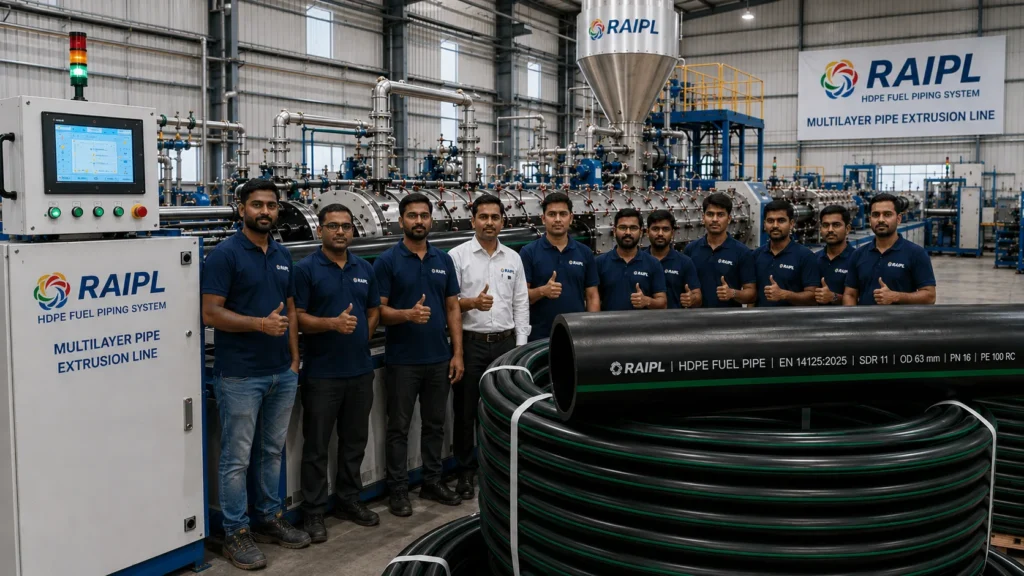
RAIPL (Rahul Arts India Pvt. Ltd.) has developed manufacturing capability for specialized multilayer HDPE fuel piping systems intended for underground petroleum applications.
The production approach combines:
- HDPE structural materials
- Tie-layer technology
- EVOH barrier technology
- Multilayer extrusion
- Controlled calibration
- Cooling
- Product marking
- Traceability
- Quality control
The objective is to manufacture a repeatable engineered product, not simply a visually similar HDPE pipe.
From Raw Material to Petrol Pump
The complete journey can be understood as:
Raw Material
↓
Multilayer Extrusion
↓
Pipe Formation
↓
Cooling & Calibration
↓
Marking & Traceability
↓
Quality Control
↓
Finished Coil
↓
Project Delivery
↓
Installation
↓
Testing
↓
Petrol Pump Operation
Every stage contributes to the final piping system.
Frequently Asked Questions
How is HDPE fuel pipe manufacturing different from normal HDPE pipe production?
Multilayer fuel pipe uses multiple polymer streams and specialized tooling to create an engineered pipe wall containing structural, bonding and barrier layers.
What materials are used?
Depending on the approved pipe design, the construction can include HDPE, specialized tie-layer material and EVOH barrier resin.
Why is calibration important?
Calibration helps maintain the required pipe dimensions so the finished product can interface correctly with compatible fittings.
Why is pipe marking important?
Marking supports product identification and traceability by connecting the finished pipe with relevant manufacturing records.
Are HDPE fuel pipes supplied in coils?
Depending on pipe size and product configuration, HDPE fuel pipes can be supplied in long continuous lengths or coils.
Is manufacturing alone enough to prove fuel suitability?
No. The product also needs appropriate technical evaluation, testing, documentation and applicable certification for its intended fuel application.
Explore RAIPL Multilayer HDPE Fuel Piping
RAIPL manufactures multilayer HDPE fuel piping systems for underground petroleum applications, combining specialized barrier technology with compatible electrofusion fittings, product traceability and technical support.
Explore the RAIPL HDPE Fuel Piping System for product sizes, technical specifications, fittings and project requirements.
Quality Is Built During Production
A high-quality multilayer fuel pipe is not created by one final inspection.
It is created through control at every stage:
Right Materials
Right Processing
Right Layer Structure
Right Dimensions
Right Marking
Right Quality Checks
That is the principle behind RAIPL’s development of specialized multilayer HDPE fuel piping manufacturing capability in India.

3 Responses