What Is a Multilayer HDPE Fuel Pipe?
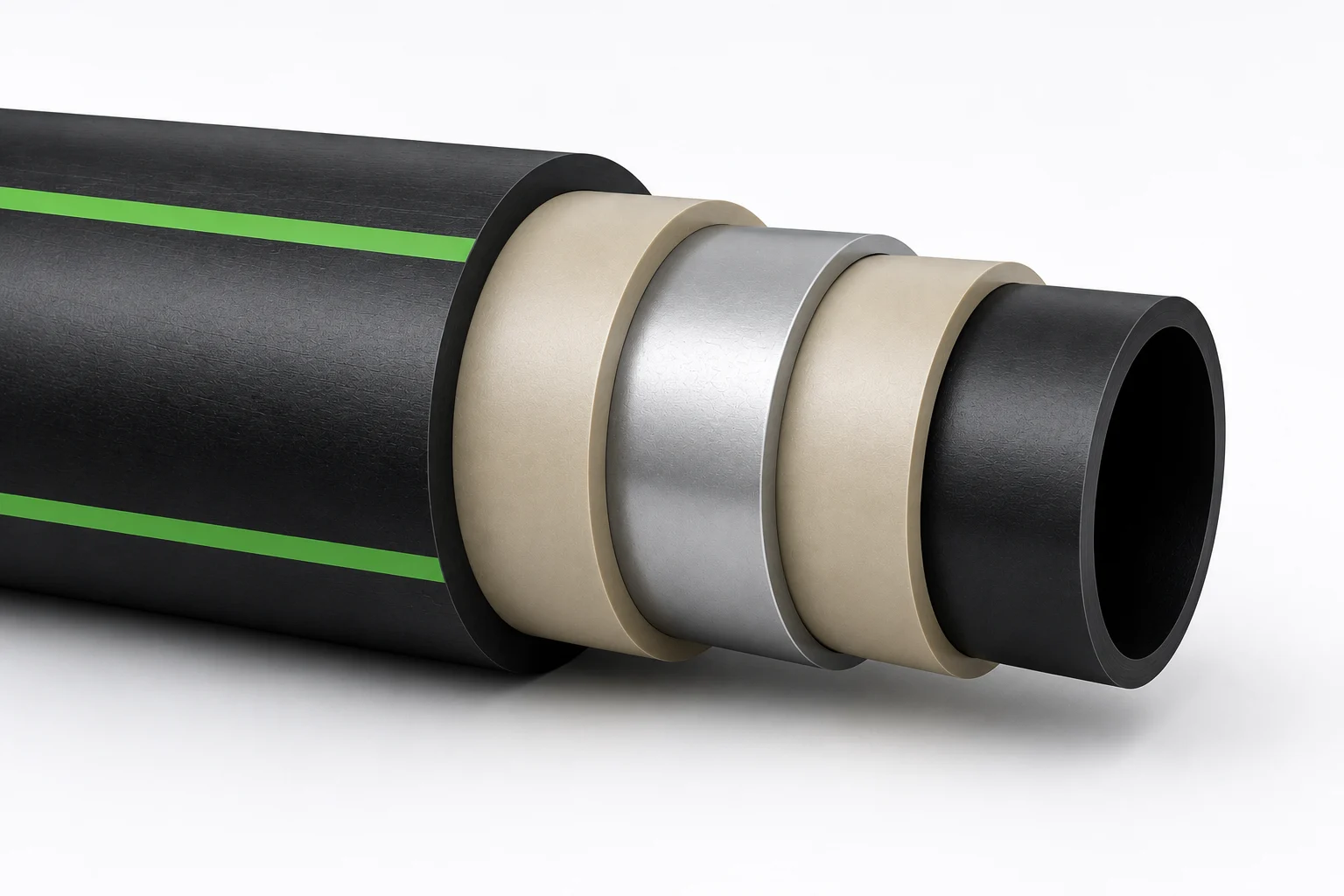
From the outside, a multilayer HDPE fuel pipe may appear relatively simple.
But inside the pipe wall is an engineered combination of different polymer materials, each selected to perform a specific function.
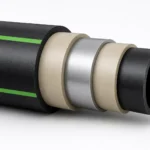
Unlike a conventional single-material PE pipe, a specialized multilayer fuel pipe combines structural layers, bonding layers and barrier technology into one integrated pipe.
A typical multilayer construction can be understood as:
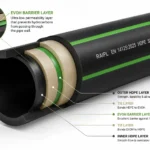
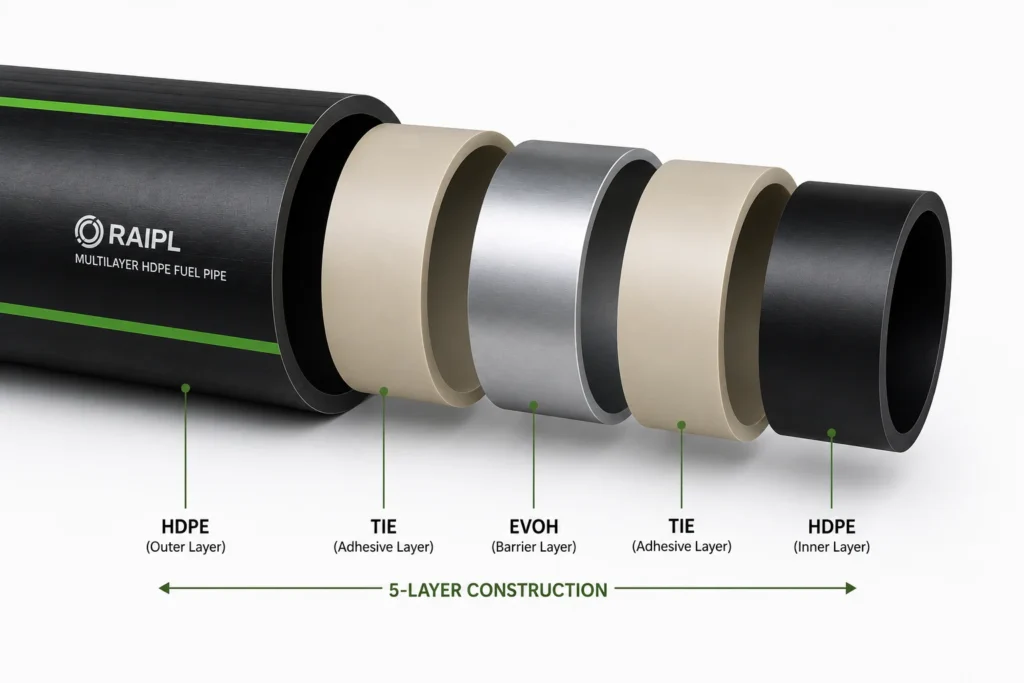
HDPE → Tie Layer → EVOH Barrier → Tie Layer → HDPE
Why use several different materials instead of simply making the entire pipe from HDPE?
Because underground fuel piping has different performance requirements from ordinary water piping.
Rather than expecting one polymer to provide every required characteristic, multilayer technology combines materials with complementary properties.
Why Does Fuel Piping Need Specialized Construction?
Petrol and diesel are very different from water.
Petroleum fuels contain hydrocarbons, and their interaction with polymer materials needs to be considered when designing a thermoplastic fuel piping system.
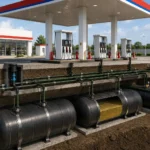
An underground fuel pipe also needs to perform within an environment involving:
- Petroleum fuel contact
- Underground installation
- Mechanical stresses
- Joint connections
- Soil conditions
- Temperature changes
- Long-term operation
- Hydrocarbon permeation considerations
This is why a specialized fuel pipe is engineered around its intended application.
The pipe wall itself becomes a functional multilayer structure rather than simply a hollow tube.
Layer 1: HDPE — The Structural Foundation
HDPE stands for High-Density Polyethylene.
It is widely used in piping applications because of characteristics including:
- Good mechanical properties
- Flexibility
- Corrosion resistance
- Relatively low weight
- Suitability for underground installation when correctly designed
- Compatibility with established fusion technologies
In a multilayer fuel pipe, HDPE provides important structural properties.
The outer HDPE portion helps form the durable external structure of the pipe, while the inner HDPE portion forms part of the internal pipe construction.
But HDPE alone is not expected to perform every function required from a specialized fuel piping system.
This is where the additional layers become important.
Layer 2: The Tie Layer — The Hidden Connection
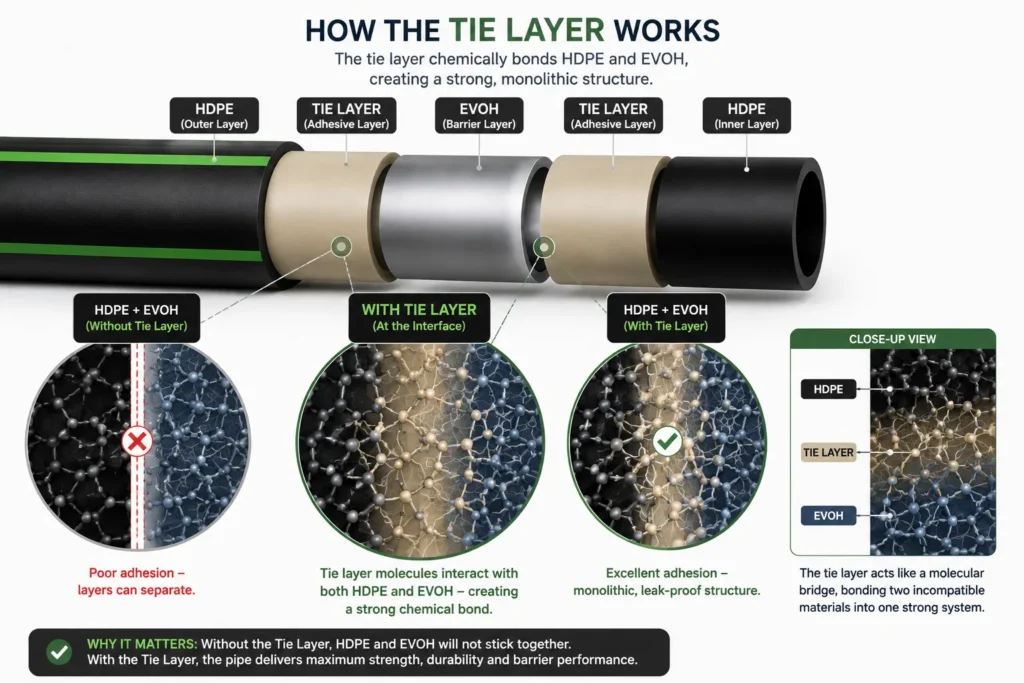
One of the least visible but most important components of a multilayer pipe is the tie layer.
Different polymer materials do not always naturally adhere strongly to each other.
HDPE and a specialized barrier polymer, for example, have different material characteristics.
Simply placing one next to the other may not create the engineered multilayer bond required for the pipe.
A specialized adhesive polymer layer is therefore introduced between them.
This is called a tie layer.
Its purpose is to help bond the structural HDPE and barrier materials together.
You can think of it as the connecting layer that allows materials with different properties to function as one integrated pipe wall.
Layer 3: EVOH — The Barrier Technology
At the heart of the multilayer construction is the barrier layer.
One material commonly used for barrier applications is:
EVOH — Ethylene Vinyl Alcohol
EVOH is known for its strong barrier properties in suitable multilayer applications.
In an engineered fuel pipe, the EVOH layer provides additional resistance against the movement of hydrocarbons through the pipe wall.
This is particularly important because polymers behave differently from metallic materials when exposed to certain molecules.
The EVOH layer therefore performs a specialized function within the overall pipe structure.
What Is Hydrocarbon Permeation?
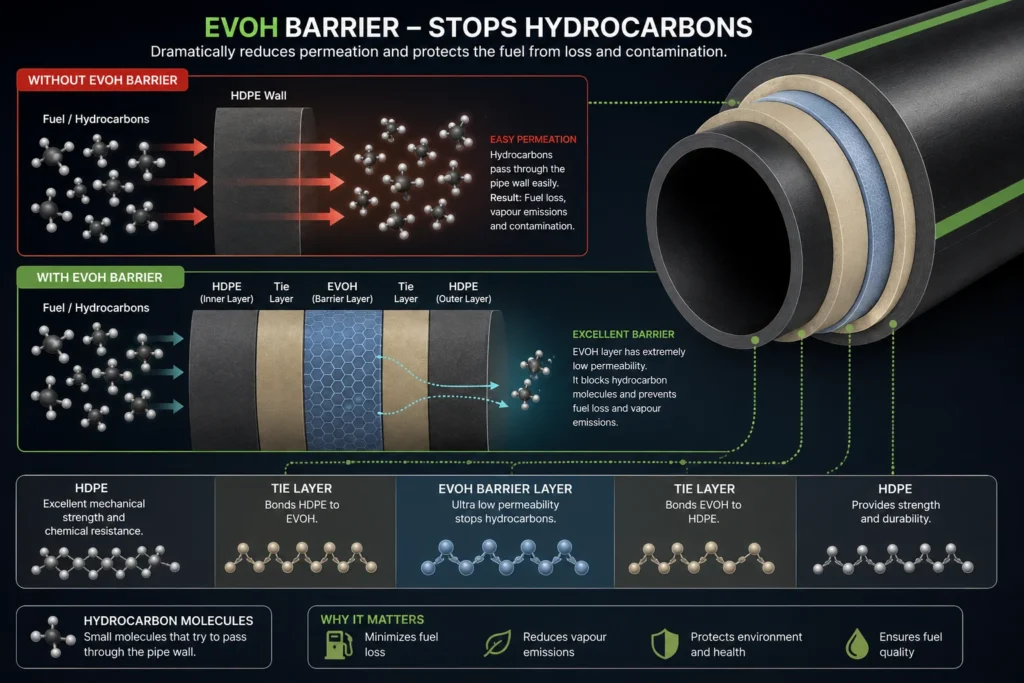
To understand the importance of the barrier layer, it helps to understand permeation.
Permeation is different from a conventional leak.
A conventional leak might occur because of:
- A damaged pipe
- An improperly installed fitting
- A failed connection
- Physical damage
Permeation happens differently.
At a molecular level, certain molecules can potentially migrate through polymer materials over time.
The pipe may look completely intact from the outside.
There may be no visible hole.
Yet molecular movement through the material can still be an engineering consideration.
For thermoplastic petroleum piping, controlling hydrocarbon permeation is therefore important.
How Does the EVOH Barrier Help?
The EVOH barrier layer provides additional resistance to the passage of hydrocarbons through the multilayer pipe wall.
A simplified way to understand the system is:
Fuel → Inner HDPE → Barrier Structure → Outer HDPE → Underground Environment
The HDPE provides important structural characteristics.
The EVOH provides the specialized barrier function.
The tie layers maintain adhesion between these different materials.
The result is not simply several layers stacked together.
It is an integrated engineered structure.
Why Are Tie Layers Needed on Both Sides?
If the barrier material sits between HDPE layers, bonding needs to be maintained at the relevant material interfaces.
That is why the simplified construction is represented as:
HDPE → Tie → EVOH → Tie → HDPE
The tie layers help create adhesion between the HDPE and EVOH materials.
Without the correct bonding system, a multilayer pipe could face issues with layer adhesion.
This demonstrates why multilayer pipe manufacturing requires more than simply adding additional extrusion materials.
Material selection, compatibility and processing control all matter.
How Is a Multilayer Pipe Manufactured?
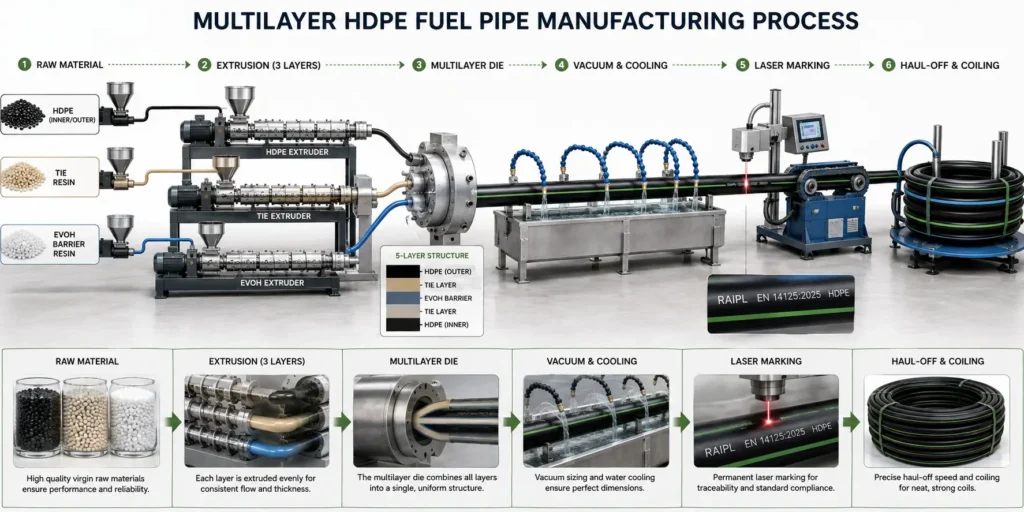
Producing a multilayer pipe requires specialized extrusion technology.
Instead of a conventional process involving only one material stream, multiple materials need to be processed and brought together into the required pipe structure.
A simplified manufacturing sequence can be understood as:
Raw Material Preparation → Multiple Extrusion Streams → Multilayer Die → Calibration → Cooling → Dimensional Control → Marking → Coiling/Finishing → Quality Control
Each stage matters.
Step 1: Raw Material Preparation
The process begins with the correct raw materials.
Depending on the certified pipe design, these can include:
- HDPE resin
- Tie-layer material
- EVOH barrier resin
- Other approved materials or additives where applicable
Material identification and controlled handling are important because changes in raw material can affect the final product.
Step 2: Multiple Extrusion Streams
The different polymer materials are processed through dedicated extrusion systems.
Each material needs suitable processing conditions.
The objective is to deliver each material consistently into the multilayer forming system.
This requires controlled parameters such as:
- Material feeding
- Temperature
- Extrusion rate
- Layer distribution
- Production speed
The exact parameters depend on the equipment, material system and approved manufacturing process.
Step 3: Formation of the Multilayer Structure
The different molten polymer streams come together within specialized tooling to create the multilayer pipe wall.
This is where the required layer sequence is formed.
The objective is to maintain a consistent structure around the circumference and along the length of the pipe.
This is one reason multilayer extrusion requires precise manufacturing control.
Step 4: Calibration and Cooling
After leaving the extrusion tooling, the pipe needs to be accurately sized and cooled.
Controlled calibration helps maintain the required pipe geometry.
Cooling stabilizes the polymer structure while the pipe moves through the production line.
Dimensional consistency is important because the pipe needs to interface correctly with compatible fittings.
Step 5: Product Marking and Traceability
A specialized infrastructure product should be traceable.
Pipe marking can provide important identification information relating to the product and manufacturing process according to the applicable requirements.
Traceability can help connect a finished pipe back to manufacturing and quality records.
For petroleum infrastructure, this becomes particularly valuable when documentation needs to be maintained throughout the project lifecycle.
Step 6: Coiling and Finished Product
Depending on diameter and product configuration, HDPE fuel pipes can be supplied in coils or other suitable lengths.
One advantage of long continuous pipe lengths is the potential to reduce unnecessary intermediate underground joints in suitable layouts.
The finished pipe then becomes part of a complete system incorporating fittings and transition components.
Why Layer Consistency Matters
Imagine a barrier layer that performs perfectly in one part of the pipe but becomes inconsistent elsewhere.
The complete pipe would no longer have the uniform construction intended by its design.
This is why multilayer manufacturing requires control over:
- Layer positioning
- Material distribution
- Pipe dimensions
- Surface quality
- Material bonding
- Production parameters
The performance of the finished product depends on maintaining the intended construction throughout the manufactured pipe.
The Pipe Is Only One Part of the Technology
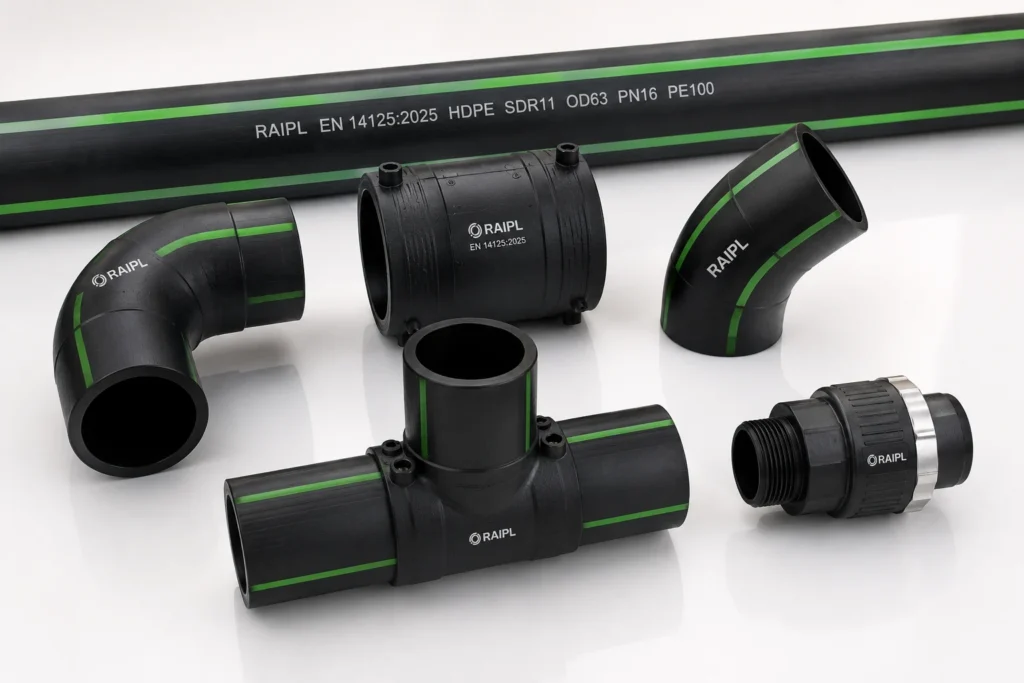
A technically advanced multilayer pipe alone does not create a complete underground fuel piping system.
The pipe needs compatible connections.
These can include:
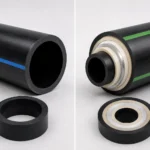
- Electrofusion couplers
- 90° electrofusion elbows
- 45° electrofusion elbows
- Electrofusion tees
- Transition fittings
- Flange adaptors
- Stub ends
- Backing rings
- Other system-specific connection components
The compatibility of these components is important because underground fuel piping operates as a complete network.
Why Electrofusion Works Well with HDPE Piping
Electrofusion provides an engineered method for joining compatible HDPE piping components.
The fitting incorporates an electrical heating element.
During installation, the pipe surface is prepared according to the specified procedure and inserted into the fitting.
Controlled electrical energy then heats the joint area.
After the specified fusion and cooling process, the connection becomes part of the piping network.
The procedure requires correct:
- Preparation
- Cleaning
- Scraping where specified
- Alignment
- Fusion parameters
- Cooling time
The quality of installation remains just as important as the quality of the manufactured pipe.
Multilayer Does Not Automatically Mean Fuel Approved
This is an important point.
A pipe should not be considered suitable for petroleum applications simply because it contains several layers.
The questions buyers should ask are:
What materials are used?
What is the purpose of each layer?
What standard has the system been evaluated against?
What certification is available?
What fittings are compatible with the pipe?
What supporting technical documentation is available?
The word “multilayer” describes a construction approach.
Suitability for fuel applications needs to be established through the appropriate engineering, testing and conformity documentation.
EN 14125 and Multilayer Fuel Piping
For thermoplastic underground fuel piping used at petrol filling stations, EN 14125 is an important European standard.
It provides requirements relevant to piping systems intended for this specialized application.
RAIPL’s multilayer HDPE fuel piping system has achieved EN 14125:2025 certification.
This combines specialized multilayer manufacturing with evaluation against requirements intended for underground petroleum piping applications.
Why Multilayer Technology Matters for India’s Fuel Infrastructure
India’s petroleum retail network requires large quantities of specialized infrastructure products.
Historically, several advanced underground fuel piping technologies used in India have been supplied by international manufacturers.
Developing multilayer extrusion capability domestically helps create:
- Advanced Indian manufacturing capability
- Local material-processing expertise
- Stronger petroleum infrastructure supply chains
- Faster technical support
- Greater availability of components
- Reduced dependence on imported piping systems
- Future export opportunities
The objective should not simply be replacing an imported product with a locally produced alternative.
The larger opportunity is to build the technology and manufacturing ecosystem within India.
RAIPL Multilayer HDPE Fuel Pipe Technology
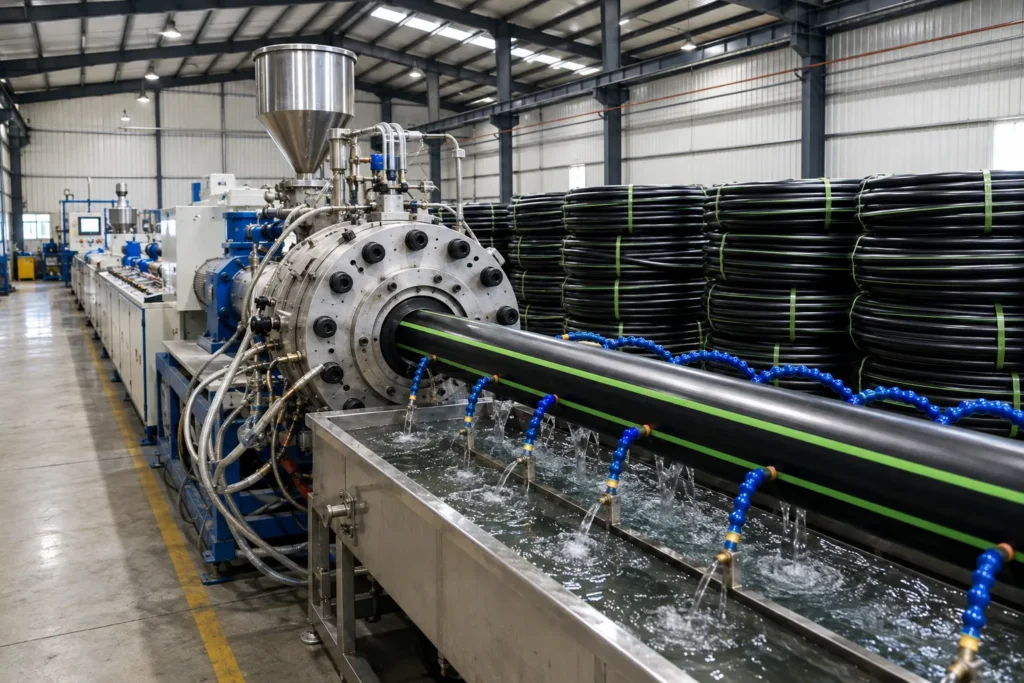
RAIPL (Rahul Arts India Pvt. Ltd.) has developed manufacturing capability for specialized multilayer HDPE fuel piping systems intended for underground petroleum applications.
The RAIPL pipe uses an engineered multilayer approach combining structural HDPE, specialized bonding layers and EVOH barrier technology.
This is supported by a broader system of compatible fuel piping fittings and connection components.
RAIPL’s objective is to manufacture not simply a pipe, but a complete Made-in-India underground fuel piping solution.
With EN 14125:2025 certification and specialized multilayer manufacturing capability, RAIPL is working toward reducing India’s dependence on imported underground petroleum piping technology.
Frequently Asked Questions
What is a multilayer HDPE fuel pipe?
It is a specialized thermoplastic pipe constructed using multiple material layers, with different layers performing structural, bonding and barrier functions.
Why is EVOH used in fuel pipes?
EVOH can provide strong barrier properties and is used within suitable multilayer structures to provide additional resistance against hydrocarbon permeation.
What is a tie layer?
A tie layer is a specialized bonding material used to promote adhesion between polymers such as HDPE and EVOH.
Why not make the entire pipe from EVOH?
Different materials are selected for different functions. HDPE provides important structural and mechanical characteristics, while EVOH performs the specialized barrier role within the multilayer construction.
Is every multilayer HDPE pipe suitable for petrol?
No. Multilayer construction alone does not establish suitability for fuel. The complete piping system needs to be designed and evaluated for its intended petroleum application.
Is multilayer HDPE fuel pipe the same as water pipe?
No. Although HDPE can be used in both products, their construction, intended application, performance requirements and applicable standards can be different.
What standard is relevant to underground thermoplastic fuel piping?
EN 14125 is an important European standard relating to thermoplastic and flexible metal pipework used for underground petrol filling station installations.
Different Layers. One Engineered Fuel Piping System.
The strength of multilayer technology comes from combining materials rather than expecting a single polymer to perform every function.
HDPE provides the structure.
Tie layers create the bond.
EVOH provides the specialized barrier function.
And controlled multilayer manufacturing brings these materials together into one engineered pipe.
For underground petroleum infrastructure, what appears to be a simple black pipe from the outside can therefore contain significant engineering within its wall.
That is the technology behind RAIPL’s Made-in-India multilayer HDPE fuel piping system.