What Is EVOH?
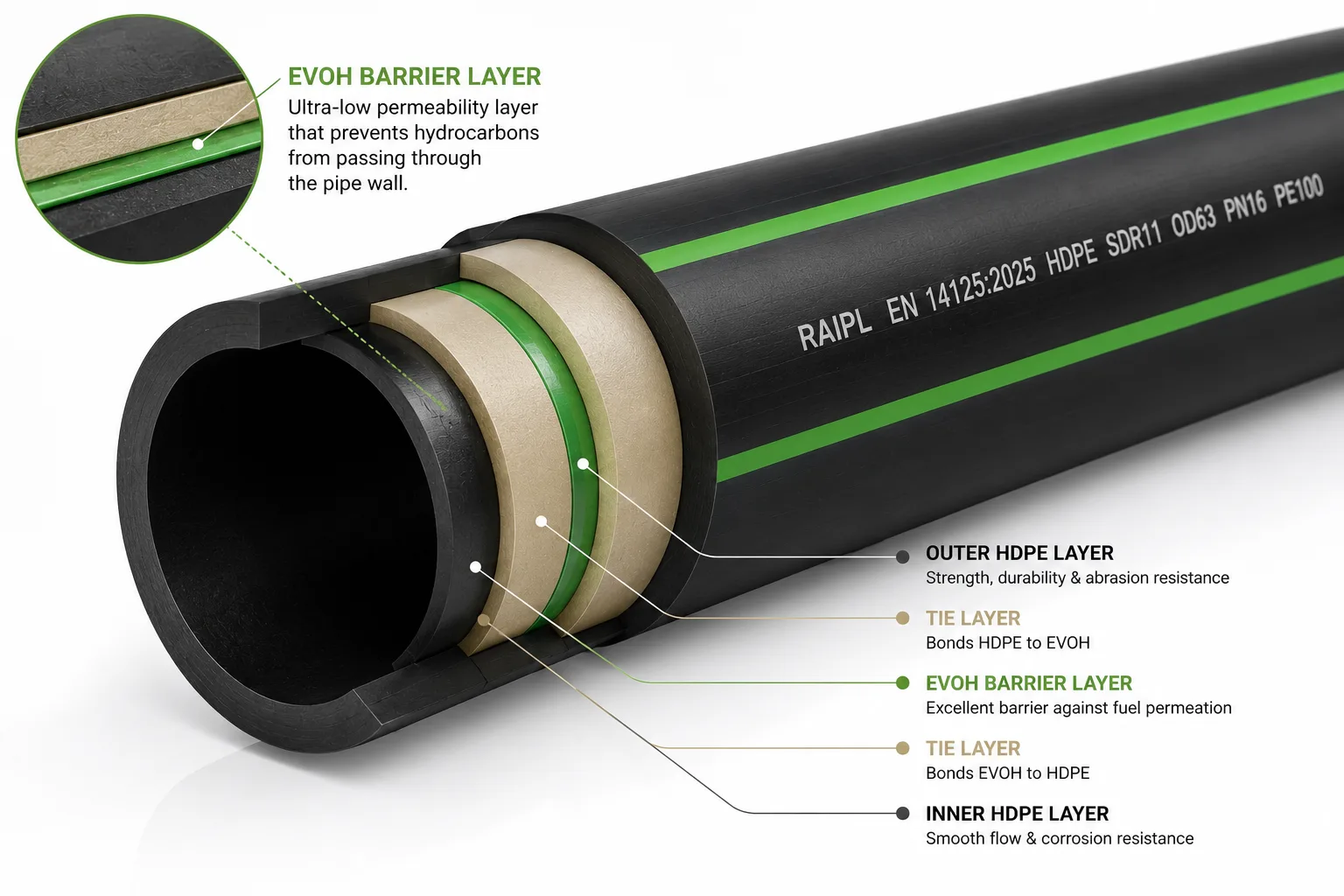
When you look at a multilayer HDPE fuel pipe from the outside, you mainly see the outer polyethylene surface.
But one of the most important parts of the pipe is hidden inside its wall.
That is the barrier layer.
A material commonly used for this purpose in multilayer polymer systems is:
EVOH — Ethylene Vinyl Alcohol.
EVOH is a specialized polymer known for its barrier properties.
In a multilayer fuel pipe, EVOH is not used as the main structural material. Instead, it performs a specific function within an engineered combination of materials.
Its role is to provide additional resistance against hydrocarbon permeation through the pipe wall.
To understand why that matters, we first need to understand what permeation actually means.
What Is Hydrocarbon Permeation?
Many people hear the word “leak” and imagine a damaged pipe with liquid escaping through a hole.
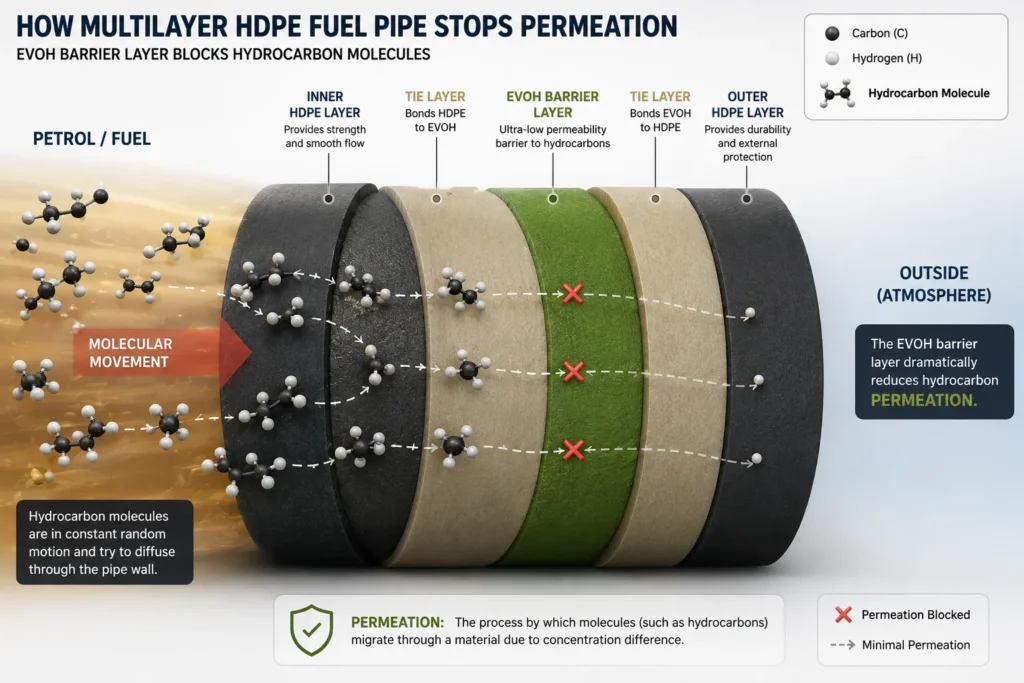
Permeation is different.
A pipe can appear completely intact:
- No crack
- No hole
- No broken fitting
- No visible damage
Yet at a molecular level, certain substances can interact with and migrate through polymer materials over time.
This process is known as permeation.
For thermoplastic piping carrying petroleum fuels, hydrocarbon permeation is therefore an important engineering consideration.
A Leak and Permeation Are Not the Same Thing
This distinction is important.
A Conventional Leak
A conventional leak generally involves fuel escaping through an unintended physical opening.
Possible causes can include:
- Pipe damage
- Failed connection
- Improperly installed fitting
- Mechanical damage
Permeation
Permeation occurs at the molecular level through the material itself.
There may be no visible defect in the pipe.
This is why controlling permeation involves material engineering, not simply making the pipe physically stronger or thicker.
Why Does This Matter for Fuel Piping?
Petrol, diesel and other petroleum fuels contain hydrocarbons.
Polymer materials can interact with these molecules differently from metallic materials.
When designing a thermoplastic fuel piping system, engineers therefore need to consider not only:
Can the pipe physically contain the liquid?
but also:
How does the pipe material behave when exposed to the intended fuel over time?
This is one of the reasons specialized fuel pipes can use a multilayer construction rather than relying on ordinary single-material HDPE.
How Does an EVOH Barrier Help?
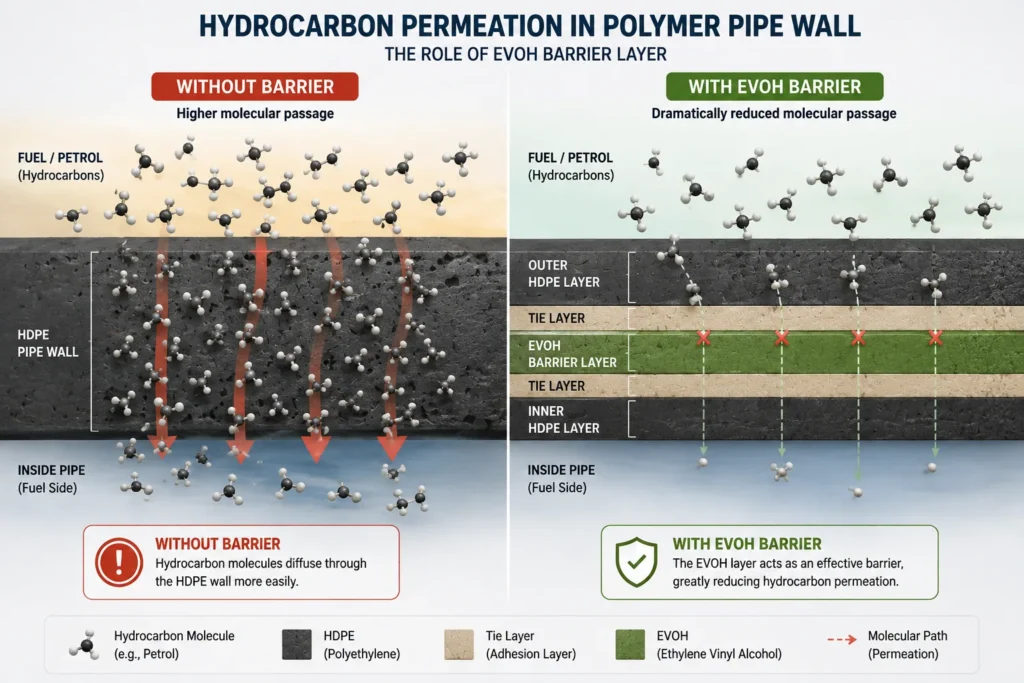
EVOH provides strong barrier properties in suitable multilayer applications.
Within an engineered fuel pipe, the EVOH layer creates an additional barrier to the movement of hydrocarbon molecules through the pipe wall.
A simplified way of visualizing the process is:
Fuel → Inner HDPE → EVOH Barrier Structure → Outer HDPE → Soil
The structural HDPE and specialized barrier material therefore perform different jobs.
Instead of asking one polymer to provide every required property, multilayer technology combines materials according to their strengths.
Why Isn’t the Entire Fuel Pipe Made from EVOH?
If EVOH provides the barrier function, a logical question is:
Why not manufacture the complete pipe from EVOH?
Because the best material for one function is not necessarily the best material for every function required from an underground pipe.
HDPE provides important properties such as:
- Structural performance
- Flexibility
- Toughness
- Corrosion resistance
- Suitability for fusion-based jointing systems
- Practicality for underground piping applications
EVOH performs a specialized barrier function.
Multilayer engineering therefore combines the two.
HDPE provides important structural characteristics.
EVOH provides the specialized barrier function.
Why Is a Tie Layer Required?
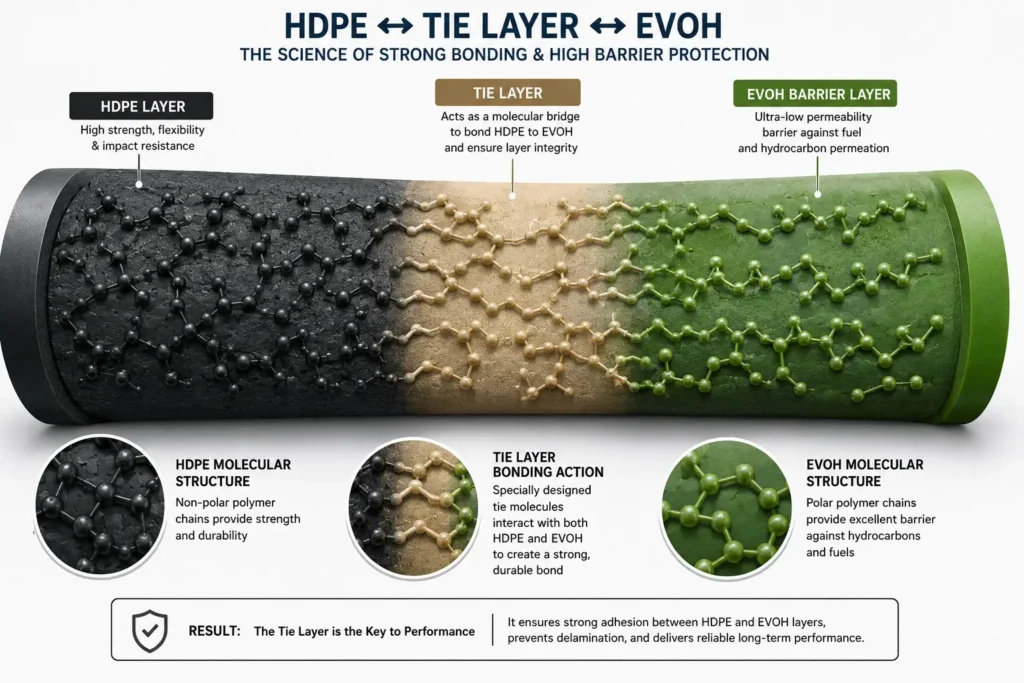
There is another challenge.
HDPE and EVOH are different polymers.
They do not necessarily create the required bond simply by being placed next to each other during manufacturing.
This is why specialized tie layers are used.
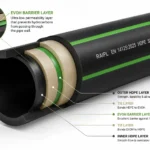
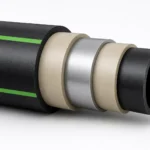
A simplified multilayer construction can be represented as:
HDPE → Tie Layer → EVOH → Tie Layer → HDPE
The tie layers help bond the different materials together.
This creates an integrated pipe wall in which the individual layers can perform their respective functions.
Think of Multilayer Fuel Pipe as a Team
A simple way to understand the technology is to think of the different layers as a team.
HDPE
Provides important structural and mechanical characteristics.
Tie Layer
Connects materials that would otherwise not achieve the required adhesion.
EVOH
Provides the specialized barrier function.
No single member of the team is expected to perform every job.
The performance comes from combining the materials into the correct engineered structure.
Why Is Layer Position Important?
A multilayer pipe is not created by randomly combining several polymers.
The position, thickness and continuity of each layer form part of the engineered pipe design.
The barrier layer needs to remain consistently positioned within the intended structure throughout the pipe.
Similarly, the tie layers need to maintain adhesion between the materials.
This is why multilayer fuel pipe production requires specialized extrusion technology and controlled manufacturing.
How Is the EVOH Layer Added During Manufacturing?
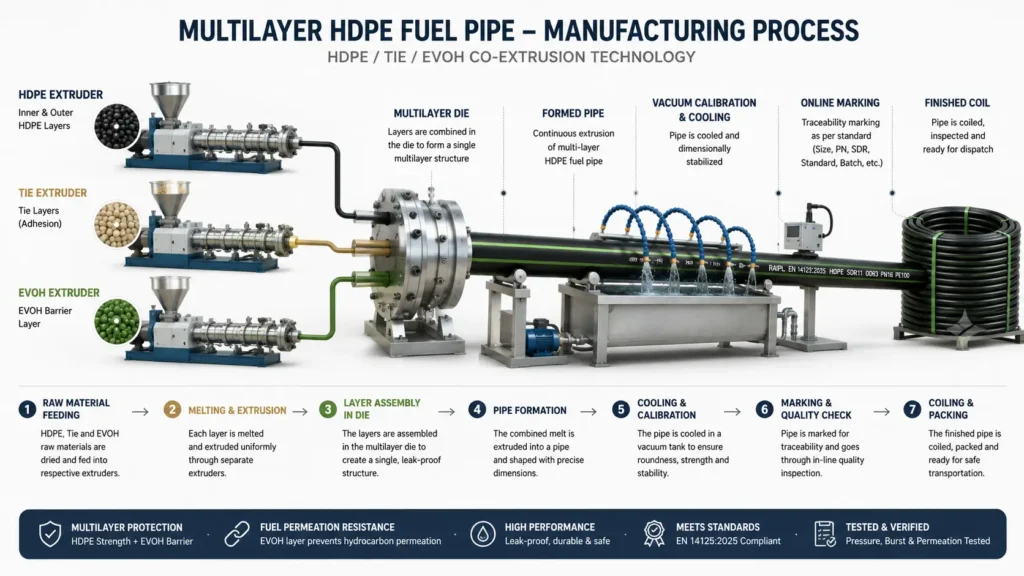
Multilayer pipe manufacturing uses multiple material streams.
A simplified production process can involve:
HDPE Extrusion + Tie-Layer Extrusion + EVOH Extrusion → Multilayer Die → Pipe Formation → Calibration → Cooling → Marking → Finished Pipe
The different polymer streams are brought together through specialized tooling to create the required multilayer structure.
The manufacturer needs to control factors such as:
- Material feeding
- Extrusion temperature
- Layer distribution
- Production speed
- Pipe dimensions
- Layer consistency
- Material bonding
This is significantly different from manufacturing a conventional single-material PE pipe.
Why Does Layer Consistency Matter?
Imagine a barrier layer that is properly formed through most of a pipe but becomes inconsistent in one section.
The intended barrier structure would no longer be uniform throughout the product.
For this reason, manufacturing control is extremely important.
A multilayer pipe should maintain its intended construction around the circumference and along the required length of the manufactured product.
This is why specialized production equipment, process control and quality assurance matter.
Is EVOH the Only Thing That Makes a Fuel Pipe Safe?
No.
This is an important point.
An EVOH layer is one component of an engineered multilayer system.
A complete underground fuel piping solution also depends on:
- Correct HDPE materials
- Correct barrier construction
- Reliable bonding between layers
- Controlled manufacturing
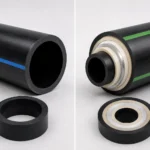
- Compatible fittings
- Correctly executed joints
- Fuel compatibility
- Mechanical performance
- Appropriate testing
- Applicable certification
- Correct installation
A manufacturer should therefore never rely on the statement “contains EVOH” as the only evidence that a pipe is suitable for petroleum service.
The complete piping system matters.
Does a Thicker HDPE Wall Replace the Need for Barrier Technology?
Not necessarily.
Structural wall thickness and barrier performance address different engineering requirements.
Increasing the thickness of a structural polymer does not automatically make it equivalent to a specialized barrier material.
This is why multilayer technology can be useful.
Rather than relying only on additional thickness of one material, engineers can incorporate another material specifically selected for its barrier characteristics.
Why Can’t an Ordinary HDPE Water Pipe Be Used Instead?
A water pipe is engineered for a different application.
Its primary purpose is transporting water according to the requirements applicable to that piping system.
Petroleum fuel introduces different considerations.
These can include:
- Hydrocarbon compatibility
- Permeation
- Fuel-specific material behaviour
- Specialized fittings
- Petroleum installation requirements
- Application-specific standards
The fact that both products may contain HDPE does not make them interchangeable.
HDPE describes the material.
Fuel piping describes the engineered application.
What About Petrol, Diesel and Changing Fuel Formulations?
Fuel composition can vary by fuel type and market requirements.
This makes material compatibility an important consideration when evaluating petroleum piping systems.
Manufacturers and project engineers should consider the fuels for which the particular piping system has been designed and evaluated.
Claims about compatibility should be supported by appropriate technical documentation rather than assumptions based solely on the word “HDPE” or “EVOH.”
What Role Does EN 14125 Play?
Barrier technology should not be considered in isolation.
For specialized thermoplastic underground fuel piping at petrol filling stations, EN 14125 is an important European standard.
The standard provides requirements relevant to piping systems intended for this application.
This is important because a fuel piping system needs to demonstrate more than the presence of a particular material.
The overall product and system need to be evaluated according to the applicable requirements.
RAIPL’s multilayer HDPE fuel piping system has achieved EN 14125:2025 certification.
What Should Buyers Ask About Barrier Technology?
When comparing multilayer fuel pipes, buyers and consultants should go beyond asking:
“Does it have a barrier layer?”
Useful questions include:
What barrier material is used?
Understand the actual material incorporated into the pipe construction.
Where is the barrier located?
The barrier should form part of a defined multilayer structure.
How is it bonded?
Understand whether dedicated bonding/tie layers are incorporated into the design.
Is the construction consistent?
Manufacturing controls should maintain the intended multilayer structure.
What standard has the system been evaluated against?
Barrier material alone does not establish fuel-piping compliance.
What certification and technical documentation are available?
Evaluate the complete documentation rather than relying on a marketing statement.
Are the fittings compatible with the system?
The pipe is only one part of the underground fuel network.
RAIPL’s Multilayer Barrier Technology
RAIPL (Rahul Arts India Pvt. Ltd.) has developed a multilayer HDPE fuel piping system for specialized underground petroleum applications.
The pipe construction combines:
HDPE structural layers
with
specialized tie layers
and
EVOH barrier technology
to create an engineered multilayer pipe structure.
The objective is not simply to manufacture a conventional HDPE pipe.
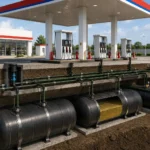
It is to develop a piping system specifically intended for the requirements of underground petroleum infrastructure.
RAIPL’s multilayer HDPE fuel piping system has achieved EN 14125:2025 certification, supporting the company’s development of advanced fuel piping technology within India.
Building Barrier Technology in India
Specialized multilayer extrusion requires more than conventional pipe manufacturing.
It requires understanding and controlling different polymer materials simultaneously.
Developing this capability within India helps build expertise in:
- Multilayer extrusion
- Barrier materials
- Polymer bonding
- Process control
- Fuel piping technology
- Specialized fittings
- Petroleum infrastructure manufacturing
This creates value beyond one product.
It contributes toward building an indigenous technical ecosystem for specialized petroleum infrastructure.
Frequently Asked Questions
What does EVOH stand for?
EVOH stands for Ethylene Vinyl Alcohol.
What does EVOH do in a fuel pipe?
Within a suitable multilayer construction, EVOH provides a specialized barrier function that offers additional resistance against hydrocarbon permeation.
Is EVOH the main structural material of the pipe?
No. In a multilayer HDPE fuel pipe, HDPE provides important structural characteristics while EVOH performs the specialized barrier function.
What is hydrocarbon permeation?
Permeation is the molecular movement of substances through a material. It is different from a conventional leak caused by a hole or failed connection.
Why are tie layers required?
Tie layers help create adhesion between different polymers such as HDPE and EVOH so they can function as an integrated multilayer structure.
Does every pipe containing EVOH automatically become a fuel pipe?
No. The complete pipe construction, materials, fittings, testing, certification and intended application need to be considered.
Is a thicker HDPE pipe the same as a multilayer barrier pipe?
No. Structural thickness and specialized barrier performance address different engineering considerations.
More Than Just a Hidden Layer
The EVOH barrier may be one of the thinnest and least visible parts of a multilayer fuel pipe, but its role is highly specialized.
It demonstrates the fundamental idea behind multilayer engineering:
Use the right material for the right function.
HDPE provides important structural properties.
Tie layers bond different polymers together.
EVOH provides the specialized barrier function.
Together, they form an engineered multilayer system designed for underground petroleum applications.
That hidden barrier technology is one of the important differences between a general-purpose HDPE pipe and RAIPL’s specialized multilayer HDPE fuel piping system.