
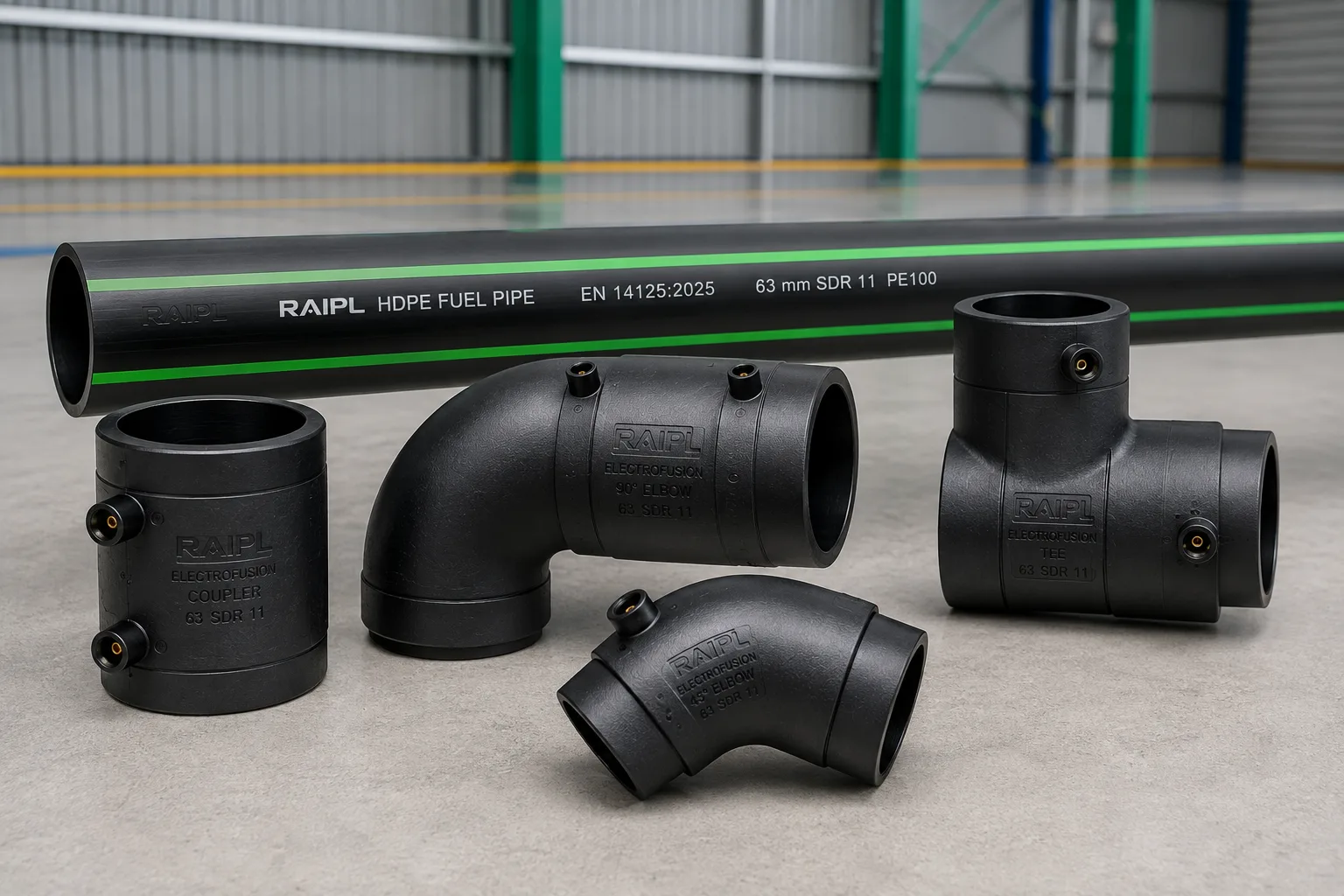
What Are Electrofusion Fittings for HDPE Fuel Pipe?
Electrofusion fittings for HDPE fuel pipe are used to connect sections of underground petroleum piping into a complete network between storage tanks, dispensers and other system components.
Depending on the piping layout, the system can require straight connections, changes in direction, branches and transitions. Electrofusion technology provides compatible fitting configurations such as couplers, elbows and tees for creating these connections.
However, fitting selection is only one part of joint quality. Pipe and fitting compatibility, surface preparation, alignment, fusion procedure, cooling and inspection all contribute to the completed connection.
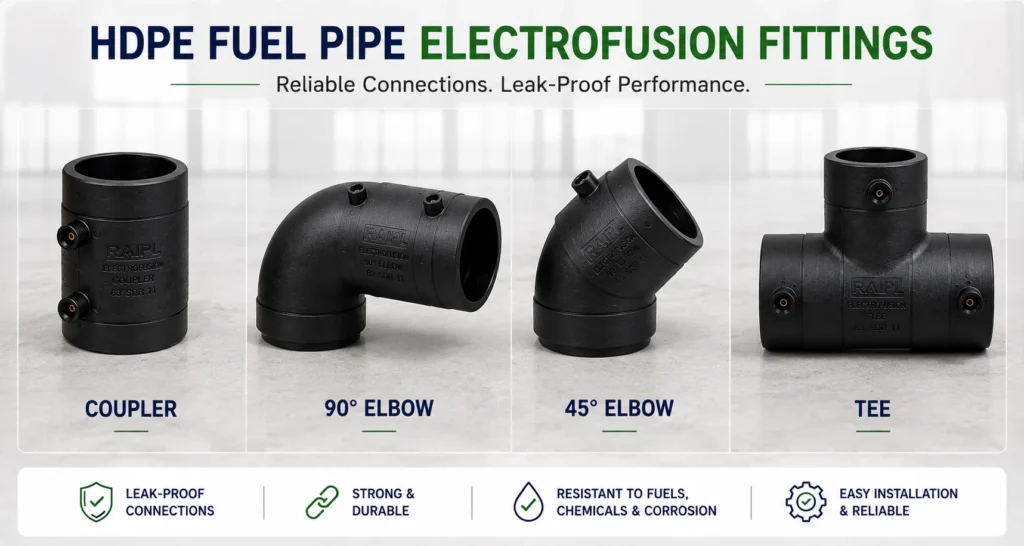
Common electrofusion fittings include:
- Electrofusion Couplers
- Electrofusion 90° Elbows
- Electrofusion 45° Elbows
- Electrofusion Tees
- Other system-specific electrofusion components
These fittings are designed to work with compatible HDPE piping according to specified installation procedures.
For underground petroleum applications, the quality of the fitting and the quality of its installation are both extremely important.
How Does Electrofusion Work?
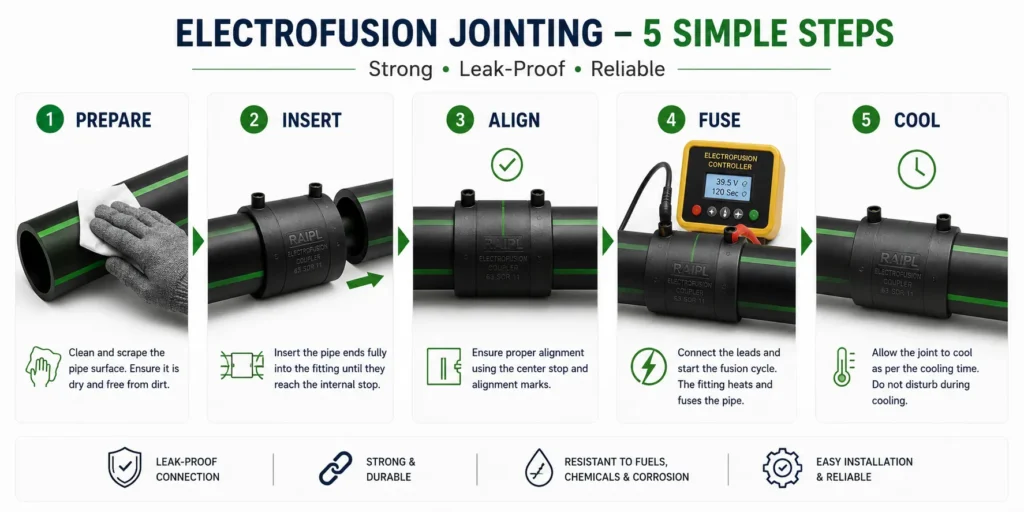
Electrofusion uses controlled electrical energy to create a fused connection between compatible thermoplastic components.
An electrofusion fitting contains an integrated electrical heating element.
The basic process can be understood as:
Pipe Preparation → Pipe Insertion → Alignment → Controlled Fusion → Cooling → Inspection
When the correct electrical energy is applied, heat is generated within the fitting’s fusion zone.
The prepared surfaces of the fitting and pipe are heated under controlled conditions to form the joint.
After the required cooling period, the connection becomes part of the piping network.
Why Is Electrofusion Used in Underground Fuel Piping?
A petrol pump contains underground pipe routes connecting storage and dispensing equipment.
Depending on the site layout, the system may require:
- Straight pipe connections
- 90-degree turns
- 45-degree turns
- Branch connections
- Equipment transitions
Electrofusion fittings provide compatible components for creating these connections within suitable HDPE piping systems.
One important advantage is that the jointing method is specifically engineered around thermoplastic piping.
However, the reliability of the finished connection depends heavily on correct preparation and installation.
Types of HDPE Fuel Pipe Electrofusion Fittings
1. Electrofusion Coupler
The electrofusion coupler is one of the most commonly used fittings in an HDPE piping system.
Its primary purpose is to connect two compatible sections of pipe.
A simplified arrangement is:
HDPE Fuel Pipe → Electrofusion Coupler → HDPE Fuel Pipe
Couplers can be required when:
- Two pipe sections need to be joined
- A continuous run needs an engineered connection
- A damaged section is replaced according to the approved repair procedure
- The project layout requires a connection point
Correct pipe preparation is essential before fusion.
2. 90° Electrofusion Elbow
A 90° electrofusion elbow is used where the pipeline needs a significant change in direction.
At petrol pumps, underground pipe routes need to work around:
- Underground storage tanks
- Dispenser islands
- Civil foundations
- Other underground services
- Site-specific structures
The 90° elbow provides an engineered directional connection without requiring the pipe to be forced into an unsuitable bend.
3. 45° Electrofusion Elbow
Not every directional change requires a 90-degree turn.
A 45° electrofusion elbow provides a more gradual directional change.
It can help the piping route follow the designed underground layout while maintaining appropriate pipe routing.
The choice between a 45° elbow, 90° elbow or permitted pipe bend should always follow the engineering design and piping-system requirements.
4. Electrofusion Tee
An electrofusion tee creates a branch in the piping network.
A simplified configuration can be understood as:
Main Fuel Line → Tee → Branch Fuel Line
The exact use of a tee depends on the petrol pump’s piping design.
As with other electrofusion fittings, compatibility with the pipe and correct installation are essential.
5. What About Transition Fittings?
Not every connection within a petrol pump fuel piping network is necessarily an HDPE-to-HDPE electrofusion joint.
At equipment interfaces or other specified locations, the system may require compatible transition components such as male or female transition adaptors, flange adaptors, stub ends or backing rings.
These components should be selected as part of the complete piping system rather than treated as unrelated accessories.
Why Fitting Compatibility Matters
An electrofusion fitting should not be selected only because its nominal diameter appears to match the pipe.
Compatibility can involve the pipe and fitting dimensions, materials, jointing design, fusion requirements, intended application and applicable system documentation.
For underground petroleum piping, buyers and installers should therefore verify that the fittings are intended for use with the relevant fuel piping system.
Mixing components without confirming compatibility can introduce unnecessary uncertainty into the completed installation.
Why Can’t Any HDPE Fitting Be Used?
A fitting should not be selected simply because the diameter printed on it matches the pipe.
For example:
63 mm pipe + any 63 mm fitting does not automatically equal a compatible fuel piping system.
Important considerations include:
- Material compatibility
- Dimensional compatibility
- Intended application
- Fusion requirements
- System certification
- Manufacturer instructions
- Fuel-service suitability
This becomes particularly important for underground petroleum infrastructure.
A general-purpose water fitting should not automatically be considered suitable for a specialized fuel piping system.
The Most Important Part of Electrofusion: Surface Preparation
The fusion machine is important.
The fitting is important.
The pipe is important.
But one of the most critical parts of a successful electrofusion joint happens before the fusion cycle begins.
That is surface preparation.
The pipe surface needs to be prepared according to the specified procedure.
Depending on the system, this can include:
- Cutting the pipe correctly
- Cleaning the work area
- Measuring insertion depth
- Marking the pipe
- Scraping the required surface
- Removing contamination
- Aligning the components
Skipping preparation steps can compromise the quality of the joint.
Why Is Scraping Important?
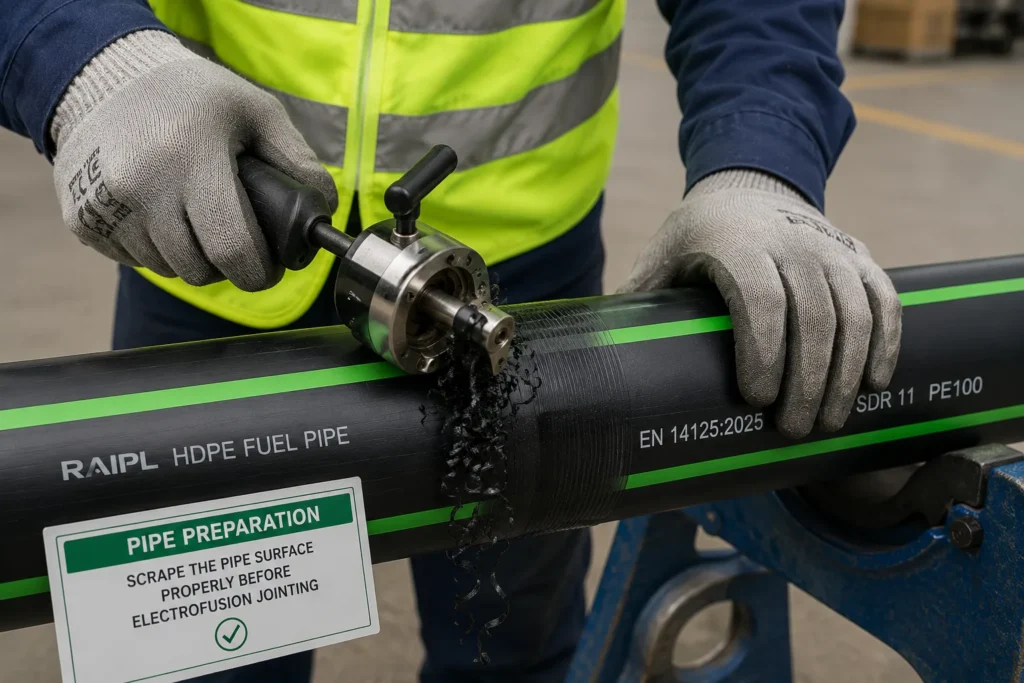
During storage and exposure, the outer surface of polyethylene pipe can develop an oxidized surface layer.
For electrofusion, the jointing surface needs to be prepared according to the fitting manufacturer’s instructions.
A suitable scraping tool is used where required to remove the specified outer surface uniformly from the fusion area.
This exposes a properly prepared surface for the electrofusion process.
The objective is controlled preparation — not randomly cutting or excessively removing material from the pipe.
Keep the Fusion Area Clean
After the joint surfaces have been correctly prepared, contamination should be avoided.
Possible contaminants include:
- Dust
- Soil
- Oil
- Grease
- Moisture
- Dirty gloves
- Construction debris
Petrol pump construction sites can be dusty environments, making good installation discipline especially important.
Prepared fusion surfaces should be handled according to the system manufacturer’s installation instructions.
Correct Pipe Insertion
The pipe needs to be inserted into the fitting to the required position.
Insertion depth should be identified and marked according to the fitting instructions.
Insufficient insertion can result in incorrect positioning within the fusion zone.
Proper measurement and marking before assembly help installers verify the correct pipe position.
Alignment Matters
The pipe and fitting should remain correctly aligned during fusion.
Excessive stress, bending or movement can affect the joint while the material is heated and cooling.
Suitable clamps or alignment equipment may therefore be used as required by the installation procedure.
The objective is simple:
Allow the joint to fuse and cool in the correct position without unnecessary movement.
The Electrofusion Cycle
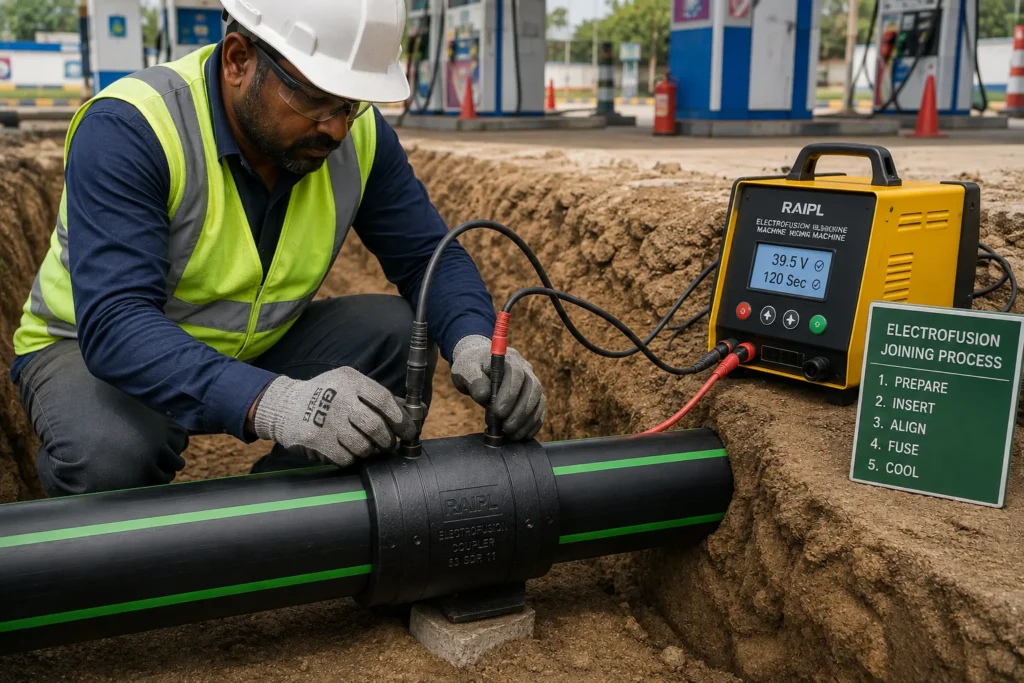
Once preparation and alignment are complete, the electrofusion equipment is connected to the fitting according to the specified procedure.
The equipment supplies the required electrical energy to the integrated heating element.
Depending on the fitting system, fusion information can be entered or read using the method specified by the manufacturer.
The installer should follow the prescribed parameters rather than estimating fusion time or settings.
Cooling Time Is Part of the Jointing Process
When the fusion cycle finishes, the joint is not automatically ready to be moved.
The connection needs the specified cooling time.
Moving, twisting or loading the joint before adequate cooling can affect its integrity.
Cooling should therefore be considered an essential stage of electrofusion — not simply waiting after the “real work” has finished.
The complete process is:
Preparation → Fusion → Cooling
All three stages matter.
Inspecting the Completed Joint
After the required cooling period, the joint should be inspected according to the piping-system and project requirements.
Inspection can include checking:
- Alignment
- Fitting position
- Fusion indicators where applicable
- Installation records
- Visible condition of the joint
Visual inspection does not necessarily replace any pressure, integrity or commissioning tests required by the project.
Common Electrofusion Installation Mistakes
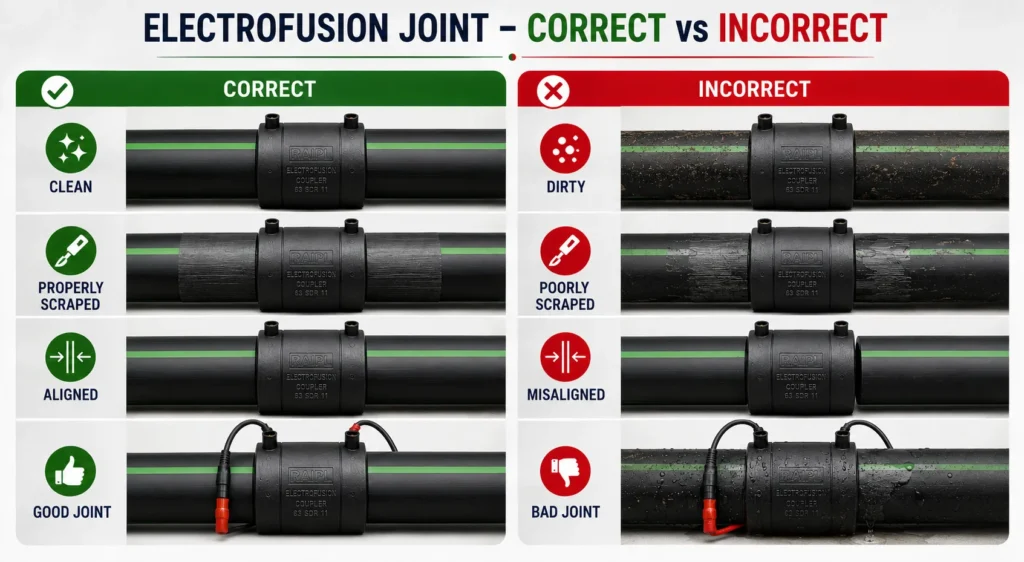
Even high-quality fittings can perform poorly when installation procedures are ignored.
Some common mistakes to avoid include:
1. Poor Surface Preparation
Failing to prepare the pipe correctly before fusion.
2. Contaminating Prepared Surfaces
Touching or exposing the prepared fusion area to dirt, oil or moisture.
3. Incorrect Insertion
Not inserting the pipe to the specified depth.
4. Misalignment
Allowing pipe and fitting to remain under unnecessary stress during fusion.
5. Incorrect Fusion Parameters
Using settings that do not correspond with the fitting requirements.
6. Moving the Joint Too Early
Disturbing the fitting before the specified cooling time has passed.
7. Mixing Unverified Components
Using fittings without confirming compatibility with the piping system.
Why Installer Training Matters
Electrofusion equipment can appear simple to operate.
But creating a reliable underground petroleum piping network requires more than connecting two electrical terminals and pressing a button.
Installers need to understand:
- Pipe preparation
- Scraping
- Cleaning
- Alignment
- Equipment operation
- Fusion parameters
- Cooling
- Inspection
- Site safety
- System-specific installation requirements
Training helps create consistency across installations.
For petroleum infrastructure, installation quality should be treated with the same seriousness as product quality.
Pipe + Fitting + Installer
A reliable electrofusion connection depends on three major elements:
Correct Pipe
Correct Compatible Fitting
Correct Installation
If any one of these is wrong, the reliability of the finished system can be affected.
This is why purchasing decisions should not focus only on the cost of an individual fitting.
The complete piping ecosystem matters.
Electrofusion vs Mechanical Connections
Different piping systems can use different connection technologies.
Mechanical connections typically rely on physical components to create and maintain the connection.
Electrofusion, by contrast, uses controlled heating to create a fused connection between compatible thermoplastic components.
Neither method should be evaluated simply as “good” or “bad.”
The appropriate connection method depends on:
- Piping material
- System design
- Intended application
- Manufacturer requirements
- Applicable standards
- Project specifications
For compatible HDPE piping systems, electrofusion provides a well-established engineered jointing technology.
Why Fittings Matter Under EN 14125
For specialized underground thermoplastic fuel piping, the performance of the system is not determined only by the straight pipe.
Connections and fittings are also important.
EN 14125 is an important European standard relating to thermoplastic and flexible metal pipework for underground petrol filling station installations.
The system approach is important because real-world petrol pump piping contains multiple joints and components.
RAIPL’s multilayer HDPE fuel piping system has achieved EN 14125:2025 certification.
RAIPL Electrofusion Fuel Fittings
RAIPL (Rahul Arts India Pvt. Ltd.) is developing a complete underground fuel piping system for petroleum infrastructure.
Along with specialized multilayer HDPE fuel pipes, the RAIPL system includes compatible fitting solutions such as:
- Electrofusion Couplers
- Electrofusion 90° Elbows
- Electrofusion 45° Elbows
- Electrofusion Tees
- Transition Adaptors
- Flange Connections
- Other system-specific components
The objective is to provide an integrated piping ecosystem rather than asking customers to source unrelated components from multiple systems.
A Complete Made-in-India Fuel Piping Ecosystem
Developing fuel pipe manufacturing within India is only one part of reducing dependence on imported petroleum piping technology.
The industry also needs:
- Compatible fittings
- Jointing technology
- Installation equipment
- Installer knowledge
- Technical documentation
- Testing
- Quality control
- Project support
RAIPL’s objective is to develop these capabilities as part of a complete Made-in-India underground fuel piping solution.
Frequently Asked Questions
What is an electrofusion fitting?
An electrofusion fitting is a thermoplastic fitting containing an integrated electrical heating element that is used to create a fused connection with compatible pipe according to a specified procedure.
What fittings are commonly used with HDPE fuel pipe?
Depending on the system, common fittings can include couplers, 90° elbows, 45° elbows, tees and specialized transition components.
Can a water-pipe electrofusion fitting be used for fuel?
Suitability should never be assumed simply because the fitting is HDPE or has the same diameter. The fitting’s intended application, system compatibility and applicable technical documentation should be verified.
Why does HDPE pipe need scraping before electrofusion?
Where required by the system procedure, scraping removes the specified outer surface from the fusion area to provide a correctly prepared surface for jointing.
Can an electrofusion joint be moved immediately after fusion?
No. The joint should remain undisturbed for the cooling period specified by the fitting/system manufacturer.
Is electrofusion difficult?
The equipment can be straightforward to operate, but reliable jointing requires correct preparation, cleaning, alignment, fusion parameters and cooling. Trained installation personnel are recommended.
A Fuel Piping System Is Only as Strong as Its Connections
Hundreds of metres of high-quality pipe cannot compensate for one poorly executed underground connection.
That is why electrofusion fittings should never be treated as minor accessories.
They are an integral part of the fuel piping network.
Correct Pipe + Compatible Fitting + Correct Installation = A Properly Engineered Connection
RAIPL’s approach is to bring these elements together as part of a complete Made-in-India underground fuel piping ecosystem.

7 Responses