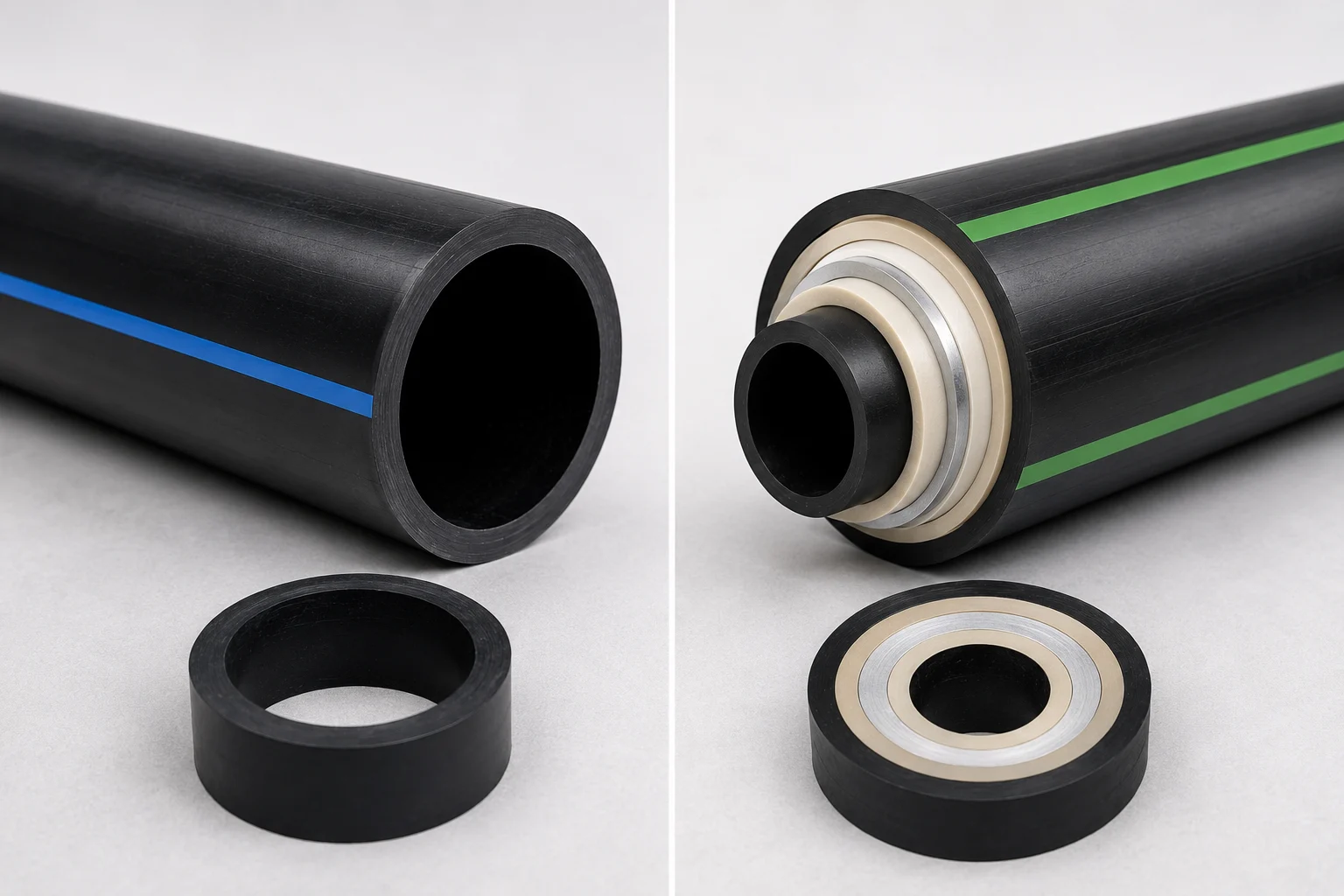
Not Every HDPE Pipe Is a Fuel Pipe
At first glance, an ordinary HDPE pipe and a specialized HDPE fuel pipe can look very similar.
Both may be black.
Both may be flexible.
Both may be installed underground.
And both may use polyethylene as an important part of their construction.
This sometimes creates a dangerous misconception:
“If HDPE can carry water or gas underground, why can’t the same pipe carry petrol or diesel?”
The answer is simple.
The application is different, so the piping system needs to be designed and evaluated differently.
A pipe intended for transporting water should not automatically be considered suitable for transporting petroleum fuels.
Fuel piping needs to address factors such as fuel compatibility, hydrocarbon permeation, system integrity, fittings, joints and application-specific testing.
HDPE Is a Material — Fuel Pipe Is an Engineered Application
The term HDPE describes High-Density Polyethylene.
It does not, by itself, define what a particular pipe is suitable for.
HDPE is used across many industries for applications including:
- Water distribution
- Gas distribution
- Industrial piping
- Drainage
- Chemical applications
- Specialized petroleum piping
However, pipes manufactured for these applications do not automatically have the same construction, performance requirements or certification.
Think about it this way:
Two vehicles can both be made primarily from steel and aluminium, but a passenger car and a heavy commercial truck are not designed to perform the same job.
Similarly:
Same base material does not mean same application.
Water and Petroleum Fuels Behave Differently
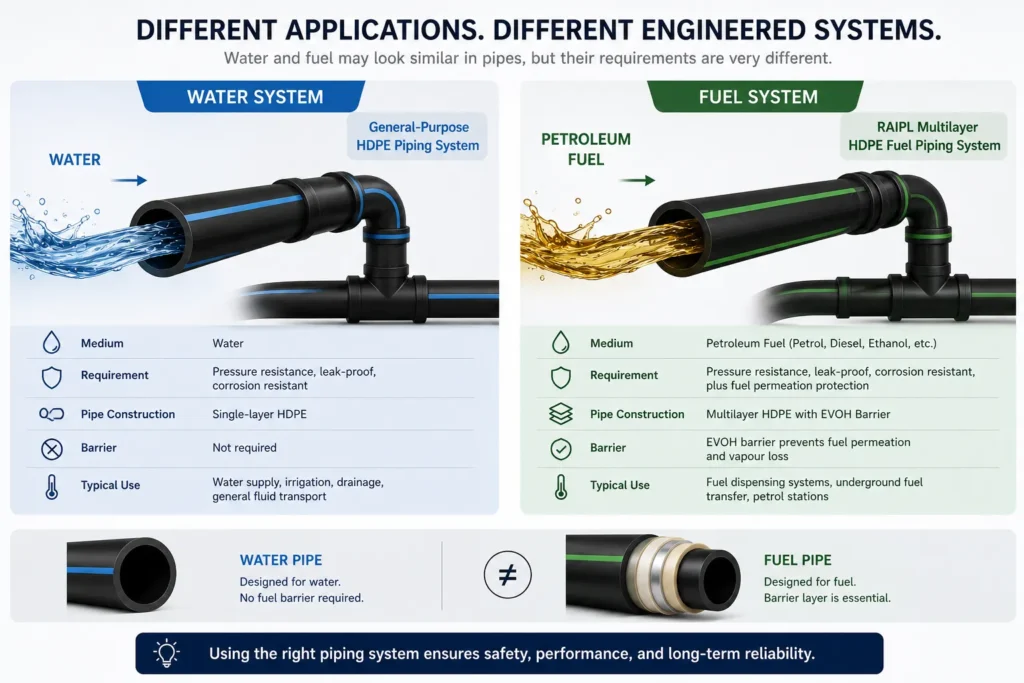
Water is fundamentally different from petrol and diesel.
Petroleum fuels contain complex hydrocarbon mixtures.
When polymer piping is used for fuel service, the interaction between the fuel and the piping materials becomes an important engineering consideration.
The piping system therefore needs to be evaluated for the fuels and operating conditions for which it is intended.
This includes not only the primary pipe material but also:
- Barrier materials
- Bonding layers
- Fittings
- Sealing materials
- Transition components
This is one reason specialized petroleum piping needs application-specific design and evaluation.
What Is Hydrocarbon Permeation?
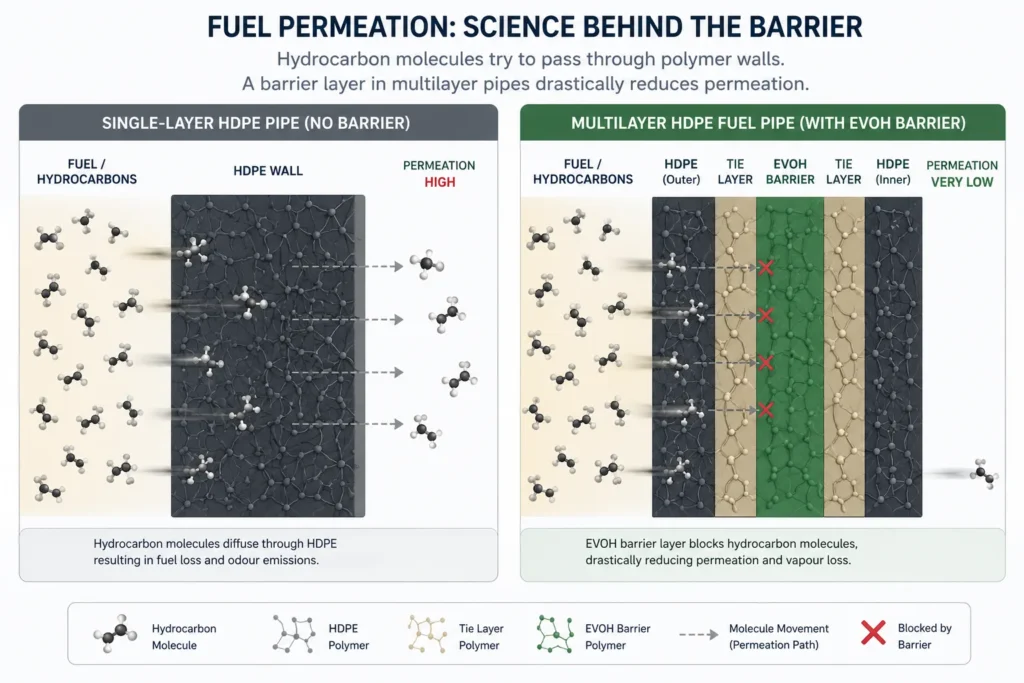
One of the major technical differences between water piping and thermoplastic fuel piping is the need to consider hydrocarbon permeation.
Permeation refers to the movement of molecules through a material at a molecular level.
It does not necessarily mean that the pipe has a visible hole or conventional leak.
Instead, certain molecules can potentially migrate through polymer materials over time.
For fuel piping applications, controlling this behaviour is important.
This is one reason specialized multilayer fuel pipes can incorporate a dedicated barrier layer.
Why Multilayer Construction Is Used for Fuel Pipes
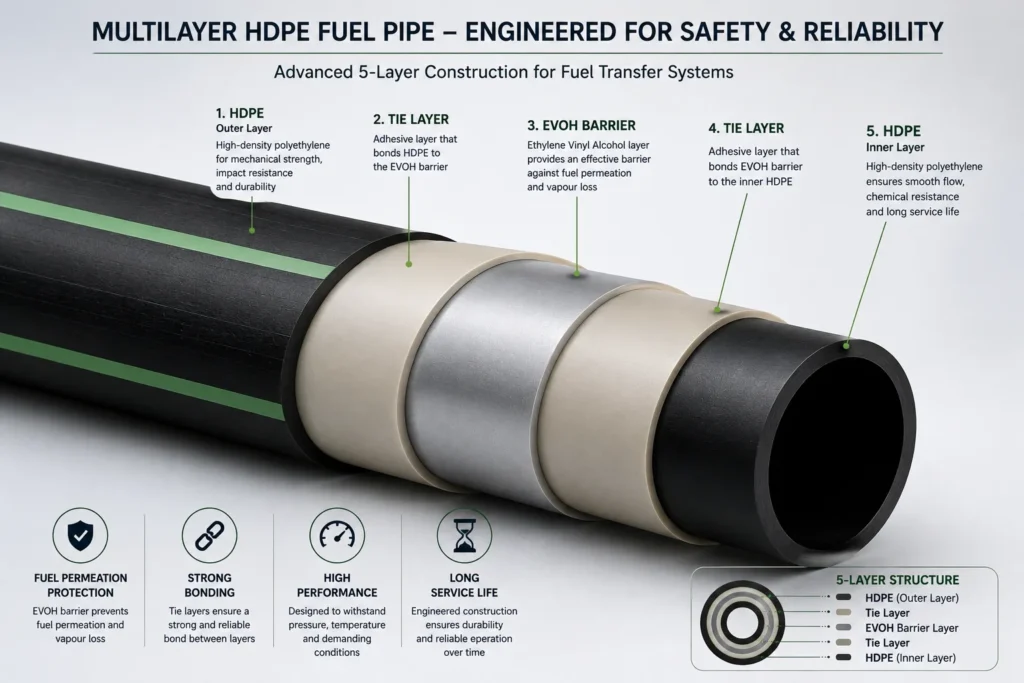
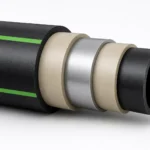
Rather than expecting one material to perform every function, an engineered fuel pipe can combine multiple materials.
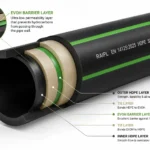
A typical multilayer concept can be represented as:
HDPE → Tie Layer → EVOH Barrier → Tie Layer → HDPE
Each layer has a specific role.
Outer HDPE Layer
The outer HDPE layer contributes to the mechanical structure and durability of the pipe.
Because the pipeline is installed underground, the exterior needs to withstand the conditions associated with handling and installation as specified for the system.
HDPE also provides the important advantage of not rusting like conventional steel.
Tie Layer
Different polymers do not necessarily bond naturally to each other.
A specialized tie layer can therefore be incorporated between the HDPE and barrier material.
Its purpose is to create adhesion between the different materials and help them function together as one multilayer structure.
The tie layer may not be the most visible part of the pipe, but it performs an important role in maintaining the integrity of the multilayer construction.
EVOH Barrier Layer
One material used as a barrier in multilayer polymer systems is EVOH — Ethylene Vinyl Alcohol.
Within a properly engineered fuel pipe construction, the barrier layer provides additional resistance against hydrocarbon permeation.
This layer is one of the key technical differences between a specialized multilayer fuel pipe and a conventional single-material HDPE pipe.
Inner HDPE Layer
The inner layer forms the internal surface of the pipe and is part of the overall engineered structure.
Together, the different layers create a piping construction designed around the requirements of its intended application.
The important point is that these layers are not simply added for appearance.
Each layer performs a technical function.
Fuel Pipe Is More Than Multilayer Construction
Adding a barrier layer does not automatically transform any pipe into a certified fuel pipe.
The complete system still needs to be designed and evaluated appropriately.
This includes:
Material Selection + Pipe Construction + Manufacturing Control + Fittings + Testing + Installation
A reliable petroleum piping system depends on all of these working together.
The Fittings Must Also Be Suitable
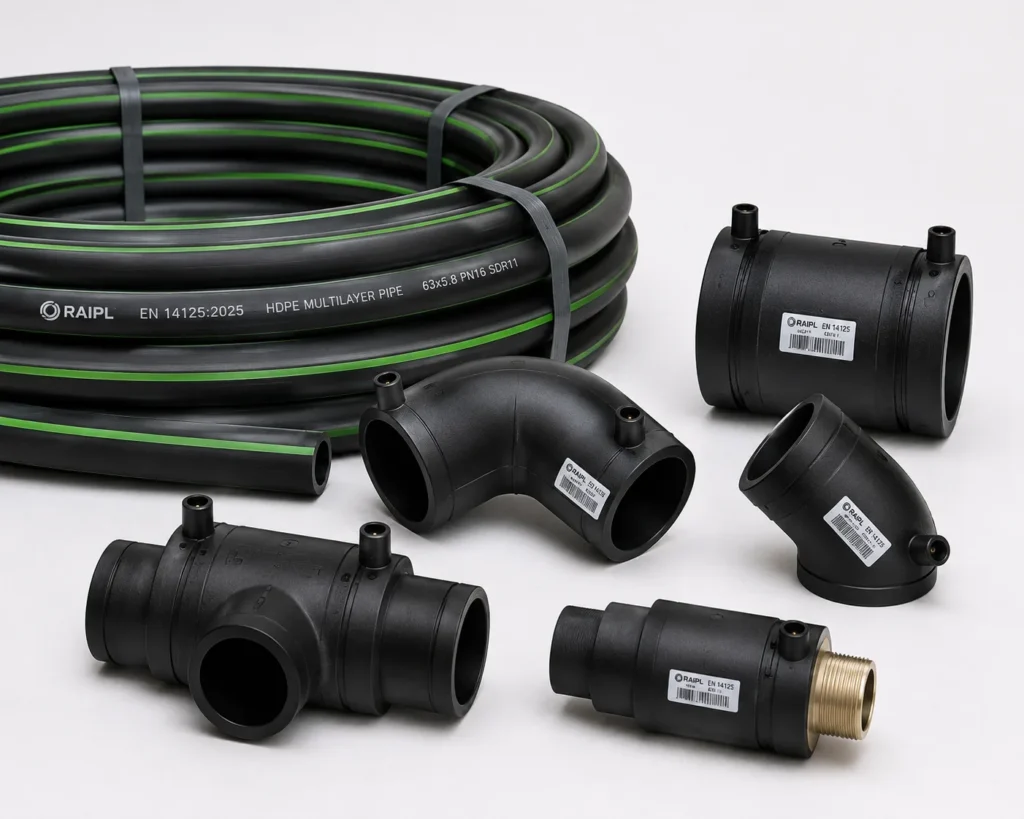
Imagine installing a technically advanced multilayer fuel pipe and then connecting it using unsuitable fittings.
The overall system would still depend on those connections.
A complete underground fuel piping network can require:
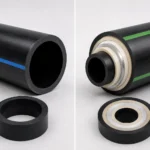
Electrofusion Couplers
Used for joining straight pipe sections.
Electrofusion 90° Elbows
Used for major directional changes.
Electrofusion 45° Elbows
Used where a more gradual change in direction is required.
Electrofusion Tees
Used for creating branch connections.
Transition Fittings
Used to interface the HDPE piping network with other system components or connection types.
Flange Connections
Flange adaptors, stub ends and backing rings can be used at appropriate system interfaces depending on the engineering design.
This is why the complete fuel piping system needs to be considered rather than simply buying a pipe based on material and diameter.
Joint Quality Matters
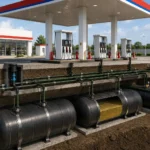
Underground piping is difficult to access once the petrol pump forecourt has been completed.
The quality of every underground connection therefore matters.
Specialized HDPE fuel piping systems can use electrofusion fittings.
The process involves controlled heating between the prepared pipe surface and electrofusion fitting.
Successful electrofusion depends on correct installation procedures.
Important factors can include:
- Proper pipe preparation
- Correct scraping where required
- Clean jointing surfaces
- Correct alignment
- Correct fusion parameters
- Proper cooling time
- Appropriate installation equipment
- Trained installers
Even the best pipe cannot compensate for poor joint installation.
What About HDPE Gas Pipe?
Another common misconception is:
“If an HDPE pipe is approved for gas, surely it can also carry petrol.”
That assumption should not be made.
Gas distribution and liquid petroleum fuel piping are different applications with different operating conditions and technical requirements.
A pipe designed and certified for one application should not automatically be assumed to comply with another.
Always verify the specific intended application, applicable standard and supporting documentation.
What About Pressure Rating?
Another common mistake is selecting a fuel pipe based primarily on pressure rating.
A buyer might think:
“This HDPE pipe has a high pressure rating, so it should easily handle fuel.”
Pressure performance is important, but it is only one part of the system.
A pipe can have excellent pressure capability while still not being designed or evaluated for petroleum fuel service.
Fuel piping selection can involve considerations such as:
- Pressure performance
- Fuel compatibility
- Permeation resistance
- Mechanical performance
- Joint performance
- Fitting compatibility
- Applicable standards
- Product certification
- Installation requirements
Pressure rating alone does not establish suitability for fuel service.
Why Does EN 14125 Matter?
For specialized thermoplastic underground fuel piping used at petrol filling stations, EN 14125 is an important European standard.
The standard addresses piping intended specifically for this environment.
This is fundamentally different from assuming that a pipe designed to another application standard is automatically suitable for fuel.
RAIPL’s specialized multilayer HDPE fuel piping system has been developed for underground petroleum applications with EN 14125:2025 certification.
This distinction is important.
The question should not simply be:
“Is this an HDPE pipe?”
The better question is:
“Is this piping system specifically designed and evaluated for underground fuel applications?”
How Can Buyers Identify a Specialized Fuel Pipe?
Before selecting an underground petroleum pipe, buyers and consultants should examine the technical documentation.
Some important questions include:
What is the intended application?
The manufacturer should clearly identify the pipe as being intended for the relevant petroleum application.
What standard applies?
Check the applicable technical standard and its edition.
Is supporting certification available?
Review the actual certificate and its scope rather than relying only on marketing claims.
Are technical test documents available?
Where applicable, examine the relevant supporting documentation.
Are compatible fittings available?
The manufacturer should provide an engineered system rather than forcing installers to combine unrelated components.
Is the product traceable?
Proper product marking and manufacturing traceability are important in specialized infrastructure applications.
Water Pipe vs Specialized Fuel Pipe — Quick Comparison
Intended Application
Water Pipe: Designed for water-service requirements.
Fuel Pipe: Designed specifically for petroleum fuel applications.
Fluid
Water Pipe: Water.
Fuel Pipe: Petroleum fuels for which the particular system has been designed and evaluated.
Hydrocarbon Permeation
Water Pipe: Hydrocarbon fuel permeation is not its intended service requirement.
Fuel Pipe: Specialized construction may incorporate barrier technology to address hydrocarbon permeation.
Construction
Water Pipe: Commonly a conventional PE construction appropriate to its intended water application.
Multilayer Fuel Pipe: Can incorporate HDPE, bonding layers and a dedicated barrier layer.
Fittings
Water Pipe: Fittings designed for the applicable water piping system.
Fuel Pipe: Compatible fittings designed/evaluated for the applicable fuel piping system.
Standards
Water Pipe: Manufactured according to standards relevant to its intended water application.
Fuel Pipe: Specialized underground fuel piping can be evaluated according to standards such as EN 14125.
Selection
Water Pipe: Selected according to water-system requirements.
Fuel Pipe: Requires consideration of fuel compatibility, permeation, system integrity, certification and petroleum-industry requirements.
Why Using the Correct Pipe Matters
Underground fuel piping becomes part of the permanent infrastructure of a petrol pump.
Once the trench has been backfilled and the forecourt completed, accessing the pipeline can require excavation and disruption of the operating site.
For this reason, the piping system should be selected correctly before installation.
The decision should not be driven only by the initial price per metre.
It should consider:
Application + Safety + Compatibility + Standards + Installation + Long-Term System Performance
RAIPL Multilayer HDPE Fuel Pipe
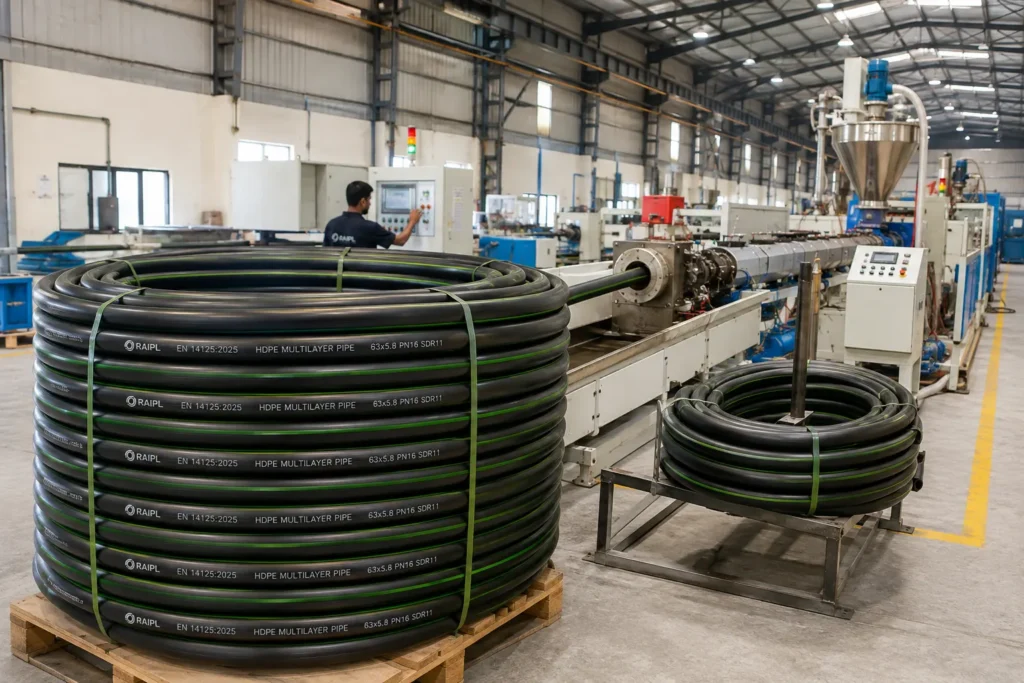
RAIPL (Rahul Arts India Pvt. Ltd.) has developed a specialized multilayer HDPE piping system for underground petroleum applications.
The RAIPL fuel piping concept combines:
HDPE structural layers + specialized bonding layers + EVOH barrier technology + compatible fuel piping fittings
to create a complete underground fuel piping solution.
The system includes multilayer HDPE fuel pipes together with compatible electrofusion and transition fittings required to create an engineered underground network.
RAIPL’s multilayer HDPE fuel piping system has achieved EN 14125:2025 certification as part of the company’s objective to develop advanced petroleum infrastructure technology within India.
Made in India Should Also Mean Engineered for the Application
Local manufacturing should never mean taking an existing general-purpose product and simply changing its label.
Specialized infrastructure requires specialized engineering.
For RAIPL, developing fuel piping in India means building the required:
- Manufacturing capability
- Material knowledge
- Multilayer technology
- Testing capability
- Fitting ecosystem
- Quality control
- Technical documentation
The objective is not to manufacture another HDPE pipe.
The objective is to develop a Made-in-India fuel piping system designed specifically for petroleum infrastructure.
Frequently Asked Questions
Can normal HDPE water pipe carry petrol?
An ordinary HDPE water pipe should not automatically be used for petrol. Fuel piping should be specifically designed and evaluated for the intended petroleum application.
Is HDPE fuel pipe the same as HDPE water pipe?
No. Although both can contain HDPE, their intended applications, construction, performance requirements, fittings and applicable standards can be different.
Why does fuel pipe need a barrier layer?
A barrier layer can provide additional resistance against hydrocarbon permeation through the polymer pipe wall.
What is EVOH?
EVOH stands for Ethylene Vinyl Alcohol. It is a polymer used as a barrier material in various multilayer applications and can be incorporated into engineered fuel pipe constructions.
Can HDPE gas pipe be used for petrol?
A gas pipe should not automatically be assumed suitable for liquid petroleum fuel service. The product’s intended application, applicable standards and supporting documentation should be verified.
Does a high-pressure rating mean an HDPE pipe can carry fuel?
No. Pressure capability alone does not establish fuel suitability. Fuel compatibility, permeation, system components, testing and applicable standards also need to be considered.
Choose the Pipe for the Application
HDPE is an extremely versatile engineering material.
But versatility does not mean every HDPE pipe is interchangeable.
A water pipe should be selected for water.
A gas pipe should be selected according to its gas application.
And an underground fuel piping system should be specifically designed and evaluated for petroleum service.
When the infrastructure is going underneath a petrol pump forecourt for years of operation, selecting the right piping system from the beginning matters.
RAIPL is working to provide that specialized fuel piping technology through a complete Made-in-India multilayer HDPE fuel piping system.