
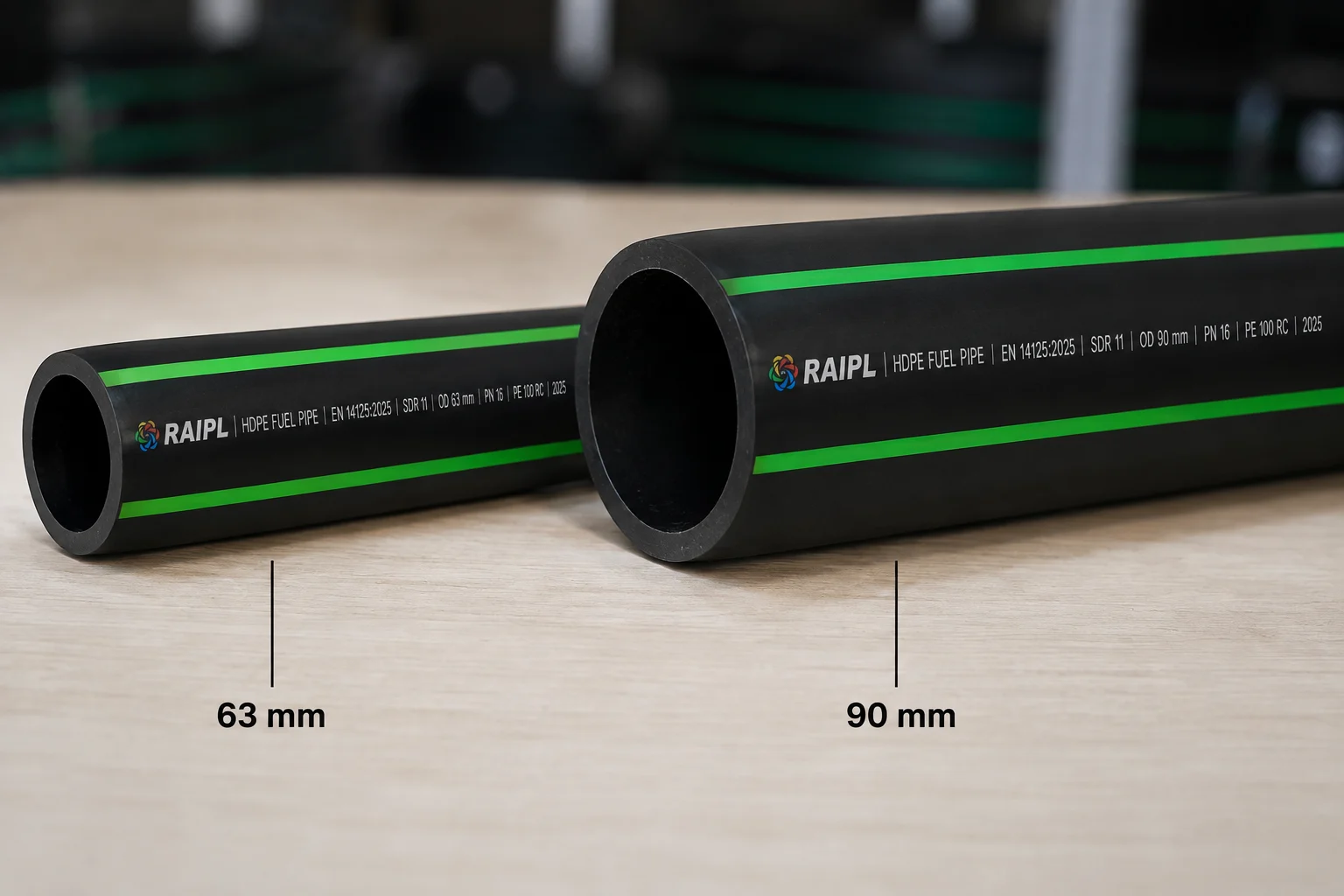
63mm vs 90mm HDPE Fuel Pipe: What Does the Size Mean?
Choosing between 63mm vs 90mm HDPE fuel pipe is not simply a matter of selecting the larger diameter. The correct fuel pipe size for a petrol pump depends on the engineering requirements of the underground piping system, including route length, required flow, piping layout, fittings, equipment connections and project specifications.
Both 63 mm and 90 mm multilayer HDPE fuel pipes can form part of an underground petroleum piping system, but the appropriate size should be determined according to the specific installation rather than a universal rule.
This guide explains the key differences between the two sizes and the factors engineers, consultants and petrol pump owners should consider before selection.
| Consideration | 63 mm Fuel Pipe | 90 mm Fuel Pipe |
|---|---|---|
| Pipe diameter | Smaller | Larger |
| Internal flow area | Lower relative to 90 mm | Higher relative to 63 mm |
| Handling | Generally easier due to smaller size | Requires consideration of larger pipe dimensions |
| Routing | Suitable where engineering design specifies 63 mm | Suitable where engineering design specifies 90 mm |
| Fittings | Use compatible 63 mm fittings | Use compatible 90 mm fittings |
| Selection basis | Project engineering | Project engineering |
Why Pipe Size Matters
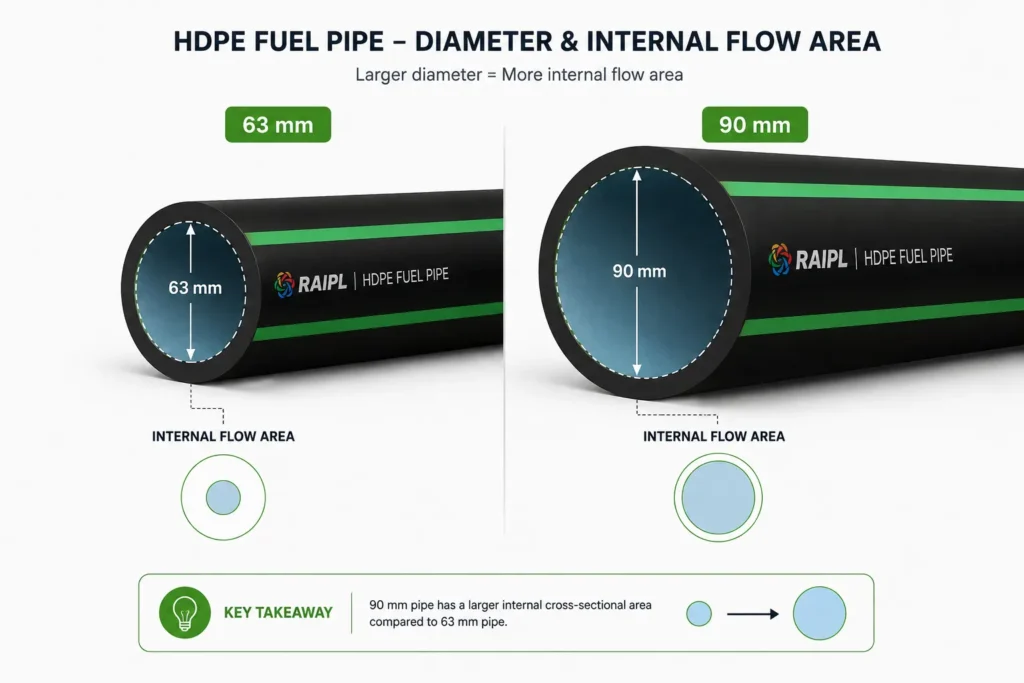
The diameter of a fuel pipe influences how the system behaves hydraulically.
In simple terms, pipe size can affect:
- Flow capacity
- Flow velocity
- Pressure loss
- System response
- Installation layout
- Fitting selection
- Project cost
A pipe that is unnecessarily large can add cost and installation complexity.
A pipe that is too small may not support the intended system performance.
That is why pipe diameter should come from engineering calculations and project requirements.
What Does 63 mm Mean?
When a pipe is described as 63 mm, it generally refers to its nominal outside diameter within the applicable piping system.
The exact internal diameter depends on the wall construction and product design.
A 63 mm fuel pipe can be suitable for many underground petrol-pump applications depending on the required flow, distance and equipment configuration.
However, suitability should be confirmed through the project design rather than assumed from diameter alone.
What Does 90 mm Mean?
A 90 mm HDPE fuel pipe has a larger nominal outside diameter.
A larger pipe can provide greater flow capacity under suitable conditions, but that does not automatically make it the correct choice for every installation.
The engineering team still needs to consider:
- Required flow
- Pipeline distance
- Number of fittings
- Equipment
- System configuration
- Space
- Routing
- Project specifications
The larger diameter should be selected because the system requires it, not simply because “bigger is better.”
Bigger Pipe Does Not Always Mean Better
This is one of the most common misunderstandings in pipe selection.
A larger pipe can reduce flow velocity and friction losses for a given flow rate, but unnecessary oversizing can create other considerations.
These may include:
- Higher material cost
- Larger fittings
- Increased coil or transport dimensions
- More space required in trenches
- Different bend-radius requirements
- More difficult handling
Correct engineering aims to find the appropriate size, not the largest available size.
How Flow Requirement Affects Pipe Size
The first major factor is the amount of fuel the system needs to move.
Higher flow requirements may require a larger pipe depending on the complete hydraulic design.
However, pipe diameter is only one part of the calculation.
The engineering team also needs to consider:
- Pumping arrangement
- Dispensing equipment
- Number of dispensers
- Simultaneous demand
- Pipeline length
- Fittings
- Elevation differences where applicable
Pipe size should therefore be selected as part of the complete fuel-delivery system.
Why Pipeline Length Matters
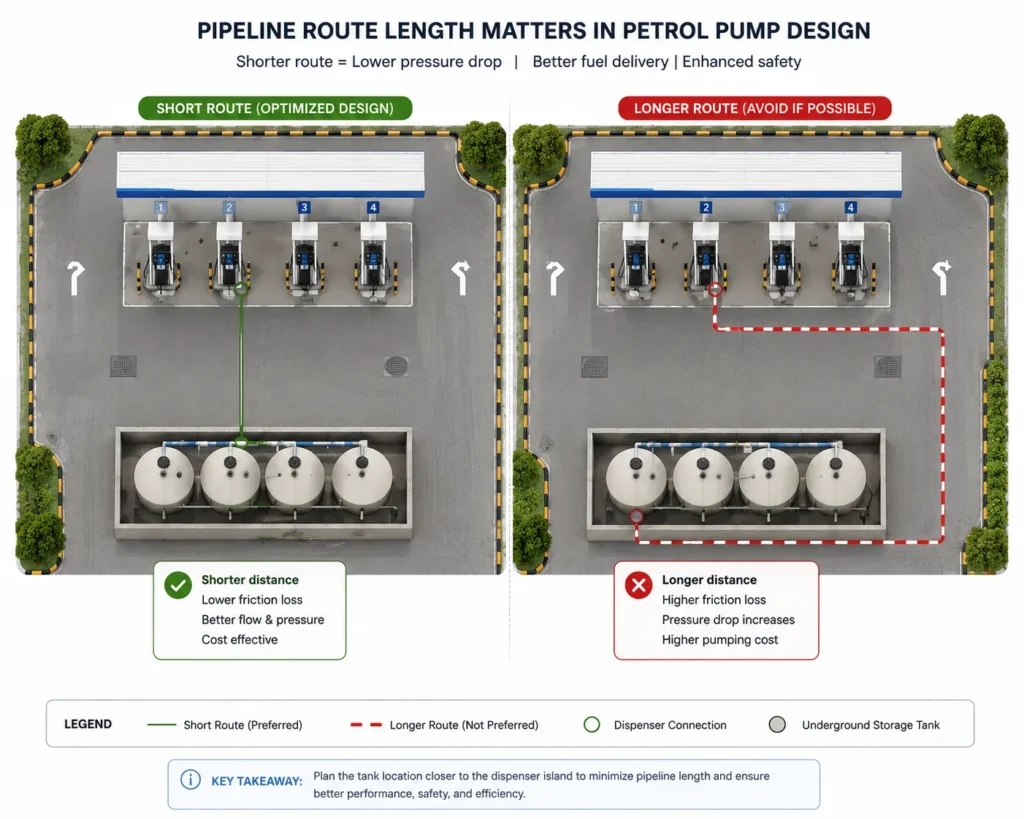
A longer pipeline generally introduces more frictional resistance than a shorter pipeline of the same diameter.
This means that two petrol pumps with the same equipment may not necessarily require the same pipe size if their underground layouts are very different.
For example:
Site A
Tank is relatively close to the dispenser island.
Site B
Tank is located much farther away.
The longer route may require different hydraulic consideration.
That is why pipe size should not be selected only from a standard product list.
Fittings Also Influence System Performance
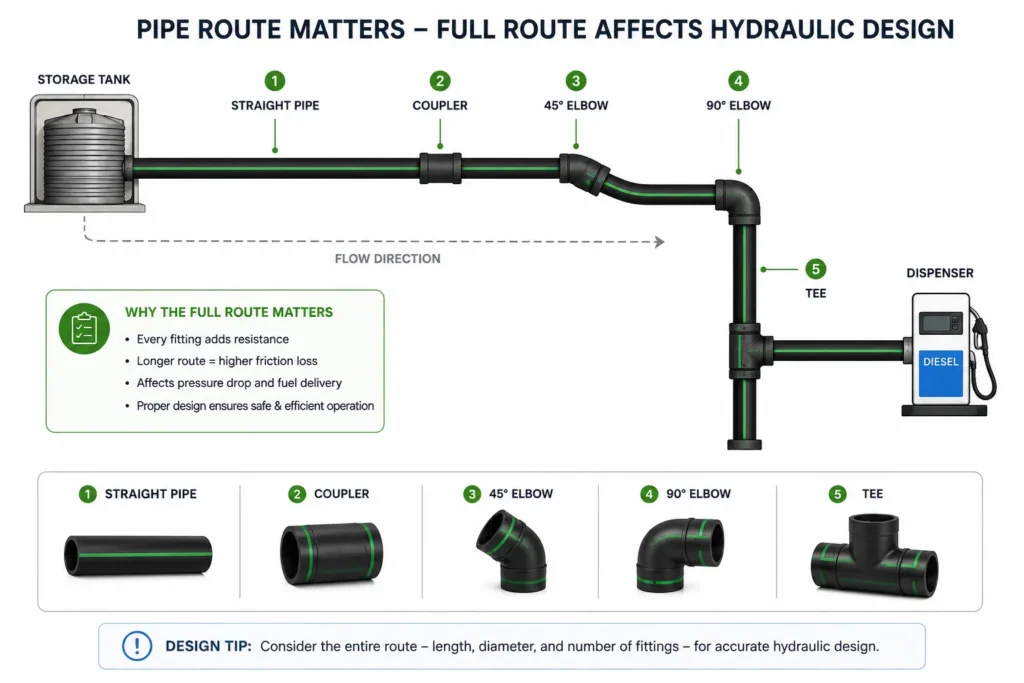
A fuel line does not consist only of straight pipe.
The route can include:
- Couplers
- 45° elbows
- 90° elbows
- Tees
- Transition fittings
- Flange connections
Each component forms part of the hydraulic system.
A route with many directional changes and fittings can behave differently from a long straight run.
The complete route needs to be considered during sizing.
When Should You Consider 63mm HDPE Fuel Pipe?
Depending on the project design, a 63 mm fuel pipe may be considered for many underground retail fuel applications.
Potential reasons for selecting 63 mm can include:
- Suitable required flow
- Compact underground routing
- Easier handling
- Smaller fittings
- Efficient use of trench space
- Appropriate project specification
However, the actual application should always be confirmed by the project’s engineering design.
When Should You Consider 90mm HDPE Fuel Pipe?
A 90 mm pipe may be considered where the system requires a larger flow path or where project-specific engineering indicates that the larger diameter is appropriate.
Possible considerations can include:
- Higher flow requirement
- Longer pipeline runs
- System-specific hydraulic design
- Project specification
- Larger installation configuration
Again, the diameter should be selected from engineering requirements rather than a general rule.
The Same Petrol Pump Can Use Different Pipe Sizes
It is possible for one fuel station to contain more than one pipe diameter depending on the system design.
Different fuel lines may serve different equipment or flow requirements.
For example, one route may use one diameter while another route is engineered differently.
This is why a petrol pump piping design should be viewed as a complete network rather than assuming one pipe size must be used everywhere.
Don’t Choose Pipe Size by Dispenser Count Alone
Another oversimplification is:
“Two dispensers need 63 mm, four dispensers need 90 mm.”
There is no universal rule that simple.
Dispenser count can influence demand, but the engineering calculation also needs to consider:
- Dispenser type
- Flow rate
- Simultaneous operation
- Pipe length
- Equipment configuration
- System layout
- Applicable project criteria
A proper design should combine all of these factors.
Pressure Rating Is Not the Same as Pipe Size
Pipe size and pressure capability are different considerations.
A 90 mm pipe is not automatically “stronger” simply because it is larger.
Similarly, a 63 mm pipe should not be selected only because it has a particular pressure rating.
The complete product specification needs to be reviewed.
For fuel piping, suitability also depends on:
- Fuel application
- Multilayer construction
- Barrier technology
- Applicable standard
- Fittings
- Certification
- Installation requirements
Bend Radius and Routing
HDPE provides useful flexibility for underground routing.
However, the minimum permitted bend radius depends on the specific pipe and system.
Larger-diameter pipes generally require more space to route smoothly.
Where the design requires a significant directional change, compatible fittings such as:
- 45° elbows
- 90° elbows
may be used according to the system requirements.
The pipe should never be forced into an excessive bend merely to avoid using the correct fitting.
Fitting Availability Should Be Checked
Before selecting a pipe size, confirm that the complete compatible fitting range is available.
For the selected diameter, the project may require:
- Couplers
- 90° elbows
- 45° elbows
- Tees
- Transition fittings
- Flange components
Selecting a pipe diameter without checking the fittings can create problems later in the installation.
A complete piping system needs both pipe and compatible connections.
Coil Size and Site Handling
HDPE fuel pipes can be supplied in long lengths or coils depending on the product and size.
Larger-diameter coils can require more space for:
- Transportation
- Unloading
- Storage
- Site movement
- Uncoiling
This should be considered during project planning.
A theoretically ideal pipe size is not helpful if the site cannot practically handle the product without proper planning.
Trench Space Also Matters
Larger pipes and fittings require more physical space.
In crowded petrol-pump sites, the underground area can already contain:
- Fuel lines
- Electrical conduits
- Drainage systems
- Foundations
- Other services
The engineering team should consider adequate separation, access and installation space.
Pipe size therefore affects not only hydraulics but also civil and installation planning.
How Should the Correct Size Be Selected?
A proper pipe-sizing process should consider the complete system.
A simplified decision approach can be:
1. Define required flow
How much fuel does the system need to move?
2. Determine pipeline length
What is the actual tank-to-dispenser route?
3. Review fittings and directional changes
How many elbows, tees and transitions are part of the route?
4. Review equipment requirements
What are the requirements of the associated pumping and dispensing equipment?
5. Calculate system losses
The engineering design should consider the hydraulic effect of the complete route.
6. Check project specification
The final pipe size needs to comply with the approved design and project requirements.
This is better than simply choosing between 63 mm and 90 mm based on habit.
63 mm vs 90 mm — Quick Comparison
Diameter
63 mm: Smaller nominal outside diameter.
90 mm: Larger nominal outside diameter.
Flow Capacity
63 mm: Suitable where the engineering design supports the required flow.
90 mm: Can provide greater flow capacity where required by the system design.
Handling
63 mm: Generally easier to transport and handle.
90 mm: Requires more handling and installation space.
Fittings
Both sizes require compatible fittings specifically intended for the piping system.
Routing
Both provide HDPE flexibility, but the minimum bend radius and routing requirements should be followed for the particular size.
Cost
A larger diameter normally involves more material and larger fittings, so it may increase system cost.
Selection
Neither is automatically better.
The correct pipe is the one selected by the approved engineering design.
Why Specialized Fuel Pipe Matters Regardless of Diameter
Whether the project uses 63 mm or 90 mm, the pipe still needs to be suitable for petroleum service.
A larger ordinary HDPE water pipe does not become a fuel pipe simply because of its diameter.
The same technical checks remain important:
- Intended petroleum application
- Fuel compatibility
- Multilayer construction
- Barrier technology
- Fittings
- Applicable standard
- Certification
- Installation procedure
Diameter answers the question:
“What size?”
It does not answer:
“Is this pipe suitable for fuel?”
EN 14125 and Pipe Selection
For thermoplastic and flexible metal underground piping used at petrol filling stations, EN 14125 is an important European standard.
The applicable product, size and certification scope should be checked when evaluating the piping system.
RAIPL’s multilayer HDPE fuel piping system has achieved EN 14125:2025 certification.
Project teams should review the exact RAIPL technical documentation relevant to the required pipe size and installation.
RAIPL 63 mm & 90 mm Multilayer HDPE Fuel Pipes
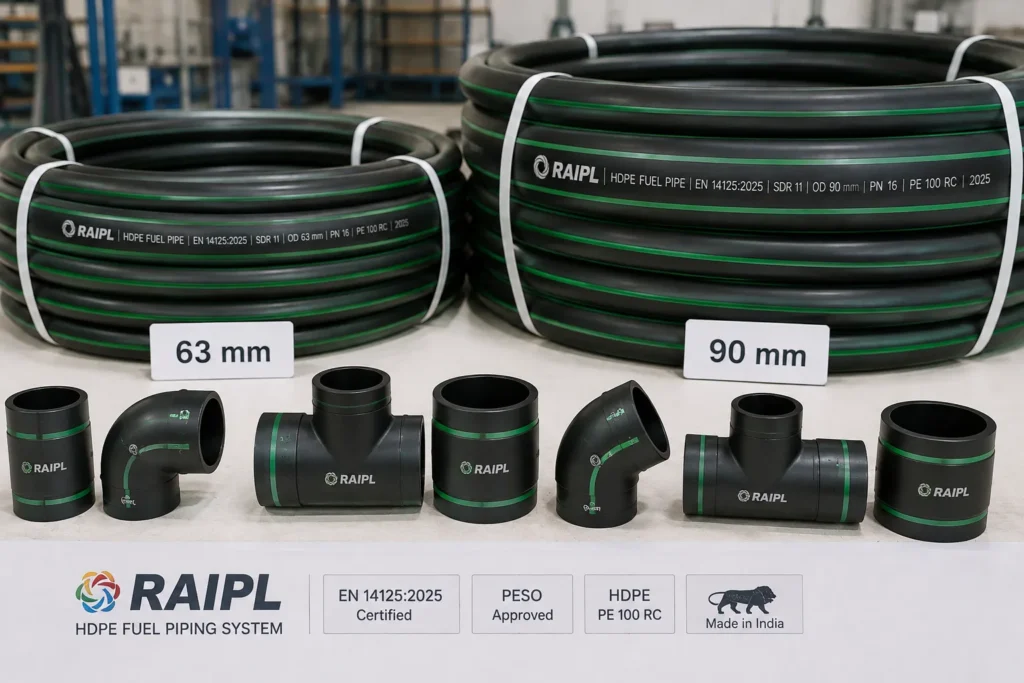
RAIPL (Rahul Arts India Pvt. Ltd.) is developing specialized multilayer HDPE fuel piping systems for underground petroleum applications.
RAIPL’s fuel piping range includes 63 mm and 90 mm multilayer HDPE fuel pipes, supported by compatible fittings and connection components.
The multilayer pipe construction combines:
HDPE structural layers
Specialized tie layers
to create an engineered pipe intended for underground petroleum applications.
The objective is to provide both the pipe and the compatible system components needed for a complete fuel piping solution.
Ask for Engineering Guidance — Not Just a Quotation
A buyer asking:
“Price for 63 mm pipe?”
is asking only one part of the question.
A better conversation is:
What is the required flow?
What is the pipeline distance?
What does the engineering design specify?
Which fittings are required?
Which pipe size is technically appropriate?
A responsible fuel piping supplier should support technical product selection rather than simply pushing the largest or most expensive pipe.
Frequently Asked Questions
Is 90 mm HDPE fuel pipe always better than 63 mm?
No. The appropriate diameter depends on the engineering design, required flow, pipeline length, fittings and equipment.
Can 63 mm pipe be used at petrol pumps?
A specialized 63 mm fuel pipe can be used where it meets the requirements of the approved system design and applicable project requirements.
When would 90 mm be required?
A larger diameter may be selected where hydraulic calculations, longer routes, flow requirements or project specifications indicate that it is appropriate.
Does a bigger pipe increase flow?
A larger internal flow area can provide greater hydraulic capacity, but actual system performance depends on the complete design.
Can the same fittings be used for 63 mm and 90 mm?
No. Fittings need to match the required pipe size and be compatible with the specific piping system.
Does pipe diameter determine fuel compatibility?
No. Fuel suitability depends on the product’s construction, materials, applicable standard, certification and intended application.
Right Size. Right System. Right Application.
Choosing between 63 mm and 90 mm is not a competition between small and large pipe.
It is an engineering decision.
The best fuel piping system is the one that uses:
The correct pipe size
with
the correct fittings
for
the correct fuel application
and
the correct engineering design.
RAIPL’s aim is to provide specialized multilayer HDPE fuel piping in both 63mm and 90mm configurations as part of a complete Made-in-India underground petroleum piping system.

One Response