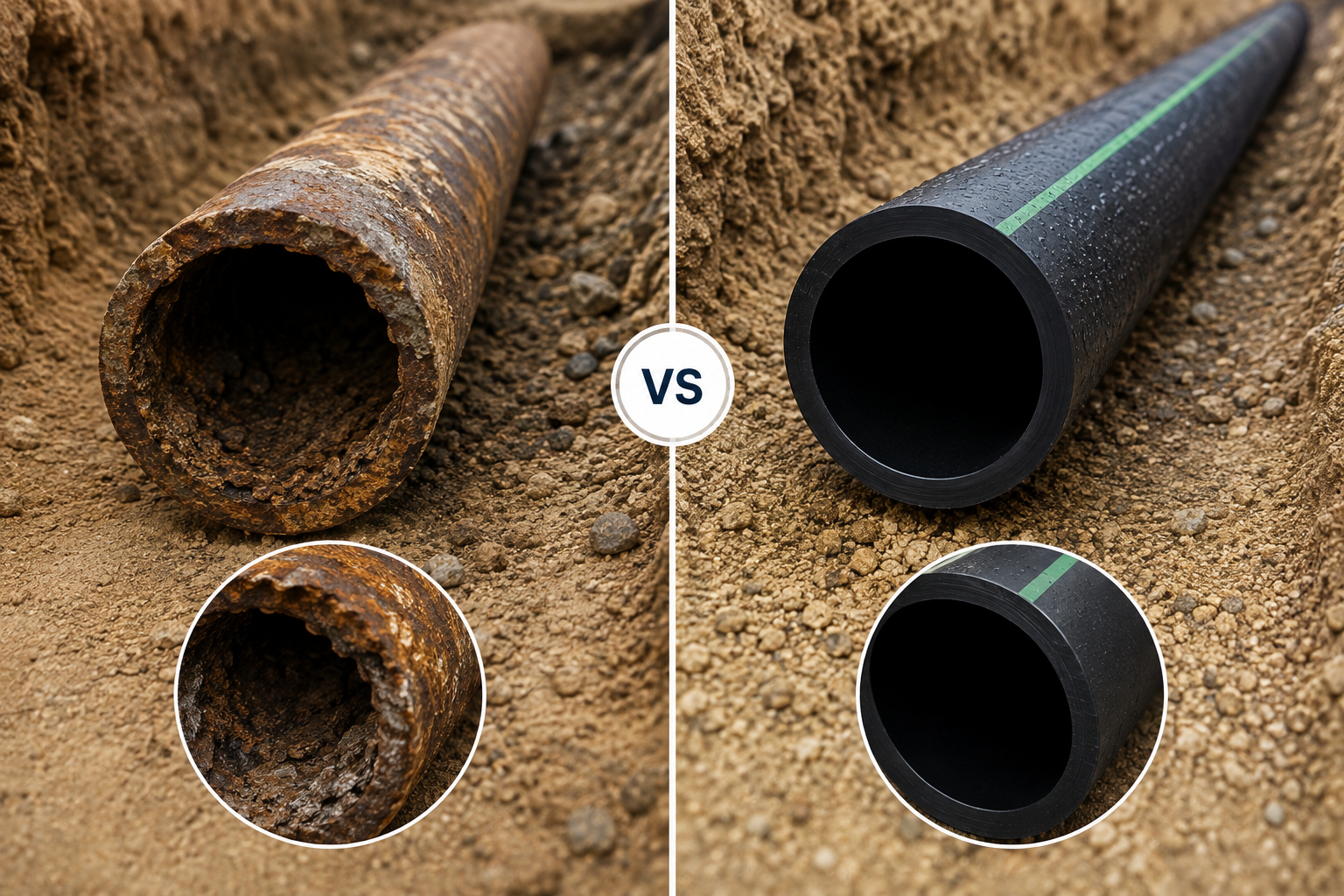
HDPE Fuel Pipe vs Steel Pipe for Petrol Pumps
HDPE fuel pipe vs steel pipe is an important comparison when evaluating underground piping systems for petrol pumps. Both technologies can be used within engineered petroleum infrastructure, but their materials, construction, jointing methods, installation characteristics and lifecycle considerations are different.
The underground piping network connects the Underground Storage Tank (UST) with the dispensing system and remains buried beneath the forecourt for much of its operating life.
Traditionally, metallic piping systems such as steel have been used for underground fuel transfer. Today, specialized multilayer HDPE fuel piping provides another engineered solution for petroleum applications.
The comparison therefore goes beyond simply asking whether plastic or metal is better. Corrosion, flexibility, number of joints, installation, fuel compatibility, permeation, maintenance and applicable technical requirements should all be considered.
1. HDPE Fuel Pipe vs Steel Pipe: Corrosion Resistance
One of the most significant differences between steel and HDPE is their behaviour in underground environments.
Steel Fuel Pipe
Steel is mechanically strong, but because it is a metallic material, corrosion protection is an important consideration in underground installations.
Moisture, soil conditions and damage to protective coatings can affect metallic piping over time.
The exact corrosion-control measures required depend on the piping system, installation conditions and applicable engineering specifications.
HDPE Fuel Pipe
HDPE does not rust in the same way as steel.
This makes corrosion resistance one of the important characteristics of HDPE when used in underground piping applications.
However, corrosion resistance alone does not make an ordinary HDPE pipe suitable for petroleum.
A specialized fuel pipe still needs to be designed and evaluated for fuel service.
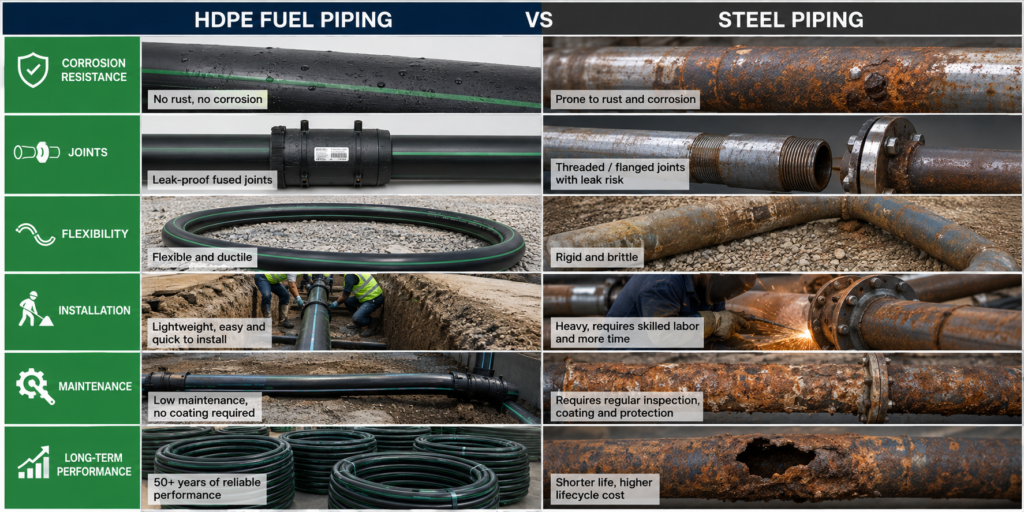
2. Pipe Construction
The construction of the two piping systems is fundamentally different.
Steel Pipe
A conventional steel pipe relies primarily on its metallic wall for structural strength and fuel containment.
Additional protective systems may be used depending on the installation and project requirements.
Multilayer HDPE Fuel Pipe
Specialized HDPE fuel piping can use multiple engineered material layers.
A typical multilayer concept can include:
HDPE → Tie Layer → Barrier Layer → Tie Layer → HDPE
Each layer performs a particular function.
The HDPE layers provide important structural and mechanical properties, while the barrier layer provides additional resistance against hydrocarbon permeation.
The tie layers help bond the different materials into a single pipe structure.
This multilayer construction is one of the important differences between a specialized HDPE fuel pipe and a conventional single-material PE pipe.
Learn how these materials function together in our guide to multilayer HDPE fuel pipe construction.
3. Flexibility and Underground Routing
Petrol pump layouts are not always perfectly straight.
Pipelines need to travel between underground storage tanks and dispensers while working around foundations and other underground infrastructure.
Steel Pipe
Steel is relatively rigid.
Directional changes generally require suitable fittings and engineered connections.
HDPE Fuel Pipe
HDPE provides greater flexibility than rigid metallic piping.
Depending on the pipe diameter, permitted bend radius and system requirements, this flexibility can assist installers in routing the pipeline through an underground installation.
However, HDPE should never be bent beyond the manufacturer’s specified limits.
Correct installation practices remain essential.
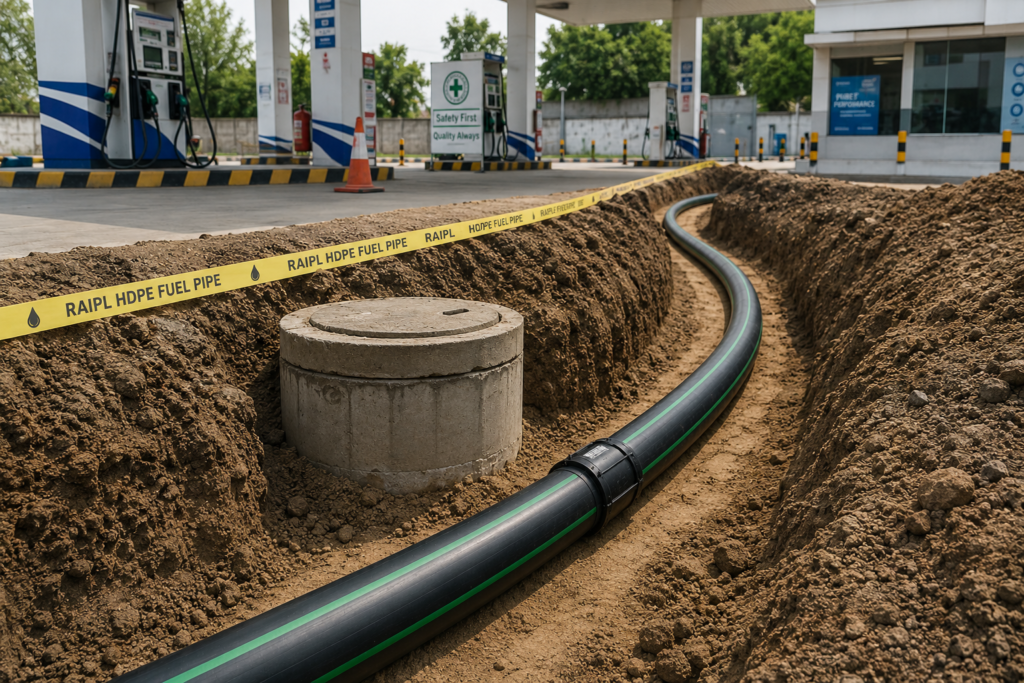
4. Number of Underground Joints
Every connection in an underground fuel network needs to be properly designed and installed.
Reducing unnecessary joints can therefore simplify certain piping layouts.
Steel Systems
Depending on the installation design, steel piping can require multiple fittings and connections for directional changes and longer routes.
HDPE Systems
HDPE fuel pipes may be supplied in relatively long continuous lengths or coils depending on their diameter and design.
This can allow some underground routes to be completed with fewer intermediate connections.
Where joints are required, compatible fittings such as electrofusion couplers, elbows and tees can be used according to the approved system and installation procedure.
5. Jointing Technology
The jointing methods used for the two systems are also different.
Steel Pipe Connections
Steel piping can use threaded, welded, flanged or other engineered connection methods depending on the system design and specification.
Each method has its own installation and inspection requirements.
HDPE Electrofusion Connections
HDPE fuel piping systems can use electrofusion technology.
An electrofusion fitting contains an integrated electrical heating element.
During the fusion process, controlled electrical energy heats the fitting and prepared pipe surfaces to form the joint.
Correct surface preparation, alignment, fusion parameters and cooling time are essential.
The quality of the finished system therefore depends not only on the pipe and fitting, but also on following the correct installation procedure.
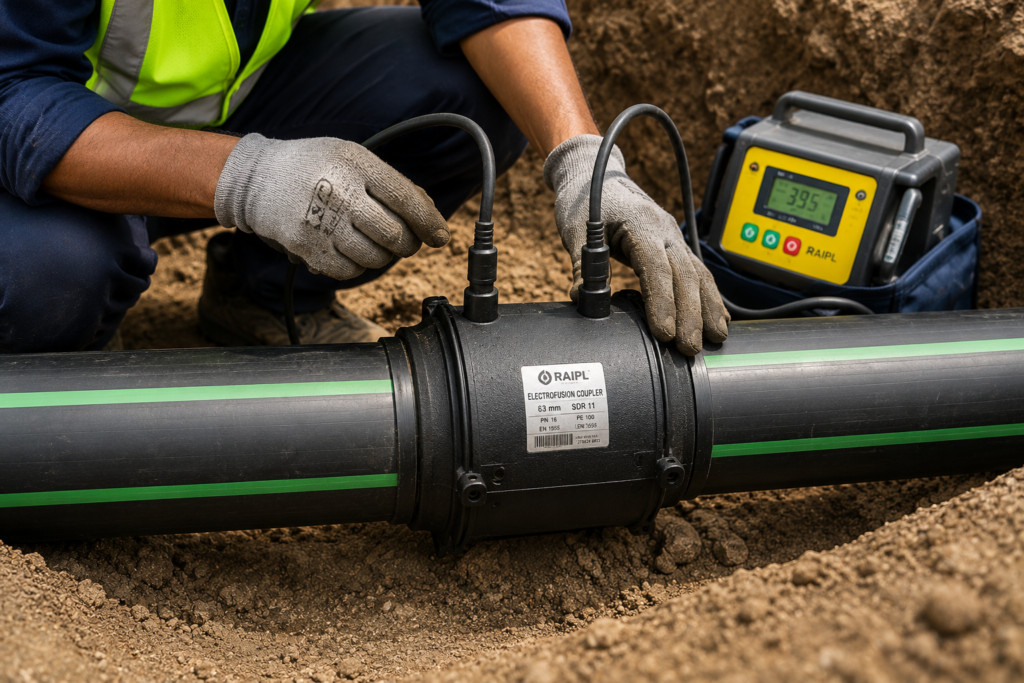
Read our complete guide to electrofusion fittings for HDPE fuel pipe for couplers, elbows, tees and jointing principles.
6. Installation
Installation conditions at petrol pumps can be challenging because much of the work happens inside excavated trenches.
Steel Pipe
Steel components are rigid and generally heavier than comparable polymer components.
Installation may therefore involve additional handling considerations depending on pipe size and site conditions.
HDPE Fuel Pipe
HDPE is comparatively lightweight and flexible.
This can make transportation, handling and positioning inside trenches easier in many installations.
Longer continuous lengths may also reduce the number of individual pipe sections that need to be connected.
However, easier handling should never be confused with casual installation.
Fuel piping is a specialized system and should be installed by trained personnel using the correct procedures and equipment.
See the HDPE fuel pipe installation guide for common installation mistakes and correct joint-preparation principles.
7. Fuel Permeation
This is an important technical consideration when comparing polymer and metallic piping.
Metallic pipe walls inherently behave differently from polymers regarding hydrocarbon permeation.
For thermoplastic fuel piping, the pipe construction needs to address the permeation characteristics relevant to the intended fuel application.
This is one reason specialized multilayer HDPE fuel pipes can incorporate a dedicated barrier layer such as EVOH.
The barrier layer provides additional resistance against hydrocarbons passing through the pipe wall.
This is also why an ordinary HDPE water pipe should not automatically be treated as an HDPE fuel pipe.
8. Maintenance Considerations
Underground fuel piping is expected to operate reliably for long periods, making lifecycle considerations important.
Steel Systems
Corrosion protection and the condition of metallic components can be relevant considerations over the operating life of the system.
HDPE Systems
HDPE itself does not rust, eliminating one of the degradation mechanisms associated with conventional steel.
However, the overall performance of an HDPE fuel piping system still depends on:
- Correct product selection
- Fuel compatibility
- Proper installation
- Correctly executed joints
- Compatible fittings
- Appropriate commissioning
- Compliance with applicable technical requirements
No piping technology should be considered maintenance-free simply because of the material from which it is manufactured.
9. Standards and Testing
The material alone should never determine whether a pipe is suitable for a petrol pump.
For specialized thermoplastic underground fuel piping, standards such as EN 14125 provide requirements relevant to piping systems used at petrol filling stations.
A fuel piping system should be evaluated based on its intended application, applicable standards, certifications, test documentation and project-specific requirements.
RAIPL’s multilayer HDPE fuel piping system has been developed for specialized underground petroleum applications with EN 14125:2025 certification.
Quick Comparison: HDPE Fuel Pipe vs Steel Pipe
| Factor | Steel Fuel Pipe | Specialized HDPE Fuel Pipe |
|---|---|---|
| Corrosion | Corrosion protection needs consideration | Does not rust like steel |
| Flexibility | Relatively rigid | More flexible within specified limits |
| Weight | Generally heavier | Comparatively lightweight |
| Pipe lengths | Rigid pipe sections | Longer continuous lengths/coils can be possible |
| Direction changes | Engineered fittings/connections | Compatible fittings and permitted pipe flexibility |
| Jointing | Welded/threaded/flanged or specified system | Electrofusion and compatible transitions |
| Permeation | Metallic wall behaves differently from polymers | Multilayer construction can incorporate barrier technology |
| Installation | More rigid/heavier handling | Lightweight and flexible handling characteristics |
| Selection | Project engineering requirements | Project engineering requirements |
So, Is HDPE Better Than Steel?
There is no responsible engineering answer that says one material is automatically better for every petrol pump.
The correct piping system depends on:
- Project specifications
- Fuel type
- Underground layout
- Applicable standards
- Regulatory requirements
- Engineering design
- Installation conditions
- Required certifications and approvals
However, specialized multilayer HDPE fuel piping offers several characteristics that make it an important modern solution for underground petroleum installations.
These include:
Corrosion resistance, flexibility, comparatively low weight, long continuous pipe lengths, engineered electrofusion connections and specialized multilayer barrier technology.
The important word here is specialized.
An ordinary HDPE water pipe should never be considered a substitute for a fuel piping system simply because both products are manufactured using polyethylene.
The Complete System Matters More Than the Pipe
A common mistake is to evaluate only the pipe.
A reliable underground petroleum network depends on the complete system:
Pipe + Couplers + Elbows + Tees + Transition Fittings + Installation + Testing
A technically advanced pipe connected using incorrect fittings or poor installation practices cannot provide the performance expected from a properly engineered system.
This is why compatibility between the pipe and fittings is extremely important.
RAIPL Multilayer HDPE Fuel Piping System
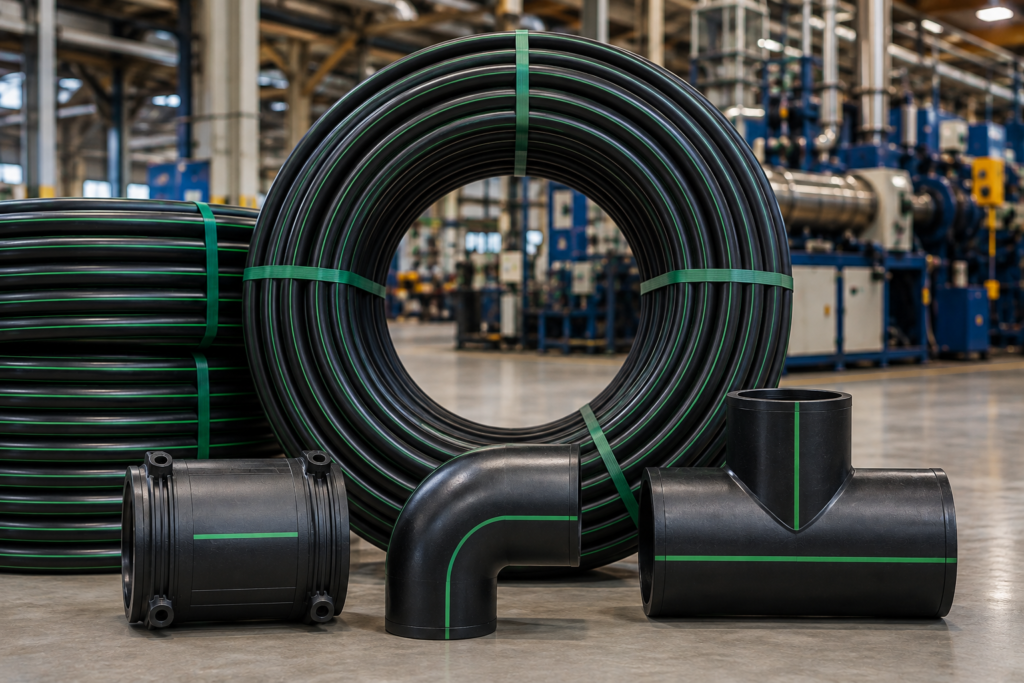
RAIPL (Rahul Arts India Pvt. Ltd.) is developing a complete Made-in-India multilayer HDPE fuel piping ecosystem for underground petroleum applications.
The RAIPL system includes specialized multilayer HDPE fuel pipes together with compatible electrofusion and transition fittings.
Our approach is focused on providing a complete piping solution rather than simply supplying an individual pipe.
With manufacturing capability in India and EN 14125:2025 certification, RAIPL aims to provide the Indian petroleum infrastructure sector with an indigenous alternative in a category that has historically depended significantly on international piping technologies.
Our long-term vision is clear:
Develop in India. Manufacture in India. Install across India. And ultimately take Made-in-India fuel piping technology to international markets.
Frequently Asked Questions
Does HDPE fuel pipe rust underground?
HDPE does not rust like conventional steel. However, the complete fuel piping system still needs correct installation, compatible fittings and application-specific evaluation.
Is HDPE fuel pipe lighter than steel?
HDPE is generally considerably lighter than steel, which can simplify transportation and handling during installation.
Does HDPE fuel pipe require joints?
Yes. Joints are required wherever pipe sections, directional changes, branches or system connections are necessary. Specialized systems can use electrofusion fittings for these connections.
Can ordinary HDPE water pipe replace steel fuel pipe?
No. A general-purpose HDPE water pipe should not automatically be used for petroleum service. Fuel piping should be specifically designed, evaluated and certified for its intended application.
Why is a barrier layer used in multilayer HDPE fuel pipes?
The barrier layer provides additional resistance against hydrocarbon permeation through the pipe wall.
Which is better for a petrol pump: HDPE or steel?
The correct choice depends on the engineering design, applicable standards, fuel application, project specifications and regulatory requirements. Specialized HDPE fuel piping provides advantages including corrosion resistance, flexibility and lightweight construction for suitable underground petroleum applications.