
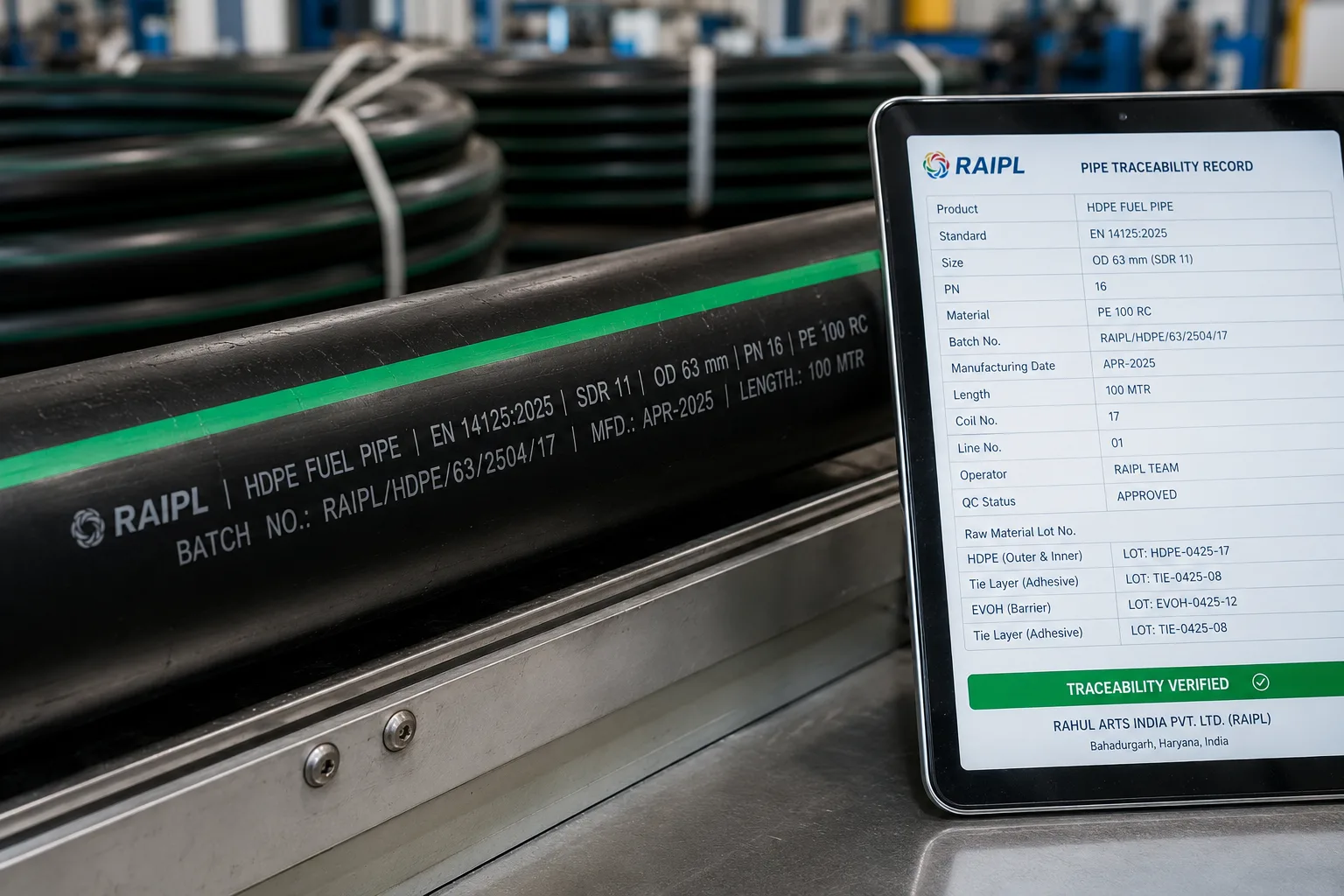
What Is Fuel Pipe Traceability?
Fuel pipe traceability is the process of identifying a fuel pipe and connecting it with its manufacturing, batch, quality, delivery and installation records. For underground fuel piping systems, traceability creates a documented link between the product manufactured at the factory and the pipe ultimately installed at a petrol pump.
For underground fuel piping, this can include information such as:
- Pipe manufacturer
- Product type
- Pipe size
- Production batch
- Manufacturing date
- Fitting batch
- Delivery records
- Installation location
- Fusion records
- Test records
The objective is simple:
Know what was manufactured, where it was supplied and where it was installed.
Why Fuel Pipe Traceability Matters for Underground Infrastructure
Most underground fuel piping disappears from view after installation.
Once the trench is backfilled and the petrol pump forecourt is completed, direct access to the pipe becomes difficult.
Unlike a visible dispenser or signboard, the piping system may remain buried for years.
That makes documentation extremely important.
A strong traceability system creates a technical history of the installation even after the physical pipe is no longer visible.
Fuel Pipe Traceability Begins with Raw Materials
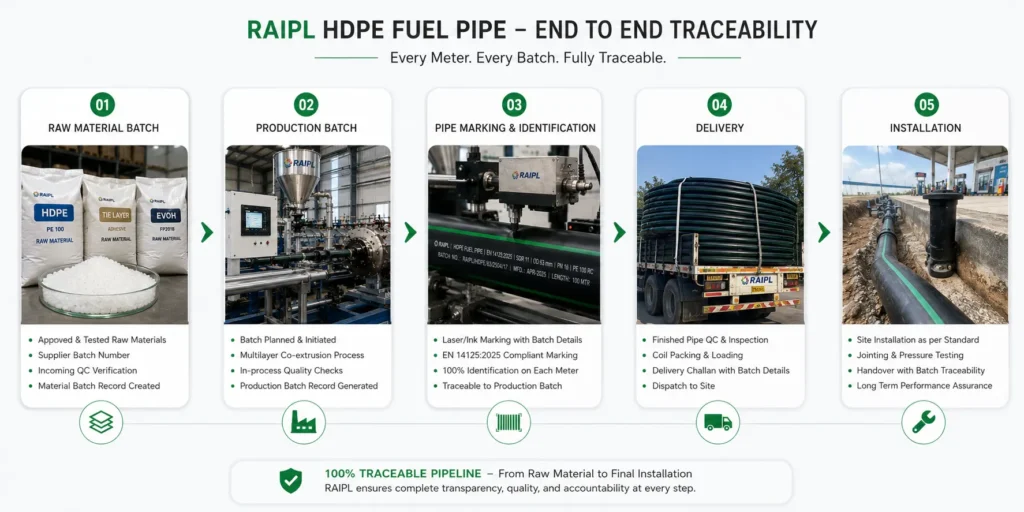
Good traceability does not start when the pipe reaches the customer.
It begins inside the factory.
The manufacturer should be able to identify the materials used in a particular production batch.
A simplified chain can look like:
Raw Material Batch → Production Batch → Finished Pipe → Delivery → Project
For multilayer piping, several different materials may be involved.
These can include:
- HDPE resin
- Tie-layer material
- EVOH barrier resin
- Other approved materials where applicable
Controlling and identifying these materials helps support manufacturing consistency.
To understand how these materials move through production, multilayer extrusion, marking and final quality control, read our guide on How Multilayer HDPE Fuel Pipes Are Manufactured.
Why Production Batch Identification Matters
A production batch groups finished products manufactured under defined production conditions.
Batch identification can help the manufacturer connect finished pipe with:
- Raw material records
- Production parameters
- Quality-control checks
- Manufacturing date
- Production-line information
- Inspection results
If a question later arises about a particular product, batch information can make investigation much more focused.
How Pipe Marking Supports Fuel Pipe Traceability
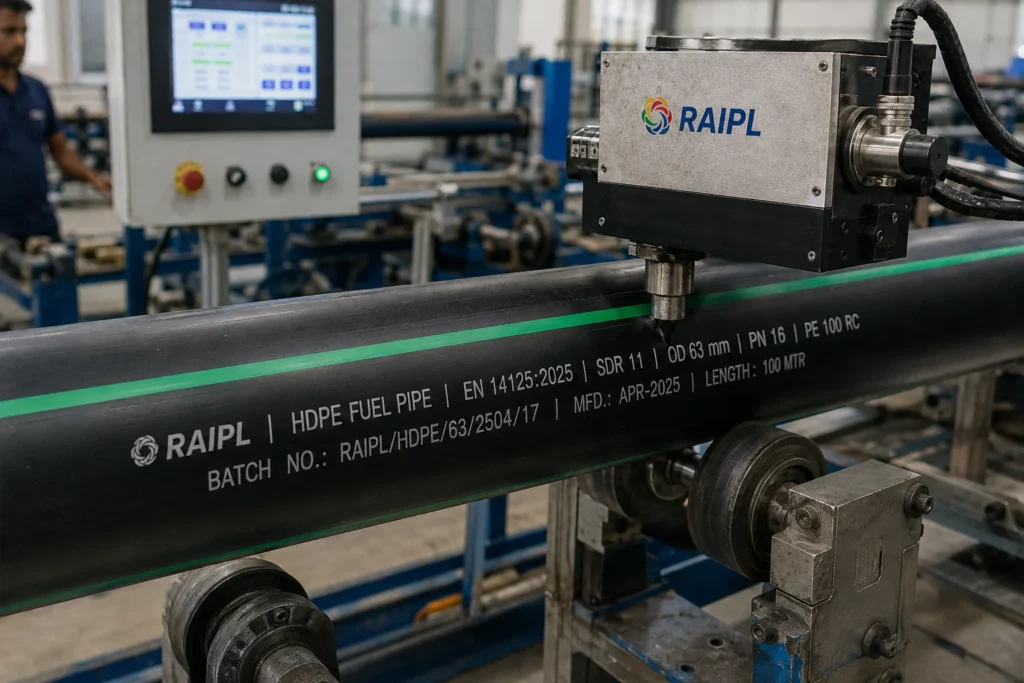
The information printed on the pipe provides a physical connection between the product and its records.
Depending on the applicable marking system, pipe identification can include:
- Manufacturer
- Product designation
- Size
- Standard reference
- Batch or lot information
- Manufacturing details
This marking should correspond with the manufacturer’s internal production records.
The physical pipe and the documentation should tell the same story.
For a detailed explanation of manufacturer identification, size, standard, batch and production information, read our guide on [How to Read HDPE Fuel Pipe Markings].
Why Fittings Should Also Be Traceable
A complete underground system does not consist only of straight pipe.
It can include:
- Electrofusion couplers
- 90° elbows
- 45° elbows
- Tees
- Transition fittings
- Flange components
These components also form part of the installed fuel path.
Where suitable product identification and batch information are available, fitting traceability can help connect individual components to project records.
This becomes particularly valuable when many joints are installed across a large fuel station.
Traceability of Electrofusion Joints
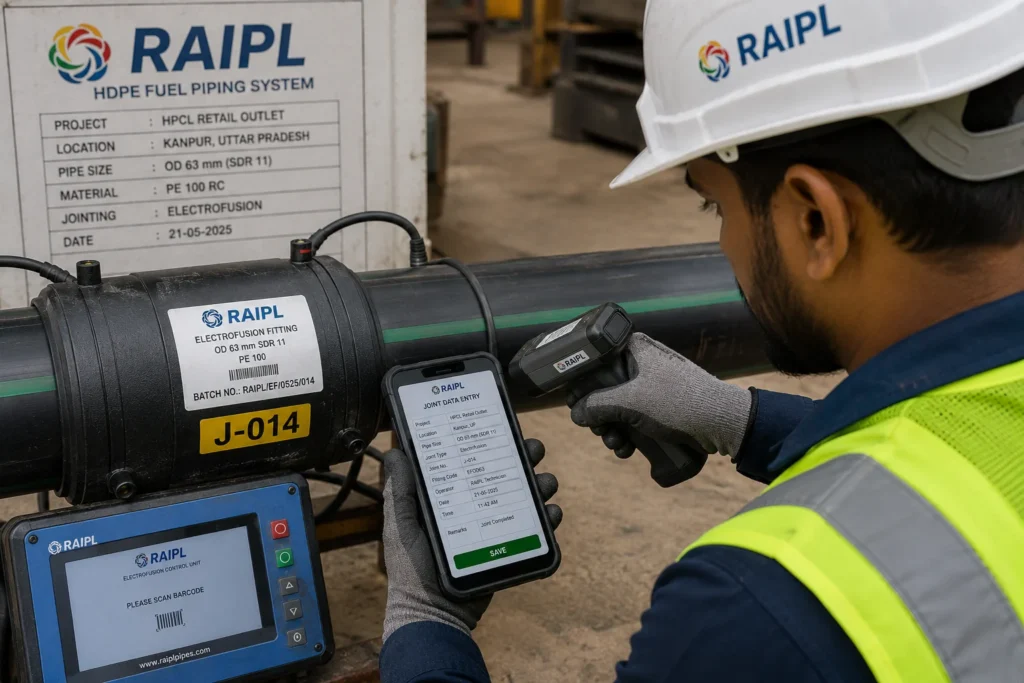
Electrofusion creates multiple connection points in the underground network.
Each joint can potentially be assigned its own record.
Depending on the system and project requirements, a joint record can include:
- Joint number
- Pipe identification
- Fitting identification
- Date
- Installer
- Location
- Fusion parameters
- Cooling confirmation
- Inspection result
Modern electrofusion equipment may also support recording of fusion data depending on the machine and system.
This adds another layer of traceability.
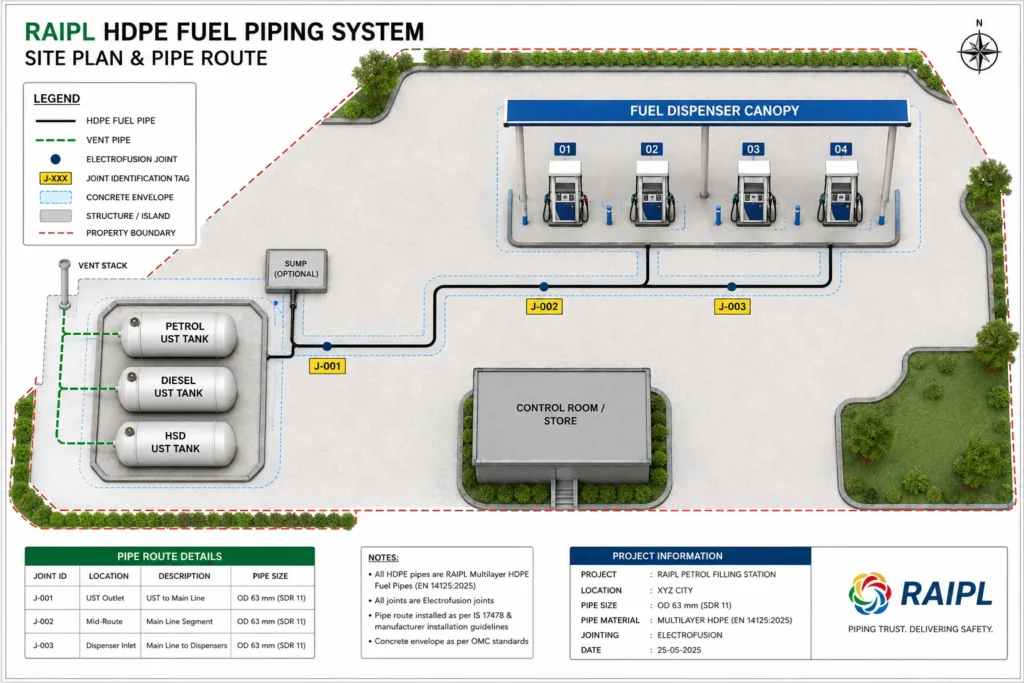
Why Joint Numbering Is Useful
On a large petrol pump project, there may be many electrofusion joints.
If every joint is simply described as “the coupler near the dispenser,” troubleshooting becomes difficult.
A better system can assign unique identifiers such as:
J-001
J-002
J-003
and so on.
These identifiers can then be linked to:
- Site drawings
- Fusion records
- Inspection records
- Test records
This makes communication much clearer.
Site Location Should Be Recorded
Knowing which batch was supplied to a project is useful.
Knowing where each section was installed can be even more useful.
Project documentation can associate pipe sections or joints with:
- Tank number
- Fuel grade
- Pipeline route
- Dispenser island
- Drawing reference
- GPS or site-plan location where appropriate
The level of detail depends on the project.
The goal is to make the underground installation understandable even after it is covered.
Why Delivery Records Matter
Traceability also connects manufacturing with logistics.
Delivery documentation can help identify:
- Product supplied
- Quantity
- Size
- Batch
- Project
- Delivery date
This creates a link between the factory records and the site records.
Without this connection, a manufacturer may know which batches were produced but not exactly where each batch was used.
Installation Records Complete the Chain
The strongest traceability system connects all stages.
For example:
Raw Material
↓
Manufacturing Batch
↓
Pipe Marking
↓
Delivery
↓
Installation Location
↓
Joint Record
↓
Commissioning Test
That is a much stronger system than simply printing the manufacturer’s name on the pipe.
Traceability Helps During Quality Investigations
Suppose a technical question arises about a pipe installed at a particular petrol pump.
With traceability, the manufacturer can potentially identify:
- Which production batch was involved
- Which materials were used
- Which QC checks were performed
- Which fittings were installed
- When the joint was fused
- What commissioning test was performed
Without records, the investigation becomes far more dependent on guesswork.
Traceability Can Help Isolate Issues
If a manufacturer identifies an issue affecting only one specific batch, traceability can help determine which products are potentially involved.
This can help avoid unnecessarily treating every product as suspect.
For example, the manufacturer may be able to determine:
Affected Batch → Specific Deliveries → Specific Projects
This is one of the practical reasons batch control is important in professional manufacturing.
Traceability Supports Continuous Improvement
Quality systems should not only detect problems.
They should also help manufacturers learn.
If field feedback identifies a recurring issue, records can help engineers compare:
- Production batches
- Raw materials
- Installation methods
- Fitting types
- Site conditions
This information can support better product and process improvements.
Why Traceability Helps Project Owners
Traceability is not only useful for the manufacturer.
Petroleum companies, project owners and consultants can also benefit.
Good project records can provide confidence about:
- What was installed
- Whether approved products were used
- Which batches were supplied
- Who performed the installation
- Which tests were completed
This creates better control over critical underground infrastructure.
Avoiding Product Substitution
Construction sites can involve multiple suppliers and different types of piping.
Traceability and clear product marking can help reduce the risk of unapproved substitution.
Receiving teams can verify:
Does the product delivered match the approved system?
This is especially important when visually similar pipes exist for different applications.
Traceability and Certification
A certificate relates to a defined product or system within its scope.
Traceability helps connect the physical product supplied to site with that certified system.
For example, buyers may review:
- Certificate
- Product marking
- Batch records
- Technical data
- Delivery documentation
Together, these provide stronger verification than any single document alone.
EN 14125 and Product Identification
For underground thermoplastic and flexible metal fuel piping, EN 14125 is an important European standard.
Applicable marking, documentation and conformity requirements help support product identification within the broader technical system.
RAIPL’s multilayer HDPE fuel piping system has achieved EN 14125:2025 certification.
Product identification and traceability help connect the manufactured pipe with the technical documentation supporting it.
Traceability Is Especially Valuable for New Technology
When a new piping technology enters a market, confidence is built gradually.
Traceability can help provide evidence from:
- Manufacturing
- Installation
- Commissioning
- Field performance
This makes it easier to build a technical history across multiple projects.
For domestic manufacturers developing specialized petroleum products, such records can become particularly valuable over time.
Digital Traceability
Modern traceability systems can go beyond printed batch numbers.
Depending on the manufacturer and project, digital systems can potentially include:
- QR codes
- Barcode identification
- Digital batch records
- Electronic fusion logs
- Cloud-based installation records
- Digital commissioning reports
These tools can make product information easier to retrieve.
However, digital systems should support—not replace—accurate manufacturing and installation records.
What Should a Good Traceability Record Include?
A practical underground fuel piping record can include:
Product Details
- Manufacturer
- Pipe type
- Size
- Batch
Fitting Details
- Fitting type
- Size
- Batch
Installation Details
- Joint number
- Site location
- Installer
- Date
Testing Details
- Inspection completed
- Test reference
- Result
- Acceptance record
The exact requirements should be determined by the project and piping system.
Traceability Should Be Simple Enough to Use
A traceability system that is too complicated may not be used correctly on site.
The best systems are usually:
- Clear
- Consistent
- Easy to record
- Easy to retrieve
- Connected to drawings and documentation
The goal is reliable information, not unnecessary paperwork.
RAIPL and Product Traceability
RAIPL (Rahul Arts India Pvt. Ltd.) is developing a complete Made-in-India multilayer HDPE fuel piping ecosystem for underground petroleum applications.
The quality approach includes focus on:
- Raw material identification
- Controlled production
- Batch records
- Pipe marking
- Fitting identification
- Quality documentation
- Installation guidance
- Testing records
The objective is to create a piping system that can be technically tracked from production through project installation.
From Factory to Forecourt
A professional underground fuel piping system should have a clear journey.
Factory
↓
Production Batch
↓
Quality Control
↓
Pipe Marking
↓
Project Delivery
↓
Installation
↓
Testing
↓
Petrol Pump Operation
Traceability connects these stages.
Without it, each stage exists in isolation.
With it, the entire product lifecycle becomes more transparent.
Frequently Asked Questions
What is pipe traceability?
Pipe traceability is the ability to connect a physical pipe with relevant manufacturing, batch, quality and delivery records.
Why is traceability important underground?
Because once the piping is buried, physical inspection becomes difficult. Records help identify what was installed and where.
Should fittings also have batch records?
Where available, fitting identification and batch information can improve complete-system traceability.
Can electrofusion joints be recorded?
Yes. Depending on the equipment and project requirements, joint details and fusion data can be recorded and linked to specific locations.
Is pipe marking enough for traceability?
No. Marking is one part of the system. Strong traceability also includes manufacturing, delivery, installation and testing records.
Can QR codes be used?
Digital tools such as QR codes can support traceability, provided the underlying product and project records are accurate and maintained properly.
If It Goes Underground, Keep a Record
Once an underground fuel pipe disappears beneath the forecourt, documentation becomes the memory of the installation.
Good traceability answers important questions:
What product was installed?
Which batch was it from?
Which fitting was used?
Who installed the joint?
Where is it located?
Was it tested?
For critical petroleum infrastructure, that information can be extremely valuable.
Traceability turns an invisible underground network into a documented engineering system.
Looking for a Multilayer HDPE Fuel Piping System?
RAIPL develops multilayer HDPE fuel piping systems for underground petroleum applications, supported by compatible electrofusion fittings, product traceability, technical documentation and installation guidance.
Explore the RAIPL HDPE Fuel Piping System or contact our team for product specifications, technical documentation and project requirements.

5 Responses