
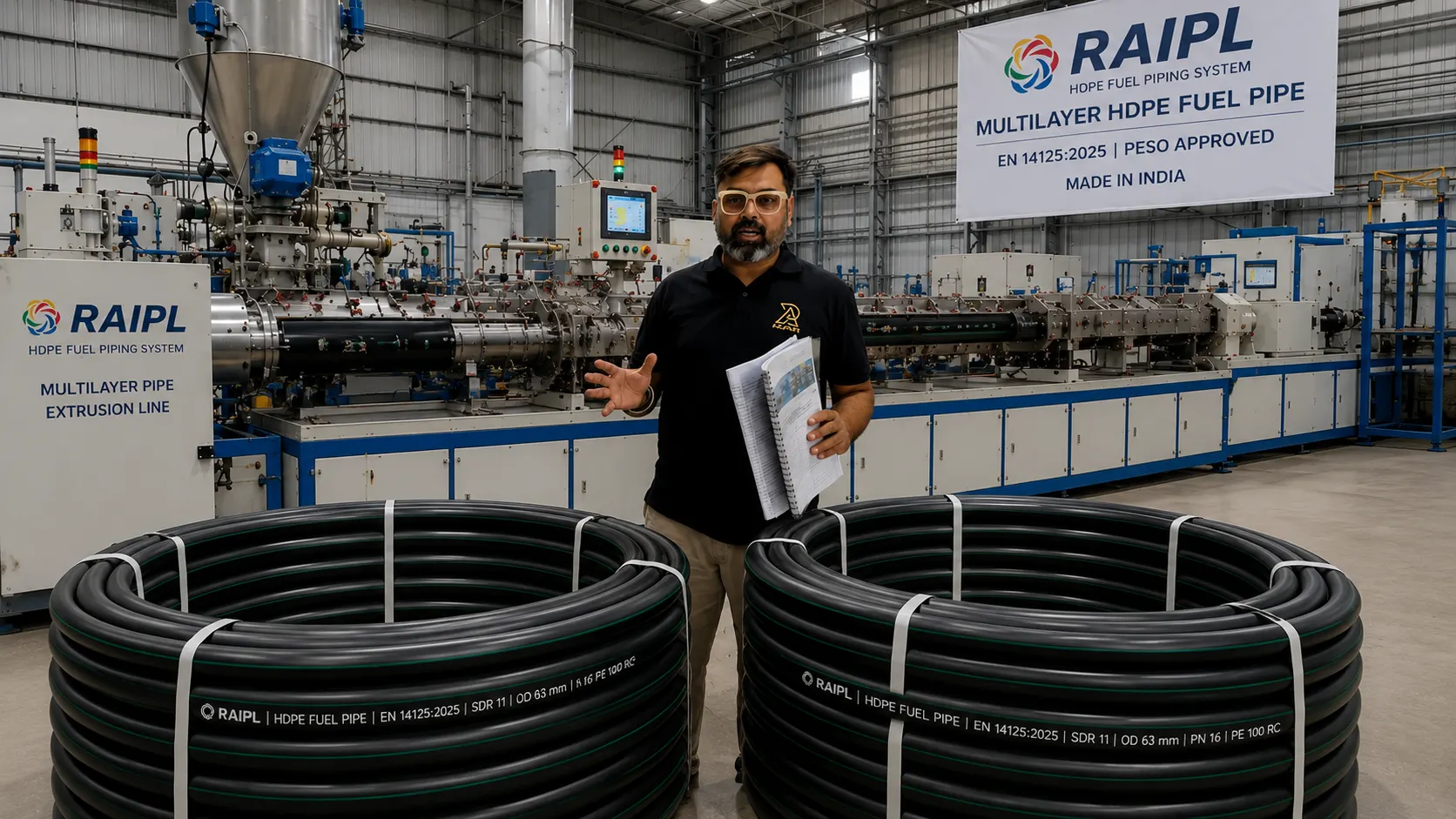
Why RAIPL Entered Fuel Piping
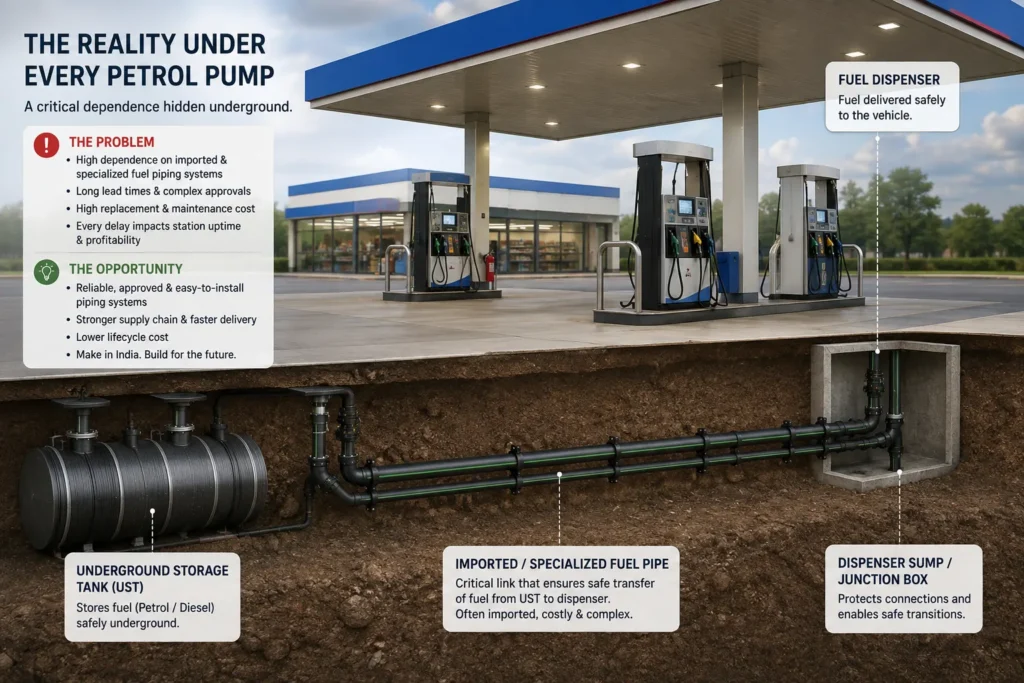
A Made in India HDPE fuel pipe represents more than local production—it represents the development of specialized Indian capability for underground petroleum infrastructure. RAIPL’s journey began with a simple question: can advanced multilayer fuel piping technology be developed and manufactured in India rather than depending entirely on imported systems?
India has a large petroleum retail infrastructure network, and every new or upgraded petrol pump requires reliable underground systems connecting fuel storage tanks with dispensing equipment.
While conventional HDPE pipe manufacturing is already well established in India, specialized multilayer fuel piping requires additional expertise in barrier technology, polymer bonding, electrofusion fittings, testing, certification and installation.
For RAIPL (Rahul Arts India Pvt. Ltd.), developing a Made in India HDPE fuel pipe became an opportunity to build specialized domestic manufacturing capability for petroleum infrastructure.
From Petroleum Infrastructure to HDPE Fuel Pipe Manufacturing
RAIPL has worked across petroleum retail infrastructure and related execution activities.
That experience provided direct exposure to the realities of petrol-pump construction and operation.
It also highlighted an important gap.
India had significant capability in:
- Civil works
- Retail outlet development
- Signage
- Fabrication
- Conventional HDPE manufacturing
- Petroleum equipment installation
But specialized multilayer underground fuel piping remained a technically demanding category.
RAIPL decided to develop capability in this area rather than remain dependent only on external technologies.
Why Manufacturing an HDPE Fuel Pipe Is Different from Ordinary HDPE Pipe
India already has many manufacturers capable of producing conventional HDPE pipe.
The challenge was different.
The requirement was to develop a pipe specifically intended for underground petroleum applications.
That meant understanding issues such as:
- Fuel compatibility
- Hydrocarbon permeation
- Multilayer construction
- Barrier technology
- Polymer bonding
- Electrofusion fittings
- System testing
- Technical standards
- Product traceability
The goal was never simply:
“Make a black HDPE pipe.”
The goal was:
Develop a specialized fuel piping system.
Understanding Multilayer Construction
A specialized fuel pipe can use multiple polymer layers to achieve different functions within one engineered wall.
A simplified multilayer concept can be represented as:
HDPE → Tie Layer → EVOH Barrier → Tie Layer → HDPE
Each layer performs a different role.
HDPE
Provides important structural and mechanical properties.
Tie Layers
Help bond different polymer materials together.
EVOH Barrier
Provides additional resistance against hydrocarbon permeation.
Developing this structure requires precise material selection and controlled multilayer extrusion.
Building Made in India HDPE Fuel Pipe Manufacturing Capability
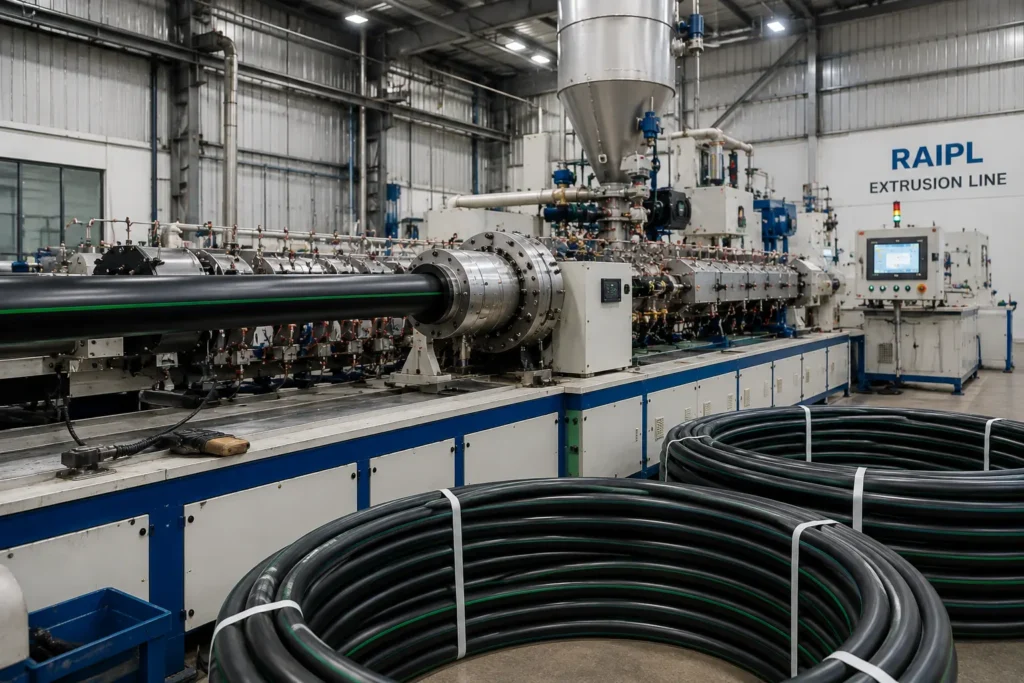
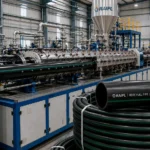
Multilayer pipe manufacturing requires more than a conventional extrusion line.
Different materials need to be:
- Fed separately
- Processed correctly
- Brought together through specialized tooling
- Maintained in the correct layer structure
- Controlled throughout production
The manufacturing process therefore requires attention to:
- Raw materials
- Extrusion temperature
- Layer distribution
- Pipe dimensions
- Cooling
- Marking
- Coiling
- Quality control
Building this capability was an important step in RAIPL’s move into specialized petroleum piping.
From Pipe to Complete System
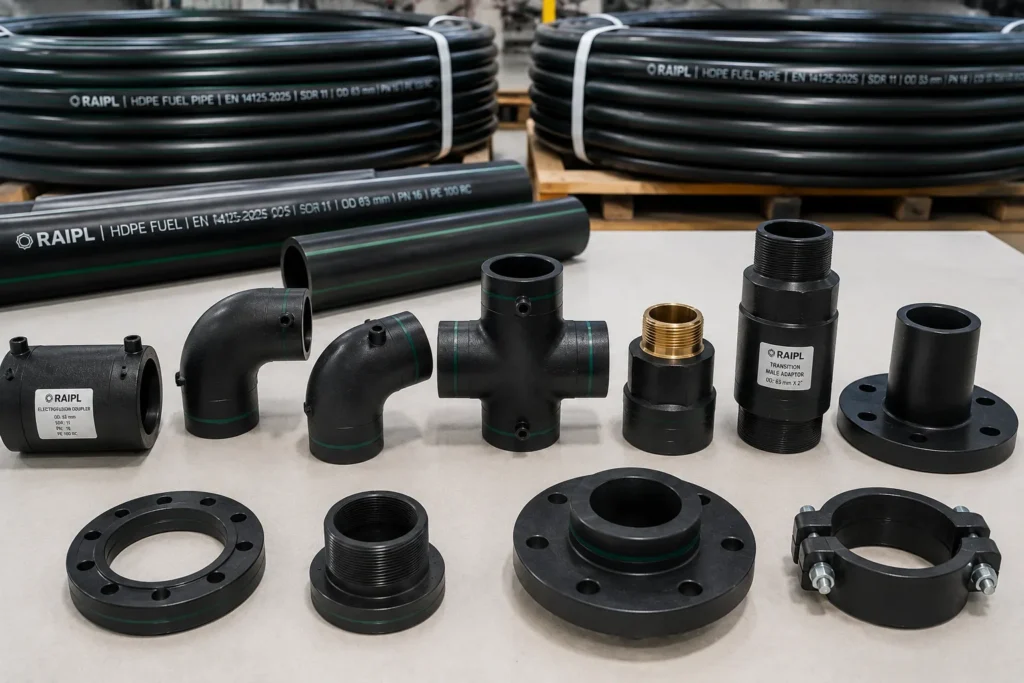
A pipe alone cannot create an underground petroleum network.
Real petrol-pump installations require components for:
- Straight connections
- Direction changes
- Branches
- Equipment interfaces
- Flanged connections
- Transitions
This meant RAIPL also needed to focus on a compatible fitting ecosystem.
That includes components such as:
- Electrofusion Couplers
- Electrofusion 90° Elbows
- Electrofusion 45° Elbows
- Electrofusion Tees
- Male Adaptors
- Female Adaptors
- Flange Adaptors
- Stub Ends
- Backing Rings
The objective became broader:
Develop the piping system, not just the pipe.
Why Testing Became a Major Part of the Journey
Specialized petroleum infrastructure cannot rely only on appearance or basic dimensions.
The system needs technical evaluation.
That means understanding and documenting:
- Material behaviour
- Pipe construction
- Fitting performance
- Joint integrity
- Fuel compatibility
- Mechanical performance
- System requirements
Testing therefore became a core part of product development rather than an activity performed only after production was complete.
The Importance of EN 14125
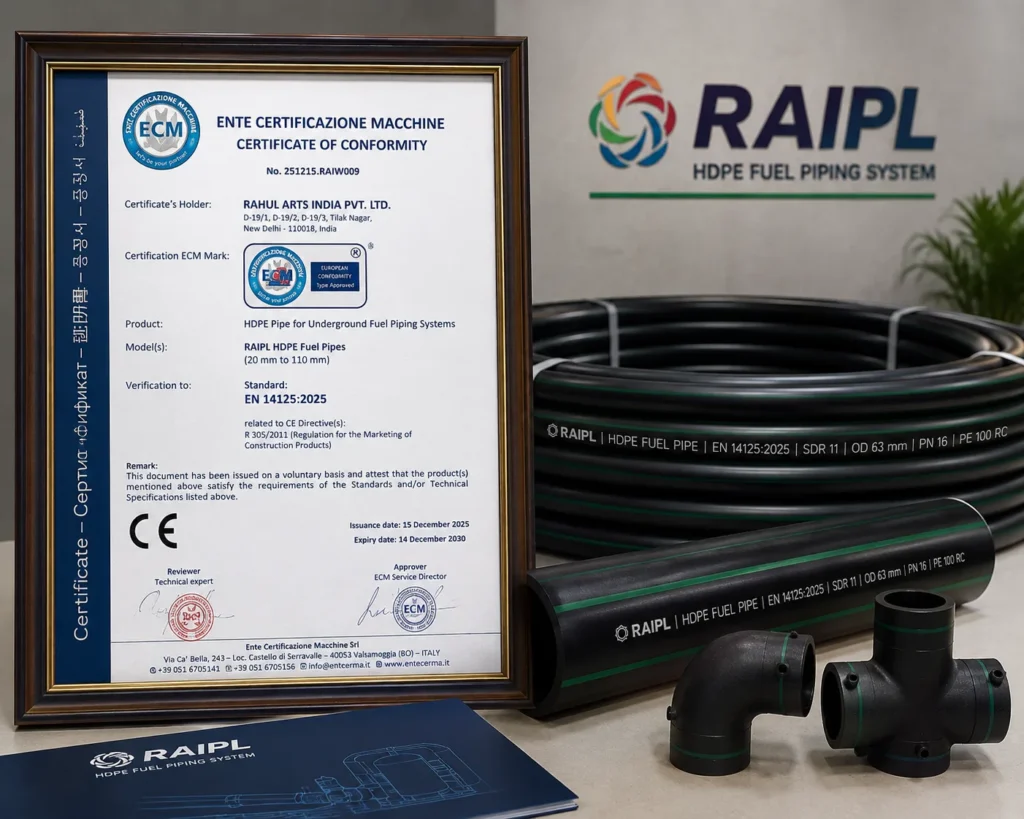
For thermoplastic and flexible metal pipework used in underground installations at petrol filling stations, EN 14125 is an important European standard.
For RAIPL, developing a specialized fuel piping system meant aligning the product with recognized technical requirements rather than treating local manufacturing as an alternative to certification.
RAIPL’s multilayer HDPE fuel piping system has achieved EN 14125:2025 certification.
This became an important milestone in the development journey.
Why the 2025 Edition Matters
Technical standards evolve over time.
That is why the edition of a standard is important.
The reference:
EN 14125:2025
identifies the 2025 edition.
For buyers, consultants and engineers, checking the exact standard edition is important when comparing technical documentation from different suppliers.
For RAIPL, aligning the product with the current edition was an important part of building a modern fuel-piping system.
Manufacturing Was Only One Part of the Challenge
Developing specialized petroleum infrastructure requires more than machinery.
A complete product ecosystem also needs:
- Technical documentation
- Product marking
- Batch traceability
- Fitting compatibility
- Installation procedures
- Quality control
- Testing records
- Technical support
This is why the journey has involved engineering, documentation and system development alongside manufacturing.
Why Installation Knowledge Matters
A high-quality pipe can still be compromised by poor installation.
Electrofusion requires disciplined preparation and execution.
Important steps can include:
Cut → Measure → Scrape → Clean → Insert → Align → Fuse → Cool → Inspect
RAIPL therefore views installer knowledge as part of the product ecosystem.
The long-term objective is not only to supply pipe but also to support correct field installation practices.
Reducing Import Dependence Through Indian Fuel Pipe Manufacturing
Imported products have played an important role in establishing specialized fuel piping in many markets.
RAIPL’s objective is not to argue that an imported product is automatically inferior.
The opportunity is different.
India should also be capable of manufacturing advanced fuel piping technology domestically.
This can help build:
- Local engineering capability
- Local manufacturing
- Faster technical communication
- Stronger supply chains
- Domestic component availability
- Future export potential
The goal is capability, not nationalism for its own sake.
Why Local Manufacturing Still Needs Global Technical Discipline
A locally manufactured product should not receive lower technical scrutiny.
In fact, a new domestic technology needs to earn market confidence.
That confidence comes from:
- Proper engineering
- Recognized standards
- Independent evaluation
- Consistent quality
- Transparent documentation
- Successful installations
- Responsive technical support
For RAIPL, Made in India means developing local capability without lowering the technical benchmark.
Product Marking and Traceability
As the system developed, product identification and traceability became another important focus.
The objective is to connect the finished product with relevant production information.
A traceability chain can include:
Raw Material → Production Batch → Pipe Marking → QC Record → Delivery → Project
For underground infrastructure, this is particularly valuable because the pipe becomes difficult to access after installation.
Batch identification and product marking become even more valuable after the pipe leaves the factory. Our guide to fuel pipe traceability explains how manufacturing, delivery, electrofusion joint and installation records can create a documented product lifecycle.
Building Confidence Through Real Installations
Any new infrastructure product needs field experience.
Technical documentation is important, but real-world installation also provides valuable feedback.
Each project can help improve understanding of:
- Site handling
- Pipe routing
- Electrofusion
- Fitting use
- Installation support
- Documentation
- Testing
This feedback helps strengthen the complete system over time.
The Goal Is Not One Product
RAIPL’s long-term vision is larger than selling metres of HDPE pipe.
The objective is to build a complete Indian petroleum piping ecosystem involving:
- Multilayer pipe
- Fittings
- Barrier technology
- Testing
- Certification
- Installation guidance
- Technical support
- Traceability
- Future product development
That ecosystem creates much more value than a single product line.
A Platform for Future Petroleum Infrastructure
Once advanced multilayer extrusion and specialized fuel-piping capability are established, the technical knowledge can support future innovation.
This can include further development in:
- New pipe sizes
- Updated fuel compatibility
- Advanced fittings
- Improved installation systems
- Technical monitoring
- Export-market adaptation
The current product is therefore also a platform for future engineering development.
The Role of Indian Manufacturing in the Next Phase
India’s petroleum infrastructure will continue to evolve.
The next phase should include not only building more infrastructure but also increasing the share of advanced technology manufactured domestically.
This means creating Indian capability in categories that were previously dominated by imported systems.
Fuel piping is one such opportunity.
The aim should be:
Indian engineering capability that can compete on technical merit.
RAIPL’s Vision as an Indian HDPE Fuel Pipe Manufacturer
RAIPL (Rahul Arts India Pvt. Ltd.) is working toward developing a complete Made-in-India underground fuel piping solution.
The system combines:
- Multilayer HDPE fuel pipe
- HDPE structural layers
- Specialized tie layers
- EVOH barrier technology
- Compatible fittings
- Electrofusion jointing
- Technical documentation
- Product traceability
- Installation guidance
- EN 14125:2025 certification
The journey is still about continuous improvement.
Every step—from manufacturing to testing to field installation—helps strengthen the technology and ecosystem.
From Make in India to Technology from India
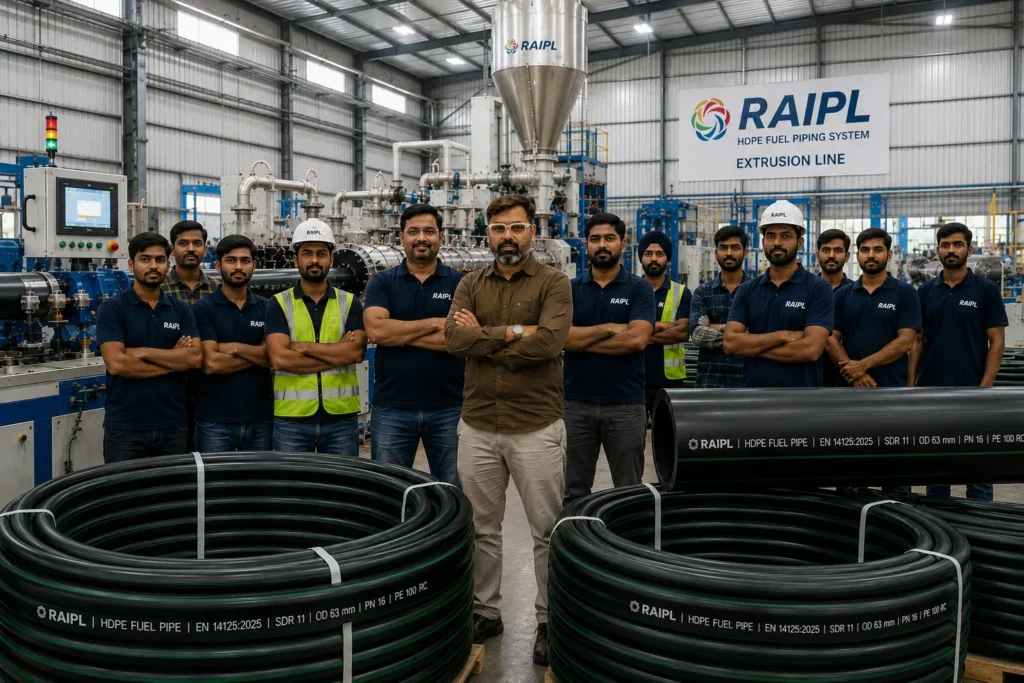
The long-term opportunity is not only to reduce dependence on imported fuel piping.
The larger ambition is to develop an Indian system that can eventually compete in international markets.
That journey follows a natural progression:
Learn the Technology
↓
Develop the Product
↓
Build Manufacturing Capability
↓
Test & Certify
↓
Install in India
↓
Build Market Confidence
↓
Expand Globally
The goal is to move from:
Made in India
to
Engineered in India
and eventually
Technology from India.
Frequently Asked Questions
Why did RAIPL enter HDPE fuel piping?
RAIPL identified an opportunity to develop specialized underground petroleum piping technology within India and reduce dependence on externally sourced systems.
Is RAIPL fuel pipe the same as conventional HDPE pipe?
No. The RAIPL system uses a specialized multilayer construction intended for underground petroleum applications.
What is inside the multilayer pipe?
The design uses HDPE structural layers, specialized tie layers and EVOH barrier technology as part of the engineered multilayer construction.
Does RAIPL also offer fittings?
The RAIPL system includes compatible fittings and transition components required to create an underground fuel piping network.
What certification does the system have?
RAIPL’s multilayer HDPE fuel piping system has achieved EN 14125:2025 certification.
Is RAIPL already exporting fuel piping systems?
RAIPL’s long-term vision includes international markets, but export capability and claims should always reflect actual current business status and target-market requirements.
Building Technology Takes More Than Building a Factory
A manufacturing machine can produce a pipe.
But building a specialized fuel piping technology requires much more:
Materials
Engineering
Manufacturing
Testing
Certification
Fittings
Installation
Documentation
Field Experience
Technical Support
RAIPL’s journey into multilayer HDPE fuel piping is about bringing these capabilities together into one Indian petroleum infrastructure ecosystem.
The ambition is simple:
Build it in India. Prove it through engineering. Use it in Indian infrastructure. And eventually take Indian fuel piping technology to the world.

One Response