
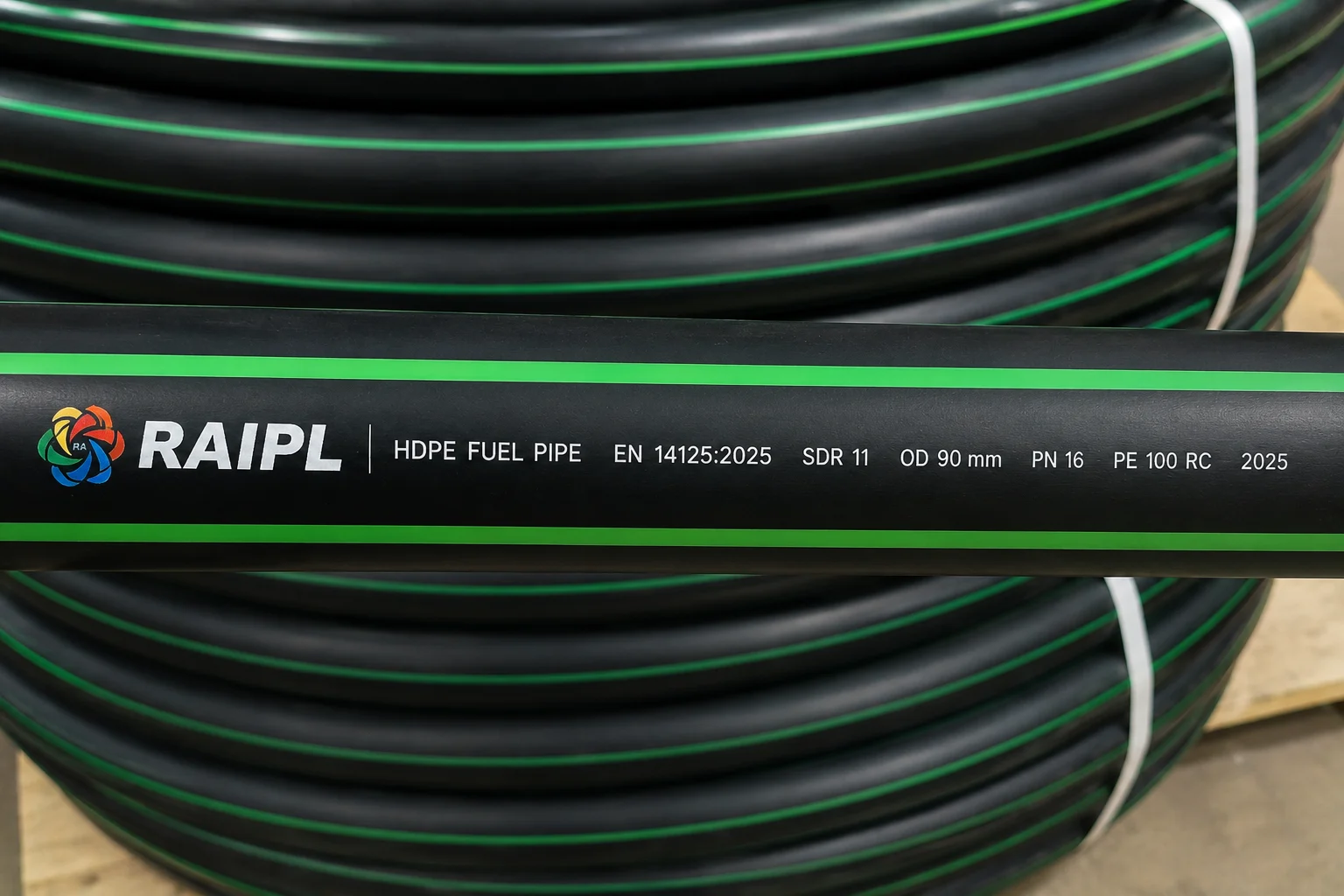
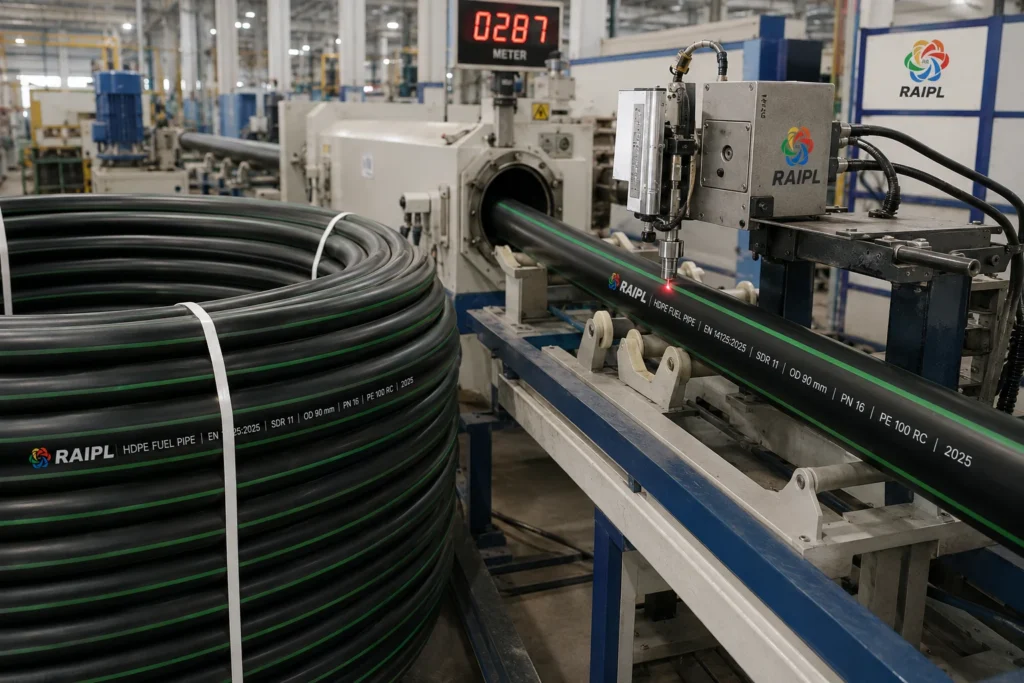
HDPE fuel pipe marking provides important information about the identity and manufacturing history of a pipe used in underground petroleum applications. Depending on the applicable product and marking system, the printed information can identify the manufacturer, product type, pipe size, technical standard, production batch and other manufacturing details.
Because underground fuel pipes become difficult to access after the petrol pump forecourt is completed, clear product identification can play an important role in quality control and traceability.
However, one distinction is important:
A marking printed on a pipe is an identification tool—it should not be treated as a substitute for the actual certificate, test report or approval document.
Why Pipe Markings Matter
An underground fuel pipe may look simple from the outside, but the information printed on the pipe can tell you a lot about the product.
For specialized petroleum infrastructure, pipe marking is not just branding.
It can help identify:
- Manufacturer
- Product type
- Pipe size
- Relevant standard
- Manufacturing information
- Batch or traceability details
- Other technical information required by the product specification
This information becomes especially important after installation because most of the piping will eventually be hidden underground.
That is why proper marking and traceability should be treated as part of the product’s quality system.
What Is Pipe Traceability?
Traceability means being able to connect a finished product back to relevant manufacturing and quality records.
For example, a pipe installed at a petrol pump may have identification that allows the manufacturer or project team to connect it with:
- Production batch
- Manufacturing date
- Raw material records
- Quality-control records
- Production-line information
- Applicable test documentation
The exact traceability system depends on the manufacturer and applicable product requirements.
The basic objective is simple:
Know what was manufactured, when it was manufactured and where it was installed.
Why HDPE Fuel Pipe Marking Matters?
Underground fuel piping is very different from equipment that remains visible.
Once the trench is backfilled and the petrol pump forecourt is completed, most of the pipe cannot be visually inspected without excavation.
Good traceability can therefore provide valuable information later.
For example, if a project needs to identify a particular pipe batch, clear marking and installation records can make that process much easier.
Traceability can support:
- Project documentation
- Quality investigations
- Product verification
- Maintenance records
- Future inspections
- Technical support
What Information Is Included in HDPE Fuel Pipe Marking?
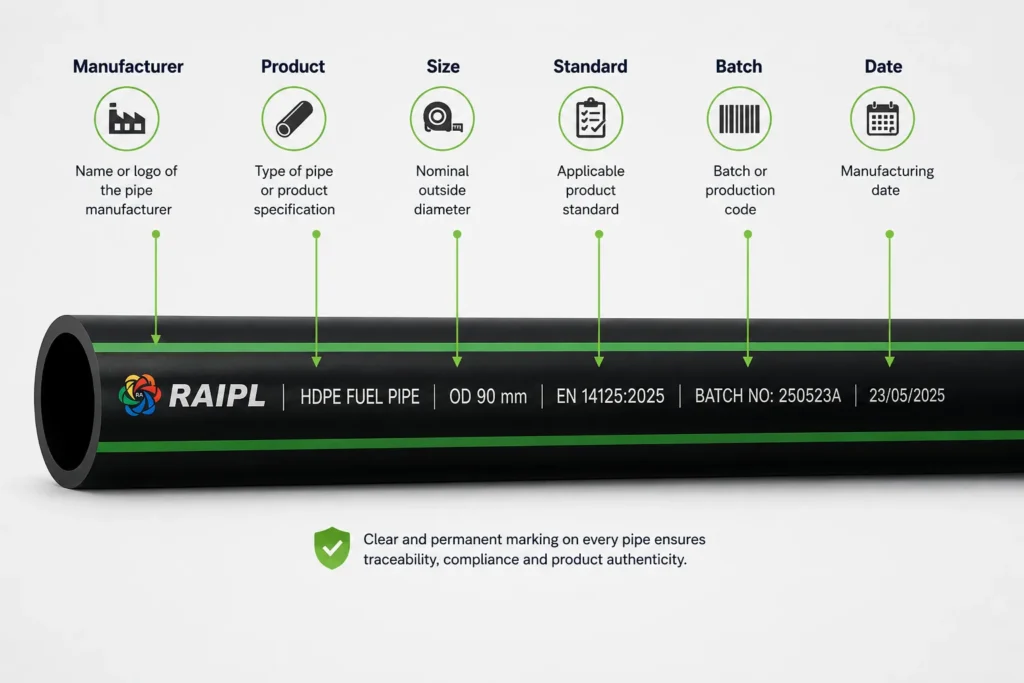
The exact information depends on the product, standard and manufacturer’s marking system.
Typical pipe markings can include several of the following elements.
1. Manufacturer Identification
The first thing a buyer should be able to identify is:
Who manufactured the pipe?
Manufacturer identification helps distinguish the product from other pipes that may be present on the same construction site.
This can be especially important on large projects where different types of HDPE pipes are being installed for different applications.
A water pipe, gas pipe and fuel pipe may all look similar at a distance.
Clear manufacturer and product identification helps reduce confusion.
2. Product Identification
The marking may identify the type or product family.
This is important because the word HDPE alone is not enough to describe the intended application.
A specialized fuel pipe should be identifiable as part of the relevant fuel piping system.
The product identification should correspond with the technical documentation supplied for the project.
3. HDPE Fuel Pipe Size
Pipe size is one of the most obvious pieces of technical information.
Depending on the piping system, the outside diameter may be indicated on the pipe.
For example, a project may specify different pipe sizes for different parts of the fuel piping network.
The installed size should always match the approved engineering design.
Never identify pipe size only by visual estimation.
4. Wall or Dimensional Information
Depending on the product and applicable requirements, markings may include additional dimensional information.
This can help installers and inspectors verify that the correct product has been supplied.
The exact information should correspond with the manufacturer’s technical data sheet.
5. Applicable Standard
One of the most important pieces of information can be the reference to the applicable standard.
For specialized thermoplastic underground fuel piping, EN 14125 is an important European standard.
Where applicable to the particular certified product and marking requirements, the standard reference helps connect the physical pipe with its technical documentation.
However, seeing a standard printed on a pipe should not replace reviewing the actual certificate and its scope.
The marking and documentation should support each other.
6. Fuel Pipe Standard and Edition
Technical standards are periodically updated.
Because of this, the edition or year referenced in technical documentation can matter.
For example:
EN 14125:2025
identifies the 2025 edition of the standard.
Buyers should understand which edition applies to the product they are evaluating.
7. Fuel Pipe Batch Number and Production Information
Batch identification is extremely useful for traceability.
A batch or lot code can help connect the finished pipe to a particular production run.
This can support access to information such as:
- Production date
- Material batch
- Quality checks
- Manufacturing records
The exact coding format depends on the manufacturer’s quality system.
8. Manufacturing Date or Production Information
Some marking systems can include information relating to the date or period of manufacture.
This provides another layer of traceability.
For project teams, this can help connect installed products with delivery records and manufacturing documentation.
9. Production-Line Information
Depending on the manufacturer’s system, markings can contain information that helps identify the production line or manufacturing source.
This can be useful for internal quality control and traceability.
Again, the exact format varies from manufacturer to manufacturer.
10. Additional Product Information
A manufacturer may include other technical or traceability information depending on the product and applicable requirements.
The key point is that all markings should be:
- Clear
- Relevant
- Consistent
- Traceable
- Supported by technical documentation
Marking should help identify the product rather than create confusion.
Marking Is Not the Same as Certification
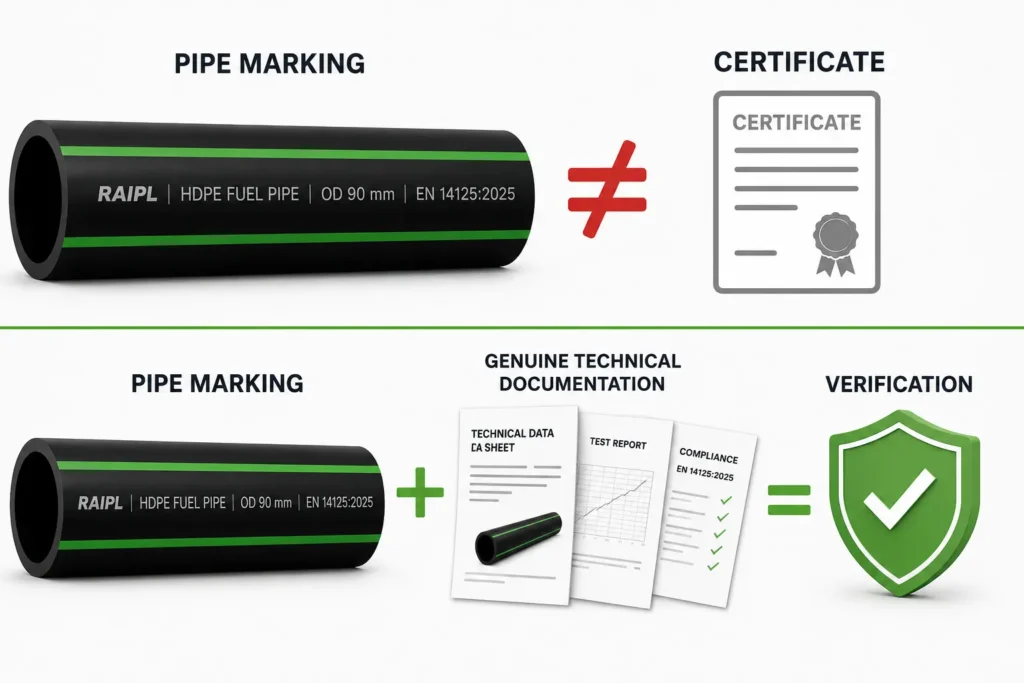
This distinction is extremely important.
Printing:
“EN 14125”
on a pipe does not, by itself, prove certification.
A manufacturer could physically print many things on a product.
Technical verification requires reviewing the actual supporting documentation.
A responsible buyer should therefore check both:
Physical Pipe Marking
and
Certificate / Technical Documentation
The two should correspond with each other.
What Should You Look for on a Fuel Pipe?
Depending on the manufacturer’s marking system and applicable requirements, information printed on an HDPE fuel pipe can include:
Manufacturing information – may include production date, line or other traceability information depending on the manufacturer’s system.
Manufacturer – identifies who produced the pipe.
Product identification – identifies the relevant pipe or piping system.
Pipe size – identifies the nominal product size.
Standard reference – where applicable, identifies the technical standard associated with the product.
Standard edition – helps distinguish between different editions of a technical standard where this information forms part of the marking.
Batch or lot number – connects the pipe with manufacturing and quality records.
Why Construction Sites Need Clear Identification
Petrol pump projects can contain many types of piping.
These may include systems for:
- Fuel
- Venting
- Water
- Drainage
- Gas
- Electrical ducting
Several of these products may be black polymer pipes.
Without clear identification, it becomes easier for materials to be confused.
Good marking provides a simple visual reference for installers, engineers and inspectors.
Should Colour Stripes Be Used to Identify a Pipe?
Colour stripes can help visually identify a product family or application according to the manufacturer’s system.
However, colour alone should never be treated as proof of technical suitability.
For example, a green stripe or another visual identifier can help distinguish a particular RAIPL product.
But buyers should still verify:
- Product marking
- Technical data
- Intended application
- Applicable certification
Colour is an identifier — not a substitute for documentation.
Why Marking Should Remain Legible
Pipe identification is only useful if it can actually be read.
Marking quality therefore matters.
Poor, incomplete or easily removed marking can reduce traceability.
The manufacturer’s process should aim to maintain clear identification through normal handling and installation conditions, subject to the applicable product requirements.
Traceability Does Not End at the Factory
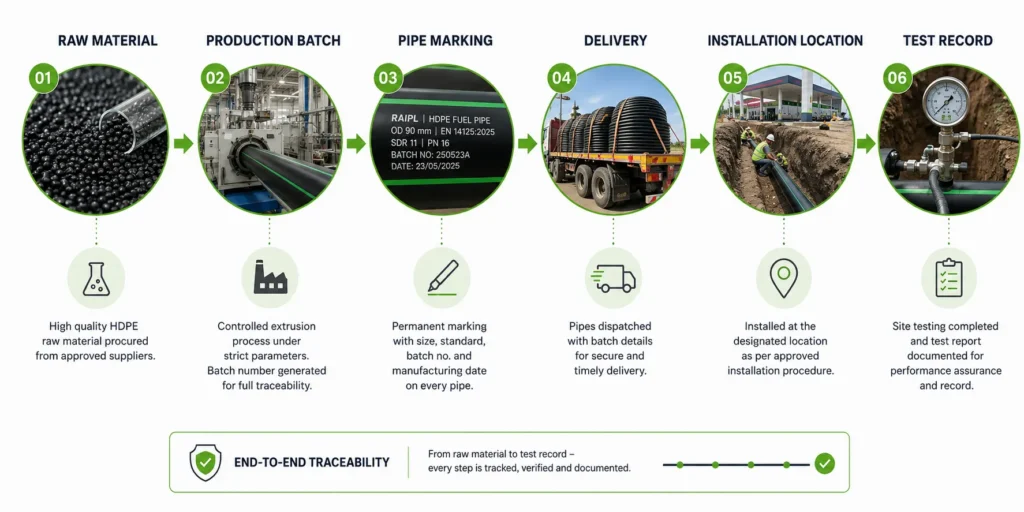
Factory traceability is only one side of the process.
Project teams can also maintain installation traceability.
For example:
Pipe Batch → Delivery → Site Location → Joint Records → Test Records
This creates a chain of information from production to installation.
Project records may include:
- Pipe batch
- Fitting batch
- Joint number
- Installation date
- Installer
- Location
- Test result
This can be extremely useful for larger petroleum infrastructure projects.
Fittings Should Also Be Traceable
The pipe is not the only component that matters.
Electrofusion and transition fittings form part of the underground network.
Depending on the product system, fittings may also include identification such as:
- Manufacturer
- Product type
- Size
- Batch information
- Fusion information
- Other relevant markings
This helps connect fittings with the broader piping-system documentation.
Fusion Records Can Add Another Layer of Traceability
For electrofusion installations, project records can also include information relating to the fusion process.
Depending on the equipment and system, records may capture information such as:
- Joint number
- Fitting
- Date
- Time
- Installer
- Fusion parameters
- Pipe location
The exact record format depends on the system and project requirements.
The goal is to create a documented installation rather than relying only on memory.
Traceability Helps Quality Control
Suppose a manufacturer identifies an issue relating to a particular production batch.
A strong traceability system can help determine:
Which products came from that batch?
Where were they supplied?
Which projects received them?
Without traceability, this process becomes much more difficult.
This is one of the reasons serious infrastructure manufacturers invest in batch identification and production records.
Traceability Also Protects Genuine Manufacturers
Product identification is not only useful for the customer.
It also helps genuine manufacturers distinguish their products from:
- Unverified alternatives
- Incorrectly substituted materials
- Unapproved products
- Products with incomplete documentation
Clear marking creates a stronger connection between the physical product and the manufacturer responsible for it.
What Should Buyers Ask the Supplier?
Before selecting a fuel piping system, buyers should ask:
How is the pipe marked?
What information is included?
How is each production batch identified?
Can the batch be linked to QC records?
Are fittings also identifiable?
What documentation is supplied with the project?
A professional supplier should be able to explain its traceability system clearly.
EN 14125 and Product Identification
For specialized thermoplastic underground fuel piping systems, technical documentation, product identification and conformity requirements work together.
EN 14125 is an important European standard relating to thermoplastic and flexible metal pipework for underground petrol filling station installations.
RAIPL’s multilayer HDPE fuel piping system has achieved EN 14125:2025 certification.
Where applicable, product marking and traceability support the connection between manufactured product, technical documentation and quality-control records.
RAIPL Fuel Pipe Marking & Traceability
RAIPL (Rahul Arts India Pvt. Ltd.) is developing a complete Made-in-India multilayer HDPE fuel piping system for specialized petroleum applications.
For RAIPL, product quality should not end at the extrusion line.
A complete quality approach includes:
- Controlled raw materials
- Multilayer manufacturing
- Product identification
- Batch traceability
- Quality records
- Compatible fittings
- Technical documentation
- Installation guidance
- Testing records
The objective is to make every supplied product identifiable and technically connected to the system it belongs to.
Frequently Asked Questions
Why is pipe marking important?
It helps identify the manufacturer, product, size and other information relevant to traceability and technical verification.
Does EN 14125 printed on a pipe prove certification?
No. Physical marking should correspond with genuine supporting certification and technical documentation. Printing a standard reference alone is not proof of certification.
What is a batch number?
A batch or lot number is an identifier that can help connect a finished product with a particular production run and relevant manufacturing records.
Should fittings also have identification?
Yes, suitable product and batch identification on fittings can improve system traceability.
Is colour stripe enough to identify a fuel pipe?
No. A colour stripe can be a useful visual identifier, but it should not replace product marking, technical documentation or verification of intended application.
Why is traceability useful after installation?
Because underground piping becomes difficult to access once buried. Records can help identify what product and components were installed at a specific location.
Read the Pipe Before You Install It
Before a fuel pipe is installed underground, take a few seconds to read what is actually printed on it.
Check the:
Manufacturer
Product
Size
Standard reference
Batch information
Traceability details
Because once the pipe goes underground, the information printed on it becomes part of the permanent technical history of the installation.
For specialized petroleum infrastructure, good marking is not decoration.
It is part of quality, verification and traceability.

2 Responses