
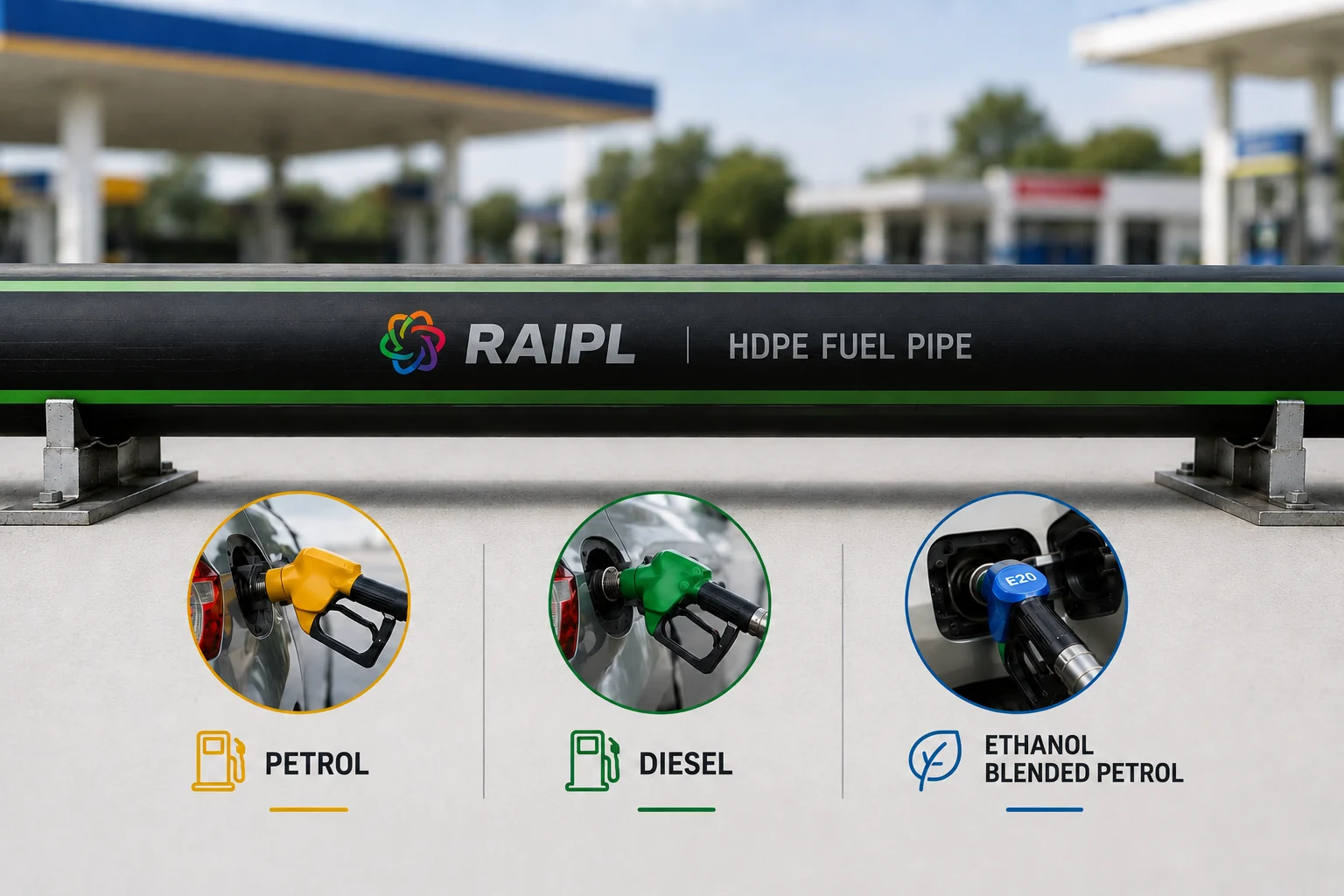
Why HDPE Fuel Pipe Compatibility Matters
HDPE fuel pipe compatibility is an important consideration when selecting an underground piping system for petrol, diesel and other automotive fuels.
Fuel piping is exposed to hydrocarbons continuously during service. The suitability of a piping system therefore depends on more than the basic HDPE material or its pressure rating. Pipe construction, barrier technology, fittings, seals, joints and documented testing can all form part of the overall compatibility assessment.
This becomes increasingly important as automotive fuel formulations evolve, including the use of ethanol-blended petrol.
Petrol and HDPE Fuel Pipe Compatibility
Petrol is a complex hydrocarbon fuel, and underground piping used for petrol service needs to be evaluated for the conditions associated with petroleum exposure.
A pipe may retain fuel without showing an obvious external leak while still requiring consideration of other characteristics such as permeation through the pipe wall.
For this reason, specialized fuel piping systems can use multilayer construction incorporating barrier technology rather than relying only on a conventional single-material HDPE wall.
Diesel and HDPE Fuel Pipe Compatibility
Diesel service also requires piping intended and evaluated for petroleum applications. The fact that a pipe is manufactured from HDPE should not by itself be considered evidence that the complete piping system is suitable for diesel service.
The relevant pipe construction, fittings, jointing system, test requirements and supporting documentation should be reviewed for the intended application.
Petrol and Diesel Are Chemically Different
Petrol and diesel are both petroleum-derived fuels, but their compositions and properties are different.
This means the interaction between the fuel and piping materials can also be different.
The piping system should therefore not be selected using a simple assumption such as:
“If it works with one fuel, it will automatically work with every fuel.”
The correct approach is to verify the intended fuel application and supporting technical documentation.
What Changes When Ethanol Is Added to Petrol?
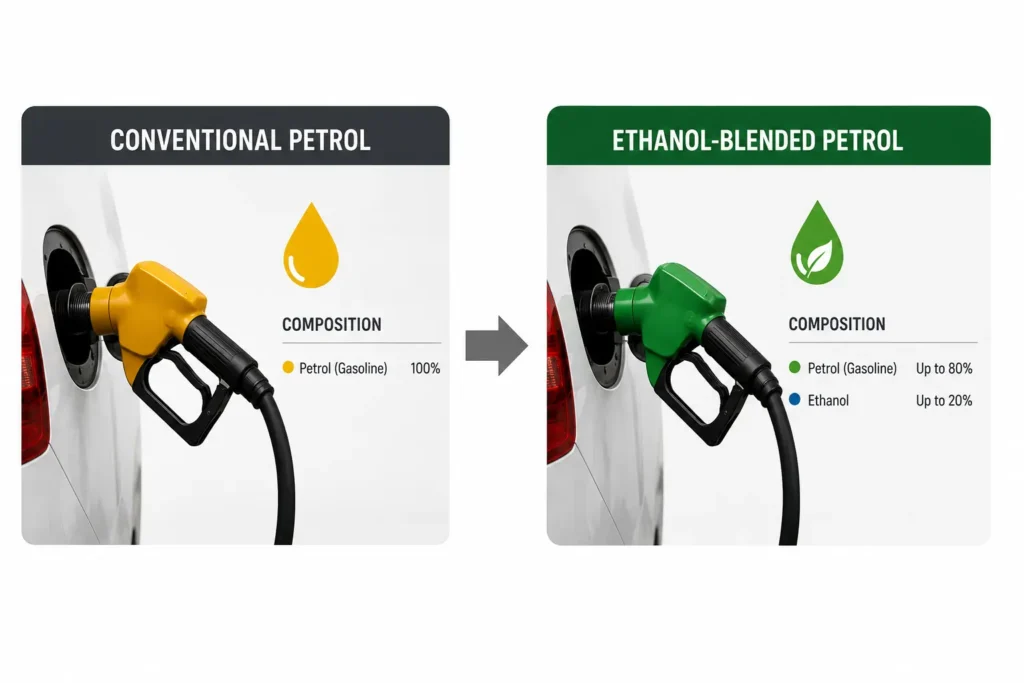
Ethanol blending changes the composition of petrol.
Ethanol has different chemical characteristics from conventional hydrocarbon fuel components.
As blending levels change, the piping system may experience a different chemical environment.
This makes material compatibility increasingly important.
The complete system should therefore consider:
- Pipe material
- Barrier layer
- Tie layers
- Fittings
- Sealing components
- Transition interfaces
- Other fuel-contact materials
Compatibility should be evaluated as a system, not only at the pipe level.
How Multilayer Barrier Technology Supports Fuel Piping
Specialized multilayer HDPE fuel pipes can incorporate a barrier layer within the pipe wall to provide additional resistance to hydrocarbon permeation.
One material used for this purpose is EVOH (ethylene vinyl alcohol). In a multilayer construction, EVOH can be positioned between structural HDPE layers with compatible tie layers helping bond the different polymers together.
A simplified multilayer construction can be represented as:
HDPE → Tie Layer → EVOH Barrier → Tie Layer → HDPE
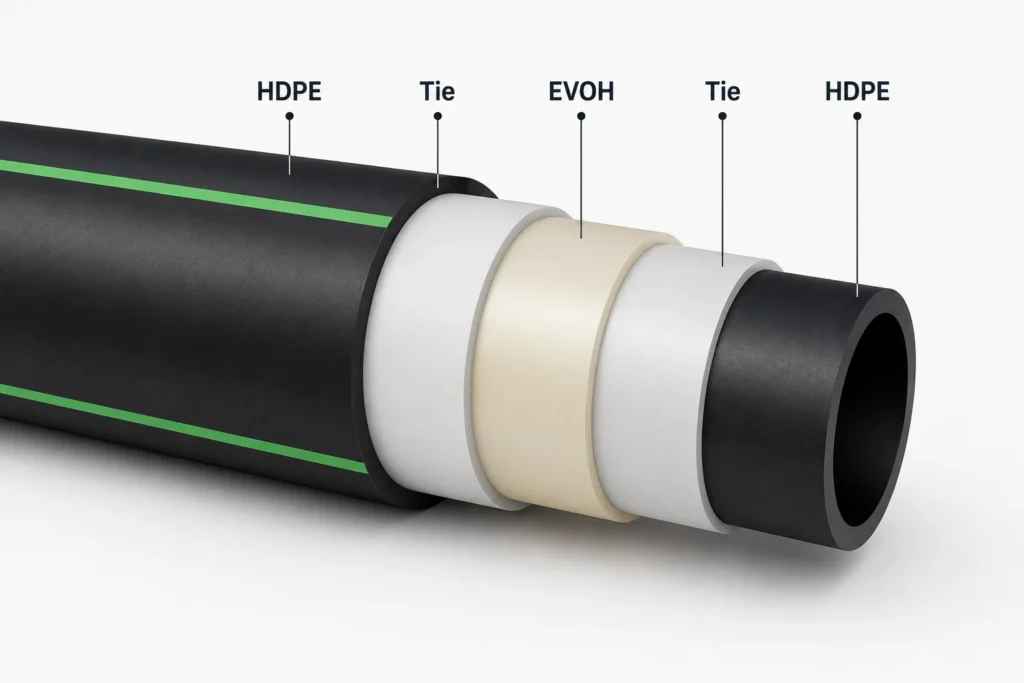
The performance of the finished pipe depends not only on the presence of these materials but also on appropriate material selection, layer consistency and manufacturing control.
Fuel Compatibility Is More Than Permeation
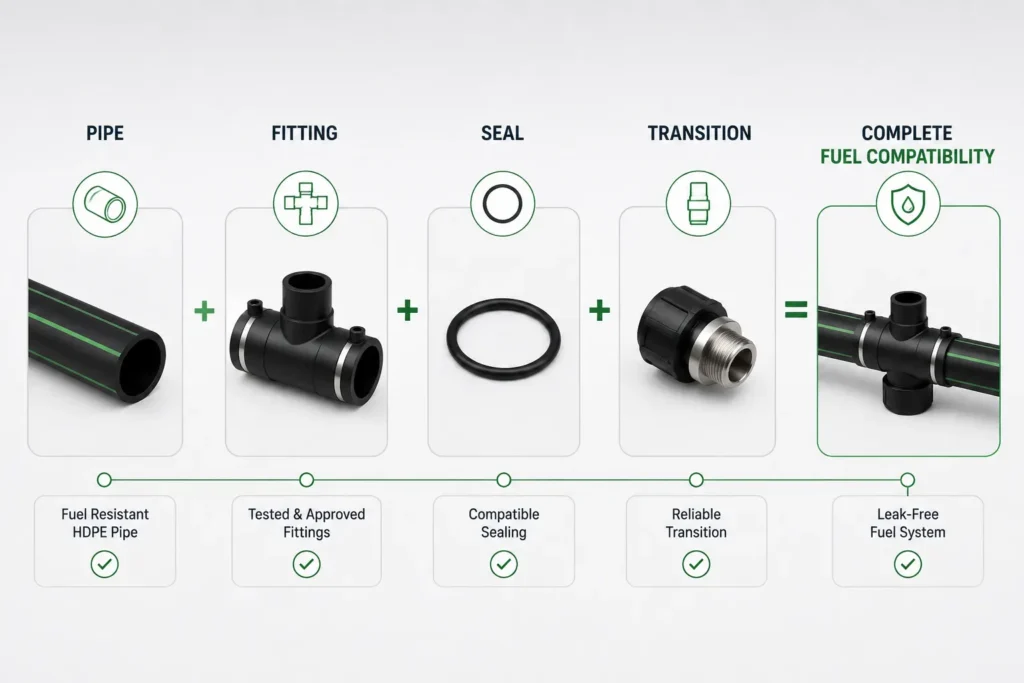
Permeation is important, but it is not the only factor.
A complete fuel piping system should also consider how fuels interact with:
- Pipe wall materials
- Fittings
- Seals
- Gaskets
- Transition components
- Joint interfaces
A pipe may perform well while another system component becomes the weak point.
That is why fuel compatibility needs to be considered across the full piping system.
Fuel Compatibility Includes Fittings and Joints
A fuel piping system is more than a straight length of pipe.
Depending on the installation, the underground network can include:
- Electrofusion couplers
- 45° elbows
- 90° elbows
- Tees
- Transition fittings
- Flange connections
- Sealing components
- Equipment interfaces
Compatibility therefore needs to be considered across the complete fuel path. A technically suitable pipe should be combined with fittings and joining components intended for the same piping system and application.
Changing Fuel Formulations Increase the Importance of Testing
Fuel formulations evolve over time.
Environmental targets, emissions policies and energy strategies can lead to changes in fuel composition.
As this happens, infrastructure materials need to keep pace.
That includes:
- Storage systems
- Fuel piping
- Dispenser components
- Seals
- Flexible connectors
- Other fuel-contact materials
For piping manufacturers, this means that compatibility should be supported by technical evaluation rather than assumptions based on past fuel formulations.
How Should Buyers Verify Fuel Compatibility?
Before selecting an underground fuel piping system, buyers and consultants should review the available technical documentation rather than relying only on marketing statements.
Important questions include:
- What fuels are covered by the applicable test or certification documentation?
- Which pipe construction was tested?
- Which pipe sizes or configurations are included within the documented scope?
- Are the relevant fittings and joining components covered or otherwise documented for the intended system?
- Which technical standard and edition applies?
- Are there limitations or conditions stated in the documentation?
- Does the documentation correspond to the actual product being supplied?
Where a project specifies a particular fuel formulation, its compatibility should be confirmed from the relevant technical documentation.
Fuel Compatibility and EN 14125
For thermoplastic and flexible metal pipework used in underground petrol filling station installations, EN 14125 is an important European standard.
The standard includes requirements relevant to specialized fuel piping systems.
RAIPL’s multilayer HDPE fuel piping system has achieved EN 14125:2025 certification.
This supports the company’s objective of developing specialized underground fuel piping technology in India.
However, every project should still verify the exact fuel application and certification scope relevant to that installation.
Why the Complete System Must Be Evaluated
A fuel piping network operates as one connected system.
Think of it as:
Pipe + Fittings + Seals + Transitions + Installation
If one component is not suitable for the intended fuel, the performance of the full system can be affected.
That is why a technically responsible supplier should not simply say:
“Our pipe is HDPE, so it is fuel compatible.”
The more important question is:
“Has the complete piping system been designed and evaluated for the intended petroleum application?”
RAIPL Multilayer HDPE Fuel Piping System
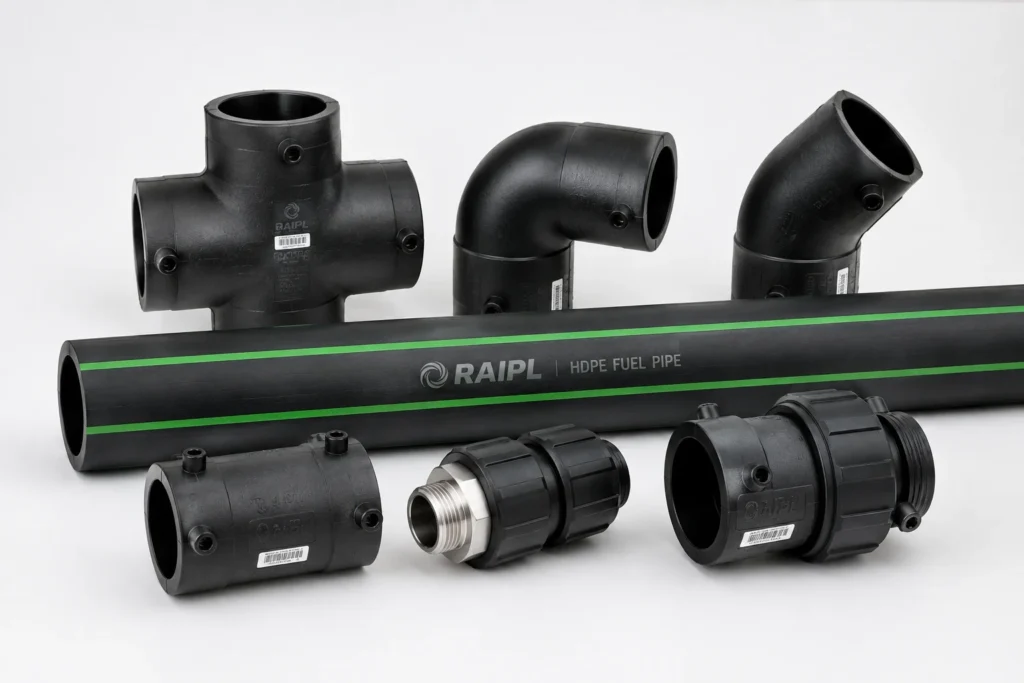
RAIPL (Rahul Arts India Pvt. Ltd.) has developed a specialized multilayer HDPE fuel piping system for underground petroleum applications.
The pipe construction combines structural HDPE, specialized tie layers and EVOH barrier technology.
The broader system includes compatible fittings and transition components required to create an integrated underground fuel network.
RAIPL’s focus is on developing a complete Made-in-India petroleum piping ecosystem rather than simply manufacturing a conventional HDPE pipe.
Why This Matters for India’s Fuel Infrastructure
India’s fuel-retail infrastructure continues to evolve.
As fuel formulations change, infrastructure also needs to adapt.
This creates a need for:
- Application-specific materials
- Updated technical standards
- Reliable testing
- Better documentation
- Compatible system components
- Strong local manufacturing capability
Developing these technologies within India can help reduce dependence on imported petroleum infrastructure while building local technical expertise.
Frequently Asked Questions
Can one fuel pipe automatically carry petrol, diesel and ethanol-blended petrol?
Not necessarily. The system’s intended fuel application and supporting technical documentation should be verified.
Why does ethanol blending matter?
Ethanol changes the chemical composition of petrol, which can affect how materials within the fuel system interact with the fuel.
Is HDPE alone enough for fuel piping?
HDPE provides important structural characteristics, but specialized fuel piping may require additional barrier technology and system-specific evaluation.
Why is EVOH used?
EVOH can provide a specialized barrier function within multilayer piping systems and offers additional resistance against hydrocarbon permeation.
Do fittings also need to be fuel compatible?
Yes. The complete system, including fittings, seals and transitions, should be suitable for the intended fuel application.
Does EN 14125 certification mean compatibility with every possible fuel blend?
The exact certification scope and technical documentation should be reviewed. Compatibility should not be assumed beyond what has been evaluated and documented.
Fuel Technology Changes — Infrastructure Must Keep Up
Petrol pump infrastructure is expected to operate for many years.
During that time, fuel formulations can evolve.
That makes material compatibility an important part of future-ready petroleum infrastructure.
The right approach is not to assume.
It is to design, test, document and verify.
RAIPL’s goal is to support that approach through specialized multilayer HDPE fuel piping technology developed for modern underground petroleum applications.

3 Responses