
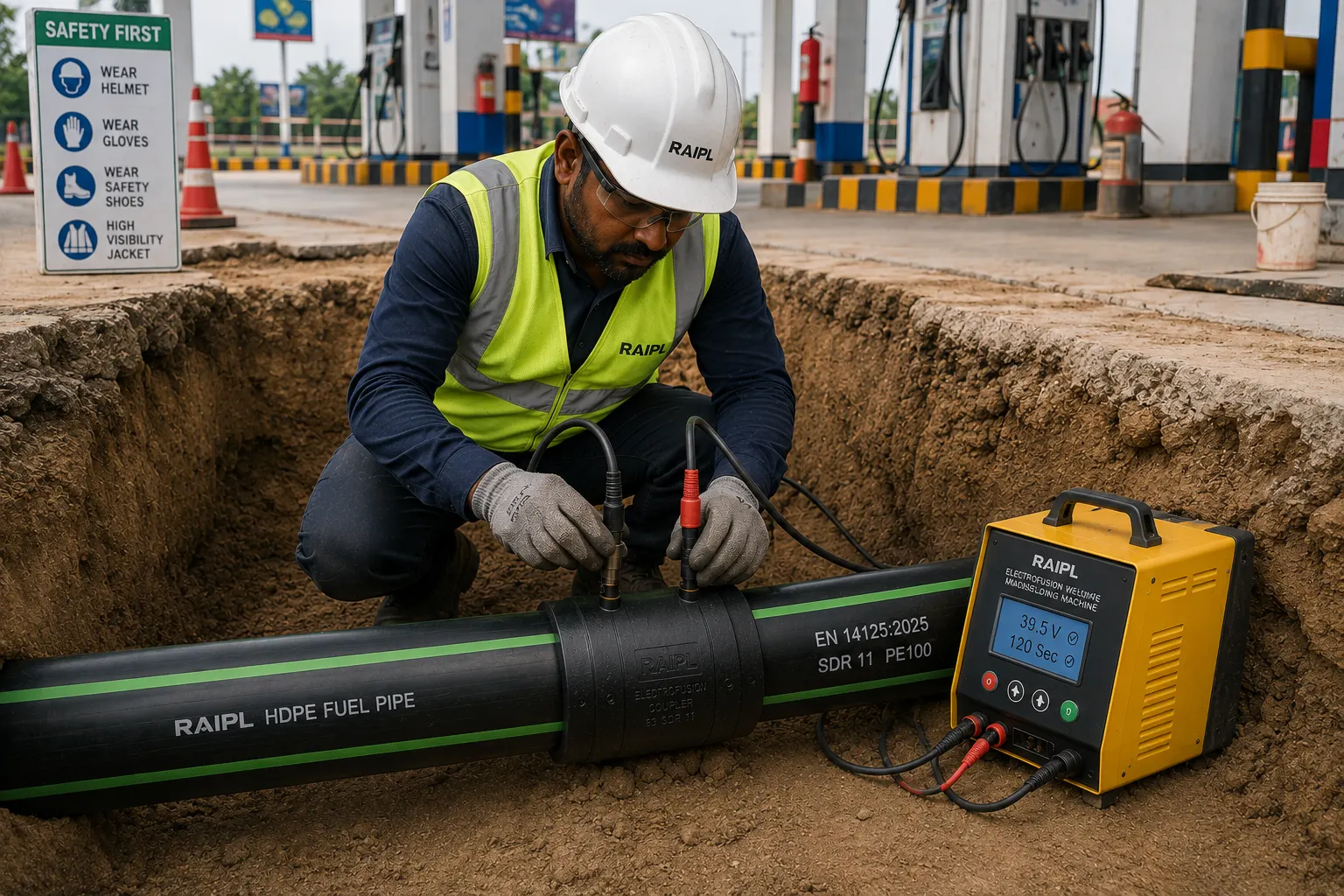
Why Correct Fuel Pipe Installation Matters
HDPE fuel pipe installation requires more than placing pipe inside a trench and connecting it between an underground storage tank and dispenser. The performance of an underground fuel piping system can also depend on pipe preparation, cleanliness, fitting compatibility, electrofusion procedure, alignment, cooling, inspection and testing.
Even a technically suitable multilayer fuel pipe can be compromised by poor installation practices.
This guide explains 10 common installation mistakes at petrol pumps and the practical principles that can help avoid them.
Mistake #1: Treating Fuel Pipe Like Ordinary HDPE Water Pipe
One of the most basic mistakes is assuming that experience with conventional HDPE water piping automatically covers specialized petroleum piping.
Multilayer HDPE fuel pipe can incorporate different materials, barrier technology and system-specific fittings intended for underground petroleum applications.
Installers should therefore follow the installation procedure applicable to the actual fuel piping system being supplied rather than transferring assumptions from unrelated HDPE applications.
Better Practice
Before installation begins, review the manufacturer’s installation instructions, fitting requirements and approved project drawings.
Mistake #2: Incorrect Pipe Cutting
A good electrofusion joint starts with correctly prepared pipe ends.
A poor or irregular cut can make correct insertion and alignment more difficult.
The pipe should be cut using an appropriate tool and according to the system manufacturer’s instructions.
The objective is to create a properly prepared pipe end without unnecessary damage to the pipe.
Better Practice
Use suitable pipe-cutting equipment and inspect the pipe end before beginning joint preparation.
Mistake #3: Inadequate Scraping Before Electrofusion
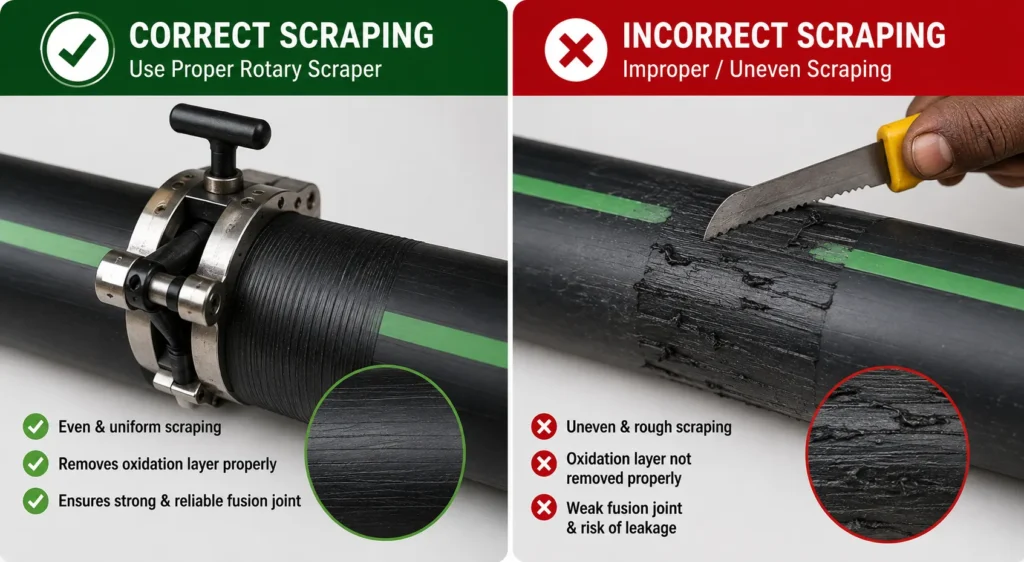
Electrofusion joint preparation generally requires the pipe surface to be prepared according to the applicable fitting and installation procedure.
Skipping the required scraping step, preparing an insufficient area or using an unsuitable technique can affect the jointing process.
The required preparation area and method should follow the instructions for the actual piping and electrofusion system being installed.
Problems can occur when installers:
- Skip scraping completely
- Scrape only part of the fusion area
- Scrape unevenly
- Use an unsuitable tool
- Remove excessive material
- Damage the pipe surface
Better Practice
Use the appropriate scraping tool and prepare the complete fusion area according to the fitting manufacturer’s instructions.
Scraping is a controlled preparation process — not random surface cutting.
Mistake #4: Contaminating the Prepared Joint Surface
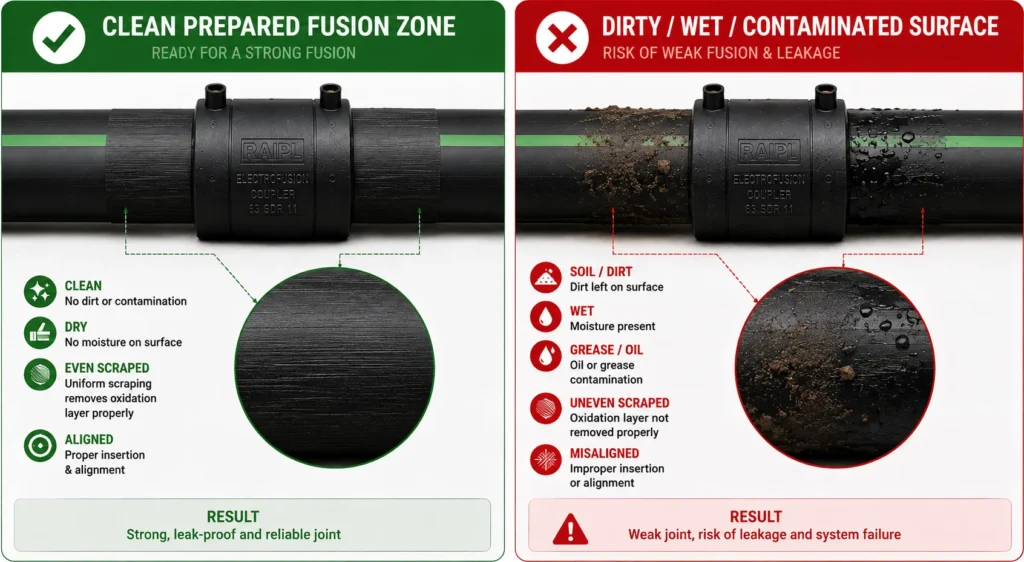
After preparation, the jointing area needs to remain protected from contamination.
Dirt, grease, moisture or unnecessary handling of the prepared surfaces can interfere with the quality of an electrofusion joint.
Installers should use the cleaning procedure and materials specified for the piping system and avoid touching prepared fusion surfaces unnecessarily.
Possible contaminants include:
- Soil
- Dust
- Oil
- Grease
- Moisture
- Dirty gloves
- Construction debris
Petrol pump construction sites can be dusty, making cleanliness particularly important.
Better Practice
Keep prepared surfaces protected and follow the manufacturer’s cleaning and handling procedure.
Once the fusion surface has been correctly prepared, avoid unnecessary contact with it.
Mistake #5: Incorrect Pipe Insertion into the Fitting
The pipe should be inserted into the electrofusion fitting to the required position according to the fitting and installation procedure.
Insufficient insertion or movement away from the intended position can affect alignment and the fusion interface.
Marking the required insertion position before assembly can help installers verify that the pipe remains correctly positioned during joint preparation and fusion.
Better Practice
Measure and mark the required insertion depth before assembly according to the fitting instructions.
After inserting the pipe, verify that the position corresponds with the marking.
Mistake #6: Poor Pipe and Fitting Alignment
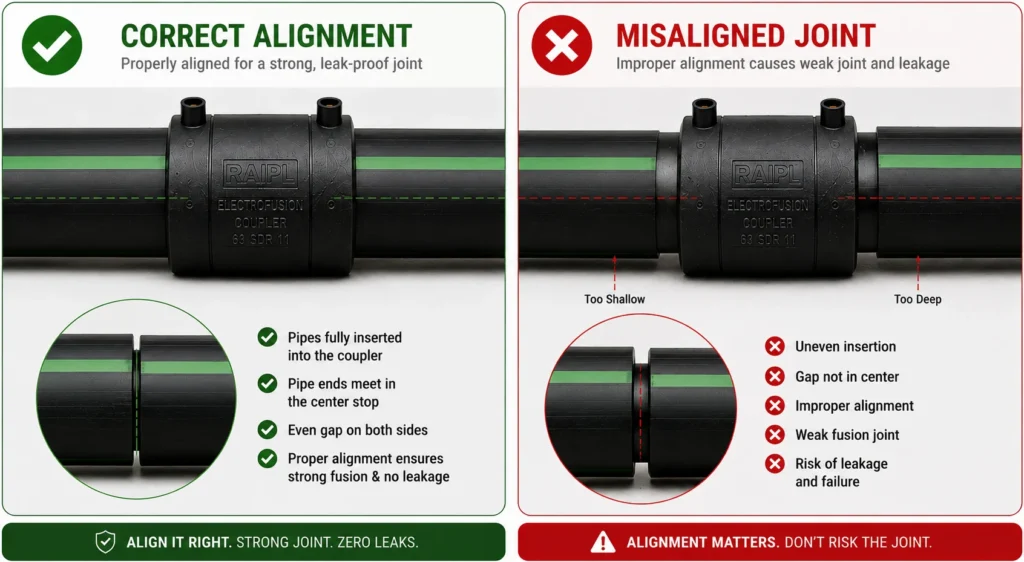
Electrofusion components should not be used to force badly aligned pipe runs into position.
Unnecessary stress at the connection can affect the joint and surrounding pipework.
The pipe route should be prepared and supported so that the components can be assembled in the intended position without excessive mechanical loading on the joint.
This can happen when:
- The pipe route is poorly prepared
- The fitting is forced into position
- The pipe is pulling sideways
- Appropriate alignment equipment is not used where required
Better Practice
Position and align the pipe correctly before beginning fusion.
Use suitable alignment/clamping equipment where required by the installation procedure.
Do not use the electrofusion fitting to force a badly routed pipe into position.
Mistake #7: Forcing the Pipe Beyond Its Permitted Bend
HDPE piping provides useful routing flexibility, but flexibility does not mean the pipe can be bent without limits.
The applicable minimum bend radius and installation requirements should be checked for the actual pipe configuration, size and operating conditions.
Where the required route cannot be achieved within the permitted bending limits, an appropriate fitting or route adjustment should be considered.
Excessive bending can place stress on:
- The pipe
- Fittings
- Joints
- Transition points
Sharp bends should never be created simply to avoid using the correct fitting.
Better Practice
Follow the minimum bend radius and routing requirements specified for the piping system.
Where the design requires a significant directional change, use the appropriate 45° or 90° fitting.
Mistake #8: Using Incorrect Electrofusion Parameters or Procedure
Electrofusion should follow the requirements of the compatible fitting and fusion equipment being used.
Installers should not guess fusion parameters or assume that settings from an unrelated fitting can automatically be applied.
Where the system uses barcodes, fitting data or specified fusion parameters, the applicable procedure should be followed and the joint information recorded where required.
Better Practice
Use compatible electrofusion equipment and follow the fitting manufacturer’s specified procedure.
Where the fitting/system provides machine-readable fusion information, use it according to the manufacturer’s instructions.
Never manually guess the fusion time or electrical parameters.
Mistake #9: Moving the Joint Before the Required Cooling Period
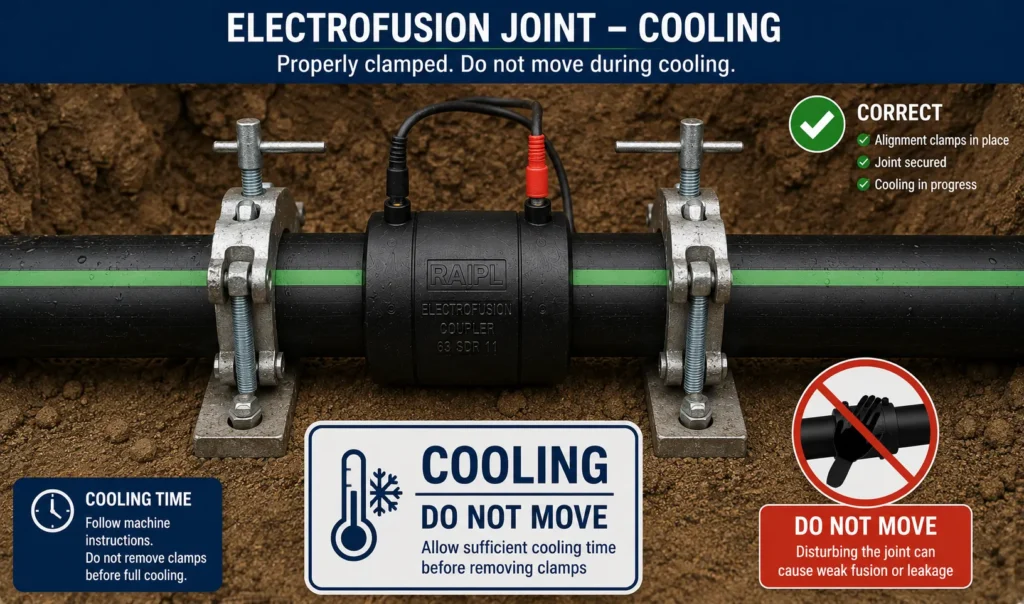
Completing the fusion cycle does not necessarily mean the joint should immediately be moved, loaded or disturbed.
The joint should remain appropriately supported for the cooling period specified by the applicable fitting or installation procedure.
Premature movement can place unnecessary stress on a connection before the jointing process is complete.
Better Practice
Respect the specified cooling time.
Keep the pipe and fitting properly positioned and undisturbed until the required cooling period has passed.
Cooling is part of electrofusion, not an optional waiting period.
Mistake #10: Backfilling Before Inspection and Required Testing
Closing the trench too early can make subsequent inspection, testing or corrective work considerably more difficult.
Where the installation and project procedure requires inspection or testing before final backfilling, these activities should be completed and documented while the relevant pipework and connections remain accessible.
Testing should therefore form part of the planned installation sequence rather than being treated as a final afterthought.
The installed system should undergo the inspections and testing required by the:
- Piping-system manufacturer
- Project specification
- Engineering consultant
- Petroleum company
- Applicable regulations
Better Practice
Complete the required inspection, testing and documentation before final closure of the trench.
Do not hide a joint underground before the required checks have been completed.
Bonus Mistake: Poor Trench Preparation
Even perfectly fused pipe and fittings can be affected by poor installation conditions.
The trench is part of the underground system.
Important considerations can include:
- Correct bedding
- Appropriate support
- Removal of sharp objects
- Required separation from other underground services
- Correct routing
- Appropriate backfill
- Required compaction
- Protection around fittings and connections
The exact requirements should follow the approved engineering design and manufacturer’s installation instructions.
Bonus Mistake: Mixing Unverified Pipe and Fittings
A 63 mm fitting is not automatically compatible with every 63 mm pipe.
Similarly, a component being made from HDPE does not automatically establish that it is suitable for petroleum service.
Before combining components, verify:
- Dimensions
- Material compatibility
- Intended application
- Jointing requirements
- Manufacturer recommendations
- Certification/system requirements
A fuel piping system should be treated as an engineered network, not a collection of independently purchased components.
The Correct Electrofusion Process
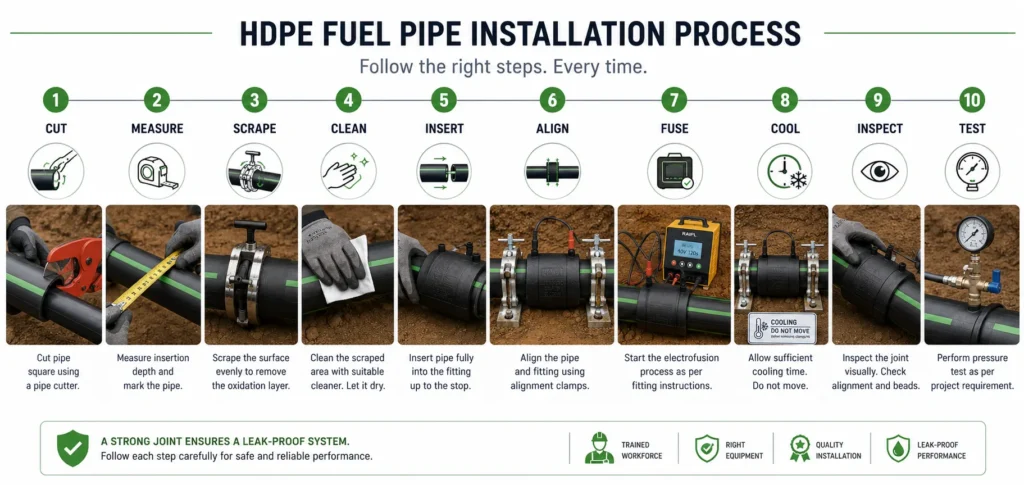
A simplified installation workflow can be represented as:
1. CUT
Prepare the pipe end correctly.
2. MEASURE
Identify and mark the required insertion/fusion area.
3. SCRAPE
Prepare the specified pipe surface using the correct tool.
4. CLEAN
Keep the fusion area free from contamination according to the specified procedure.
5. INSERT
Position the pipe correctly inside the fitting.
6. ALIGN
Secure the components in the correct position.
7. FUSE
Use compatible equipment and the specified fusion parameters.
8. COOL
Keep the joint undisturbed for the required cooling period.
9. INSPECT
Check the completed connection according to the applicable procedure.
10. TEST
Complete the project/system-required testing before final closure.
Each stage should follow the applicable manufacturer’s installation procedure and project requirements.
Skipping or rushing an individual step can affect the quality of the completed underground fuel piping system.
Why Proper Scraping Tools Matter
Installers should use tools intended for controlled pipe preparation.
Improvised methods can create:
- Uneven scraping
- Incomplete preparation
- Excessive material removal
- Surface damage
A proper rotary or approved manual scraping tool can help create more consistent preparation when used according to the system requirements.
Installation tools are not minor accessories.
They are part of achieving a repeatable jointing process.
Why Installation Records Are Useful
Modern infrastructure projects increasingly emphasize traceability.
For underground fuel piping, installation documentation can include information such as:
- Pipe identification/batch
- Fitting identification
- Joint location
- Date of installation
- Installer information
- Fusion records where applicable
- Inspection records
- Test records
Once the piping is underground, these records can provide useful information about what was installed and how the work was completed.
Installation Quality vs Product Quality
Consider two installations.
Site A
Uses a high-quality certified pipe but poor preparation, contaminated joints and incorrect fusion procedures.
Site B
Uses a properly specified piping system installed by trained personnel following controlled procedures.
The difference demonstrates an important principle:
Certification cannot compensate for poor workmanship.
Product quality and installation quality need to work together.
The ideal approach is:
Certified System + Compatible Fittings + Correct Tools + Trained Installer + Proper Testing
Why Installer Training Is Important
Electrofusion equipment can look simple.
Connect the machine, enter or scan the parameters and start the cycle.
But reliable installation requires understanding what happens before and after the machine is switched on.
Installers need to understand:
- Product handling
- Cutting
- Scraping
- Cleaning
- Alignment
- Fusion
- Cooling
- Inspection
- Trench requirements
- Safety
- Documentation
For specialized petroleum piping, trained installation personnel are an important part of the complete system.
EN 14125 and Correct Installation
A product manufactured and evaluated according to an applicable fuel piping standard still needs to be installed correctly.
For underground thermoplastic fuel piping at petrol filling stations, EN 14125 is an important European standard.
RAIPL’s multilayer HDPE fuel piping system has achieved EN 14125:2025 certification.
However, certification should never be interpreted as permission to ignore installation procedures.
The final installed system depends on both:
Product Performance + Installation Quality
RAIPL — More Than Manufacturing a Fuel Pipe
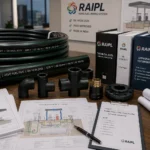
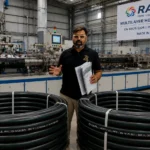
RAIPL (Rahul Arts India Pvt. Ltd.) is developing a complete Made-in-India multilayer HDPE fuel piping ecosystem.
The RAIPL system includes:
- Multilayer HDPE fuel pipe
- Electrofusion couplers
- 90° elbows
- 45° elbows
- Tees
- Transition fittings
- Flange connection components
- Technical documentation
- Installation guidance
The objective is not simply to deliver pipe to a construction site.
It is to support the development of a properly engineered underground fuel piping system.
Frequently Asked Questions
Is scraping necessary before electrofusion?
Where required by the specific piping/fitting system, the designated fusion area needs to be properly prepared using the prescribed scraping procedure.
Can sandpaper be used instead of a pipe scraper?
Installers should use the tools and preparation method specified by the piping/fitting manufacturer rather than substituting improvised methods.
Can I touch the pipe after scraping?
Prepared fusion surfaces should be protected from contamination and handled according to the manufacturer’s procedure.
Can HDPE fuel pipe be bent?
HDPE provides flexibility, but the minimum permitted bend radius and system-specific requirements need to be followed. Significant directional changes may require appropriate elbows.
Can the electrofusion joint be moved after the machine stops?
The connection should remain undisturbed for the specified cooling period.
Should the pipeline be tested before backfilling?
Required inspections and testing should be completed according to the piping-system, project and regulatory requirements before final closure.
Can any same-size electrofusion fitting be used?
Compatibility should not be assumed based only on nominal diameter. The complete piping-system requirements should be verified.
Install It Right Before It Goes Underground
A fuel pipe may remain underground for years.
The best time to identify an installation problem is therefore before the trench is closed — not after the petrol pump is operating.
Good installation comes from discipline:
Prepare correctly.
Keep it clean.
Align correctly.
Fuse correctly.
Allow it to cool.
Inspect and test before backfilling.
RAIPL’s goal is not only to manufacture advanced multilayer HDPE fuel piping in India, but also to promote the correct installation practices required to build reliable underground petroleum infrastructure.

One Response