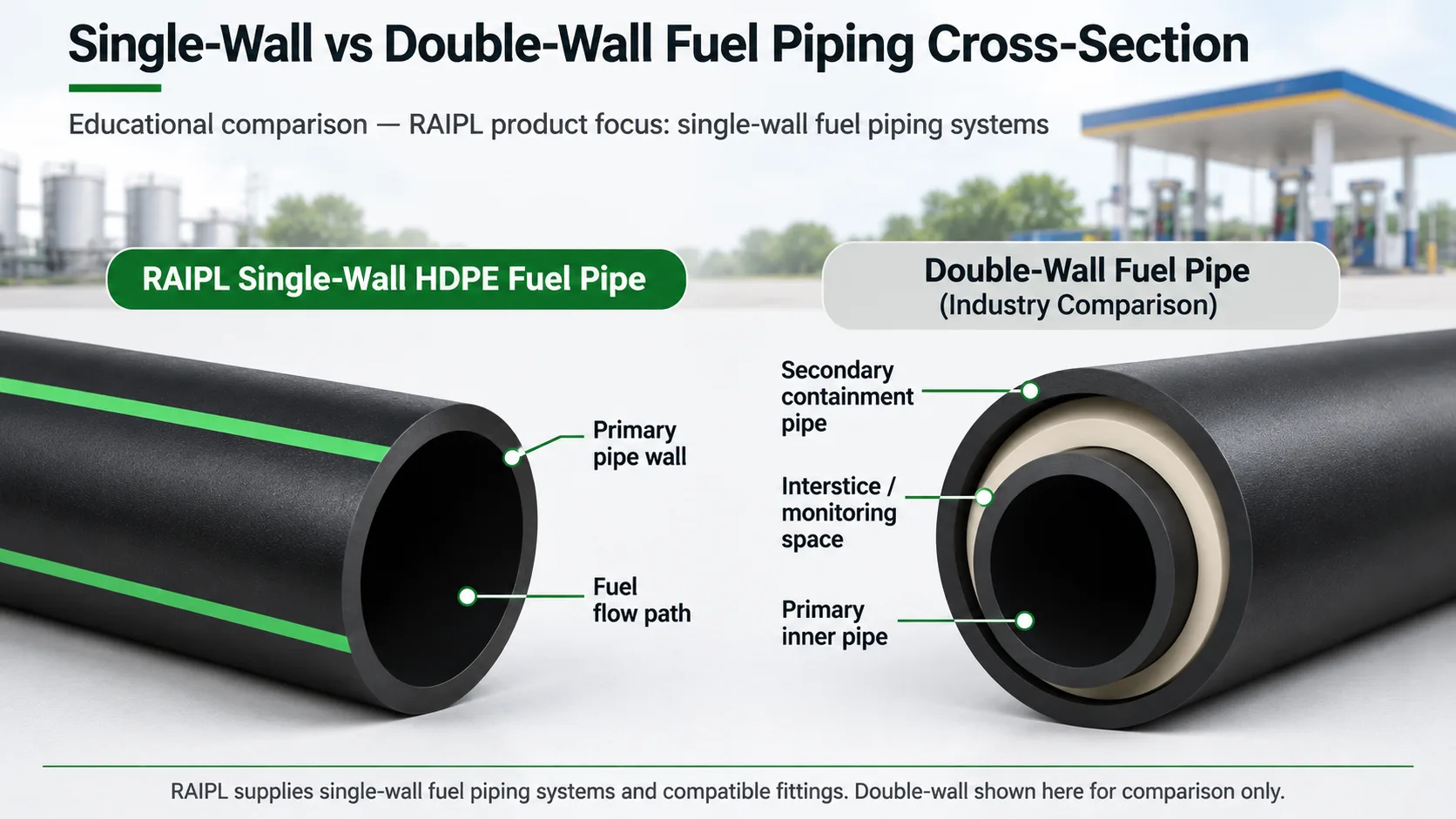
Single wall vs double wall fuel piping is an important distinction when selecting underground piping systems for petrol pumps. A supplier may describe a fuel pipe as “five-layer” or “multilayer,” while another quotation specifies “double-wall piping.” Although these terms sound similar, they don’t describe the same thing.
A multilayer fuel pipe can contain several bonded materials within one pipe wall. Double-wall piping, on the other hand, provides a separate secondary containment barrier around the primary fuel-carrying pipe.
Understanding this difference matters when comparing technical specifications, reviewing supplier quotations or checking whether the proposed piping arrangement meets the approved project requirements.
Single Wall vs Double Wall Fuel Piping: What’s the Difference?
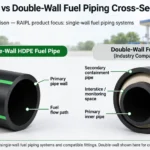
A single-wall fuel pipe has one primary pipe wall containing the fuel. There is no separate secondary-containment wall within that pipe assembly.
Double-wall fuel piping adds a surrounding containment barrier. The space between the primary and secondary barriers is called the interstitial space. In a monitored secondary-containment system, that space is used to help detect leakage. Aliaxis
The important distinction is therefore not whether a pipe has one material or several. It is whether the assembly includes a second containment boundary around the primary fuel path.
| Point of comparison | Single-wall fuel piping | Double-wall fuel piping |
|---|---|---|
| Primary fuel path | Fuel travels through the primary pipe. | Fuel travels through the inner primary pipe. |
| Secondary containment within the pipe assembly | Not provided by the single-wall pipe itself. | Provided by the surrounding secondary barrier. |
| Interstitial space | No separate space between primary and secondary pipe walls. | A space or channel arrangement exists between the barriers. |
| Role in leak monitoring | Requires the release-detection arrangements specified for the installation. | The interstitial space can form part of a suitable monitoring arrangement. |
This comparison describes containment only. It does not establish the fuel compatibility, pressure rating or project suitability of a particular product. US EPA
Why a Multilayer Fuel Pipe Can Still Be Single-Wall
Imagine a cut section of pipe with several thin material bands within its wall. Those bands may perform different jobs, but they do not necessarily represent separate containment pipes.
In a multilayer HDPE fuel pipe, structural HDPE, bonding layers and a barrier material can be joined together into one integrated wall. There is no leak-monitoring space between those bonded layers. Our multilayer HDPE fuel pipe guide explains that construction in more detail. RAIPL
A double-wall assembly is different: it has a primary fuel-carrying pipe and secondary containment around it. The primary pipe may itself be multilayer. That is why “multilayer” and “double-wall” are not competing product descriptions; both can apply to the same assembly. Aliaxis
When the terminology in a quotation is unclear, ask for a labelled cross-sectional drawing. It should identify which part carries the fuel, which part provides secondary containment, and where the interstitial space is located.
Does an EVOH Barrier Replace Secondary Containment?
No. An EVOH barrier is intended to resist hydrocarbon permeation through the pipe material. Permeation is different from fuel escaping through a damaged pipe or failed connection. Our guide to the EVOH barrier in HDPE fuel pipe explains that distinction. RAIPL
Secondary containment serves another purpose: providing a barrier around the primary system to contain leakage and support its detection. A permeation-resistant pipe wall should not be treated as a substitute for separately specified secondary containment. US EPA
How Does Leak Monitoring Fit Into a Double-Wall System?
An outer containment wall and a leak-detection system are not the same thing.
The containment provides the surrounding barrier. Monitoring checks for a condition that indicates a problem. Depending on the system design, that may involve detecting liquid in a containment area or monitoring a change in conditions, such as a loss of vacuum. US EPA
For a technical overview, see the EPA’s explanation of interstitial monitoring. It explains the relationship between the containment barrier and the monitoring equipment. The page is written in a US regulatory context; it should not be used as a statement of Indian compliance requirements. US EPA
When discussing a proposed system, ask the supplier to show how a suspected leak would reach a detection point or trigger an indication. Also ask what equipment is included in the quotation and what checks will be needed after commissioning.
“Double-wall pipe supplied” is not a complete answer to those questions.
Check the Fittings, Not Just the Straight Pipe
A pipe sample tells you about one section of the system. It does not show what happens at an elbow, branch or connection.
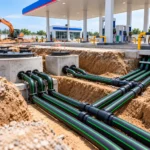
Secondary containment needs to be considered through these changes in direction and connection points. Manufacturers provide system-specific containment fittings; some designs enclose the primary fitting within a separate secondary fitting. A fitting that joins the fuel-carrying pipe should not automatically be assumed to provide secondary containment as well. franklinfueling.com
Terminations deserve the same attention. Depending on the approved arrangement, a containment sump may form part of the secondary boundary around connections where the outer pipe ends. The relevant question is where containment continues—not simply whether an outer pipe is visible along the straight run. US EPA
During a drawing review, ask:
Can we follow the secondary-containment boundary through every section and connection that the design requires it to cover?
That question helps move the discussion from a product label to the actual installed arrangement.
What to Check Before Approving a Quotation
For a useful comparison, ask each supplier to respond to the same project specification. Our recommendation is to clarify three points before comparing totals.
First, identify the configuration being offered. Is the quotation for primary pipe only, or does it include secondary containment? Request product codes and drawings rather than relying on a description such as “multilayer fuel pipe.”
Second, identify the included components. Ask for a schedule showing the proposed pipe, fittings, terminations and any specified monitoring equipment. Mark exclusions clearly. Installation support, testing and handover documentation should also be addressed in the scope you agree with the supplier.
Third, check that the documents match the proposed products. Request the applicable technical data, compatibility information, installation instructions and certification scope. Ask the supplier to identify exactly which sizes and configurations those documents cover.
Where EN 14125 is referenced, the EN 14125:2025 scope includes several fuel-pipework applications, secondary-containment pipework and fittings. A reference to the standard therefore does not, by itself, tell you which containment configuration appears in a quotation. NEN
For example, consider two offers for the same route length. One lists primary pipe and its connections. The other also lists secondary containment and monitoring-related components. Before deciding which offer is better value, reconcile both against the required component schedule. A difference in scope is not the same as a difference in price for an equivalent system.
5 Mistakes to Avoid When Comparing Fuel Piping
1. Assuming multilayer means double-wall
A pipe with several bonded material layers does not necessarily have secondary containment. Always check the manufacturer’s cross-sectional drawing.
2. Treating an EVOH barrier as secondary containment
An EVOH barrier helps limit hydrocarbon permeation through the pipe material. It does not replace a separately specified secondary containment system.
3. Assuming double-wall piping automatically detects leaks
A secondary barrier alone does not guarantee leak detection. The approved design must provide an appropriate monitoring arrangement.
4. Overlooking fittings and termination points
Straight pipe is only part of the system. The containment arrangement must also account for the required fittings, connections and termination points.
5. Comparing quotations without checking the included components
When evaluating single wall vs double wall fuel piping, ask suppliers to identify the primary pipe, secondary containment components and monitoring equipment included in their quotations.
Comparing the complete system scope helps prevent misunderstandings about what is actually being supplied.
Questions Buyers Ask
Is a five-layer fuel pipe the same as a double-wall fuel pipe?
No. Five bonded material layers can form one pipe wall. Double-wall fuel piping has primary and secondary containment barriers with an interstitial space between them. Check the construction drawing rather than relying on the layer count. RAIPL
Does double-wall piping automatically detect a leak?
No. The surrounding barrier must work with an appropriate monitoring arrangement. An outer wall alone does not guarantee that a leak will be detected or that the operator will receive an alarm. US EPA
Can single-wall connections be located inside secondary containment?
In suitable designs, yes. For example, a containment sump may provide the secondary barrier around connections within it. That does not make every single-wall installation secondary-contained; the complete arrangement needs to be assessed. US EPA
Start With the Required Configuration
When comparing fuel-piping proposals, begin with the project’s required containment arrangement. Then check the offered products, drawings and supporting documents against it.
Do not accept “more layers” as the answer to a question about secondary containment. Ask the supplier to identify the primary pipe, the secondary boundary and the monitoring arrangement separately.
Discuss Your Primary Fuel-Pipe Requirements With RAIPL
Explore RAIPL’s HDPE fuel pipe range or contact the RAIPL team with your specified pipe size, intended fuel and project requirements to request the relevant product information. RAIPL
This article explains piping terminology. Final selection, installation and testing should follow the approved project design, applicable requirements and manufacturer’s instructions.