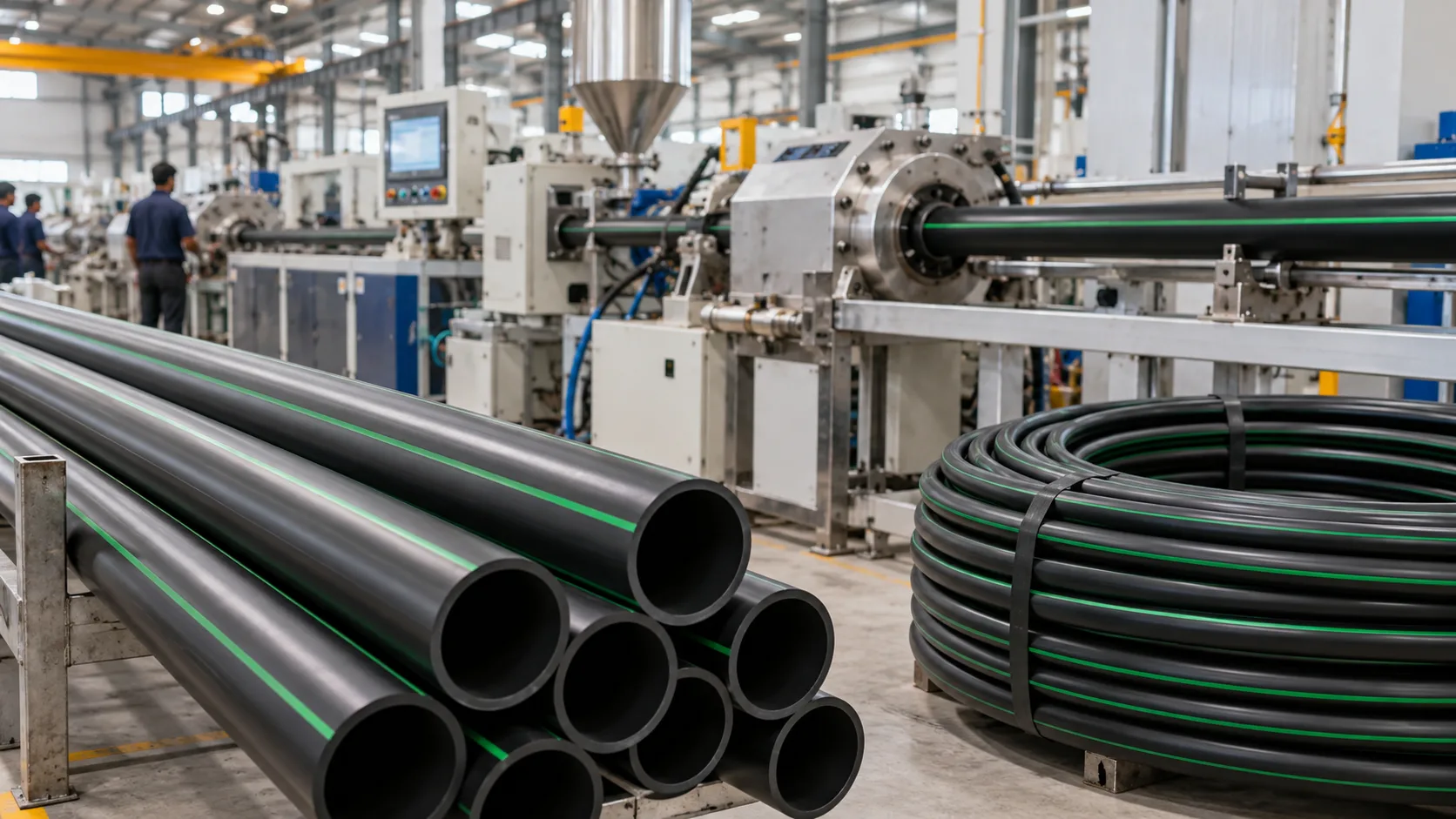
Finding an EN 14125 certified HDPE fuel pipe supplier is an important part of sourcing underground petroleum piping for petrol pumps and fuel infrastructure projects.
For OMC contractors, engineering consultants, EPC companies and procurement teams, the supplier selection process involves more than comparing pipe diameter and price.
Buyers also need to verify certification, fuel compatibility, manufacturing quality, fittings and project-specific requirements.
A fuel piping system installed beneath a petrol pump forecourt is expected to perform reliably over a long operating period. Once buried, rectification or replacement can involve excavation, additional costs and disruption to operations.
This makes the selection of a technically qualified manufacturer particularly important.
In India, RAIPL (Rahul Arts India Pvt. Ltd.), through its RAI Pipe business, manufactures specialized multilayer HDPE fuel pipes for underground petroleum applications, with EN 14125:2025 certification.
This guide explains what buyers should check before selecting a supplier.
What Is EN 14125 Certification for HDPE Fuel Pipes?
EN 14125 is a European standard covering thermoplastic and flexible metal pipework used in underground installations at petrol filling stations.
The standard addresses performance requirements for underground piping systems used to transfer liquid fuels and their vapours.
Its scope includes relevant applications such as fuel delivery pipelines, fill pipes, vapour-related pipework, secondary containment and fittings.
The 2025 edition, EN 14125:2025, supersedes the 2013 edition.
For buyers, the important point is that the standard addresses specialized petroleum piping rather than ordinary general-purpose HDPE pipes.
However, a reference to EN 14125 in a supplier’s brochure is not sufficient evidence of certification.
Buyers should request and verify the applicable documentation.
Why Choose an EN 14125 Certified HDPE Fuel Pipe Supplier?
Underground fuel piping is a specialized application.
The system needs to be evaluated for its intended fuels, operating conditions, mechanical requirements and installation method.
Selecting a supplier with relevant certification provides an opportunity to examine independently documented product conformity.
1. Product Evaluation
Certification documentation helps buyers understand which products have been assessed against a particular standard.
2. Defined Technical Requirements
The applicable standard provides a framework for assessing relevant product and system performance characteristics.
3. Supporting Documentation
A manufacturer should be able to provide technical specifications, certification information and relevant test records.
4. Procurement Verification
For petroleum infrastructure projects, technical documentation helps consultants and procurement teams evaluate whether a proposed product meets project specifications.
5. System Compatibility
Certification alone should not be treated as proof that every fitting, connection or installation configuration is covered.
The complete piping system still needs to be evaluated.
The goal is not simply to find a supplier claiming EN certification. It is to verify that the certification applies to the product being purchased.
How to Verify an EN 14125:2025 Fuel Pipe Certificate
Before placing an order, ask the manufacturer for a copy of the relevant certificate.
Review the following information carefully.
Manufacturer Name
Confirm that the legal manufacturer named in the documentation corresponds to the company supplying the product.
Standard and Edition
Check whether the documentation references EN 14125:2013 or EN 14125:2025.
If the project specifically requires the 2025 edition, confirm that the submitted evidence supports that requirement.
Product Description
Check the description of the certified product.
A certificate for one pipe construction should not automatically be assumed to cover a different construction.
Pipe Sizes
Verify that the required diameters are included within the documented certification scope.
Certification Organization
Identify the organization that issued the certificate and verify its authenticity and the nature of its assessment.
Validity and Scope
Check applicable issue dates, validity conditions, annexures and any restrictions stated in the certificate.
Supporting Test Reports
Where required, ask for relevant test reports and verify that the tested products correspond to the offered products.
Important: A certificate is not automatically evidence of accredited product certification. Buyers should also verify the issuer’s accreditation, if accredited certification is required by the project.
EN 14125:2013 vs EN 14125:2025: Why the Edition Matters
EN 14125:2025 is the newer edition of the European fuel piping standard.
When evaluating a supplier, buyers should identify the edition referenced in its technical documentation.
For a project specifying EN 14125:2025, a certificate referencing the older edition should not automatically be treated as equivalent without appropriate technical review.
Similarly, a certificate referencing the 2025 edition should be checked for its exact product scope.
The practical procurement questions are straightforward:
- Which edition does the project specification require?
- Which edition appears on the manufacturer’s certificate?
- Does the document cover the proposed pipe?
- Are the required diameters included?
- Are the fittings and installation requirements appropriately documented?
For a detailed explanation of the standard, read our guide to EN 14125:2025 for underground fuel piping.
Check Whether the Supplier Manufactures Specialized Multilayer HDPE Fuel Pipe
An HDPE fuel pipe should not be evaluated in the same way as an ordinary HDPE water pipe.
Specialized fuel piping may incorporate multiple material layers designed to perform different functions.
A typical multilayer construction can include:
HDPE → Tie Layer → EVOH Barrier → Tie Layer → HDPE
HDPE Layers
The HDPE layers provide important structural and mechanical properties for the engineered piping product.
Tie Layers
Tie layers help maintain adhesion between different materials within the multilayer structure.
EVOH Barrier Layer
EVOH, or ethylene vinyl alcohol, can be used as a barrier material to provide additional resistance against hydrocarbon permeation.
The effectiveness of the complete pipe depends on its design, manufacturing process and performance evaluation.
When comparing suppliers, ask for technical information about the proposed pipe construction and the fuel applications for which it has been evaluated.
Verify Fuel Compatibility Before Buying
Fuel compatibility is a critical part of selecting underground petroleum piping.
Petrol, diesel and ethanol-blended fuels can have different chemical characteristics.
A pipe suitable for one application should not automatically be assumed suitable for every fuel formulation.
Before ordering, confirm:
- The intended fuel type
- Relevant fuel compatibility documentation
- Any limitations specified by the manufacturer
- Compatibility of the fittings and sealing components
- Project-specific technical requirements
Where ethanol-blended fuels are involved, buyers should verify the applicable blend and test conditions rather than relying on broad compatibility claims.
The complete system should be suitable for the intended service.
Check the Availability of Compatible Electrofusion Fittings
A certified fuel pipe is only one component of an underground petroleum piping system.
The system also requires suitable fittings and connections.
Depending on the design, these may include:
Electrofusion Couplers
Used for joining compatible HDPE fuel pipe sections.
Electrofusion 90° Elbows
Used where the pipeline requires a 90-degree change in direction.
Electrofusion 45° Elbows
Used for specified directional changes.
Electrofusion Tees
Used where a branch connection is required.
Transition Fittings
Used to connect the HDPE piping system with specified equipment or other connection types.
Flange Components
Flange adaptors, stub ends and backing rings may be used where required by the engineered design.
When sourcing fittings, verify their compatibility with the pipe and the manufacturer’s approved jointing procedure.
Do not assume that fittings from different manufacturers are interchangeable simply because their nominal diameters match.
Check Manufacturing Quality and Batch Traceability
Manufacturing quality is another important factor when evaluating an HDPE fuel pipe supplier.
Buyers should ask how the manufacturer manages raw materials, production controls, inspection and product identification.
Raw Material Control
The manufacturer should maintain appropriate controls over the materials used in the pipe construction.
Production Process
Multilayer pipe production requires control of the extrusion process and the different material layers.
Quality Inspection
Relevant inspection and testing should be carried out according to the manufacturer’s quality plan and applicable requirements.
Product Marking
Pipe markings can help identify the manufacturer, product, dimensions, standard references and batch information, as applicable.
Traceability Records
Batch identification supports documentation and investigation if a product-related issue arises.
For larger petroleum infrastructure projects, traceability can be particularly valuable because the installed piping may remain underground for many years.
Check Whether the Supplier Offers 63mm and 90mm HDPE Fuel Pipes
RAIPL manufactures multilayer HDPE fuel pipes in 63mm and 90mm sizes.
The correct diameter depends on the engineering design.
63mm HDPE Fuel Pipe
RAIPL offers 63mm multilayer HDPE fuel pipe, including coil configurations.
90mm HDPE Fuel Pipe
RAIPL offers 90mm multilayer HDPE fuel pipe, including straight-length configurations.
Buyers should verify the available supply format, required quantity and fitting compatibility before ordering.
The choice between 63mm and 90mm should consider the project’s hydraulic design, piping layout and approved specifications.
Pipe diameter should never be selected solely on the basis of price or general assumptions about flow capacity.
EN 14125 Certification vs PESO Approval in India
For Indian petroleum infrastructure projects, buyers may encounter both EN 14125 certification and PESO-related approval requirements.
These should not be treated as interchangeable.
EN 14125 Certification
Relates to conformity assessment against the applicable European technical standard for underground fuel piping.
PESO Approval
Relates to applicable Indian regulatory requirements administered by the Petroleum and Explosives Safety Organisation.
The precise approval requirements depend on the product, application and relevant regulatory framework.
A manufacturer may hold documentation relating to both, but buyers should verify the exact scope of each approval.
In addition, OMC or consultant approval may be required for a particular project.
A product’s technical certification does not automatically establish its acceptance under every OMC tender or project specification.
Why Consider an Indian HDPE Fuel Pipe Manufacturer?
Indian manufacturing provides another sourcing option for contractors and procurement teams that previously relied on imported specialized fuel piping products.
Potential advantages include:
Domestic Product Availability
Local manufacturing can support supply planning and reduce dependence on overseas procurement cycles.
Direct Manufacturer Communication
Buyers can communicate with the manufacturing company regarding technical requirements, documentation and product configurations.
Procurement Coordination
Domestic suppliers may be able to support project-specific ordering and delivery arrangements, depending on production schedules and availability.
Import Substitution
Locally manufactured specialized piping can provide an alternative to imported products where technical and project requirements are satisfied.
Make in India
Domestic manufacturing contributes to the development of specialized industrial capabilities within India.
These benefits should be considered alongside product quality, certification, system compatibility and commercial requirements.
RAIPL: EN 14125:2025 Certified HDPE Fuel Pipe Manufacturer in India
RAIPL (Rahul Arts India Pvt. Ltd.), through its RAI Pipe business, manufactures specialized multilayer HDPE fuel pipes for underground petroleum applications.
RAIPL’s product range includes:
- 63mm multilayer HDPE fuel pipe
- 90mm multilayer HDPE fuel pipe
- Compatible electrofusion couplers
- Electrofusion 45° and 90° elbows
- Electrofusion tees
- Transition fittings
- Associated connection components
EN 14125:2025 Certification
RAIPL has obtained EN 14125:2025 certification for its multilayer HDPE fuel piping system.
Certificate reference: 251215.RAIW009.
The applicable certificate and supporting documentation should be reviewed to confirm the scope relevant to each procurement requirement.
PESO Approval
RAIPL also holds PESO approval relating to its fuel piping manufacturing activities. Buyers should request the applicable approval documentation to confirm its precise scope.
Made-in-India Manufacturing
RAIPL manufactures multilayer HDPE fuel pipes in India, supporting domestic sourcing for petroleum infrastructure projects.
Complete System Approach
RAIPL focuses on supplying specialized fuel pipes together with compatible fittings and associated components.
Our objective is to support buyers with an engineered fuel piping solution rather than an isolated pipe product.
Checklist Before Selecting an EN 14125 Certified HDPE Fuel Pipe Supplier
| Requirement | What Buyers Should Verify |
|---|---|
| Manufacturer identity | Legal name and product manufacturer |
| EN certification | Standard edition and certificate authenticity |
| Certificate scope | Product construction and covered sizes |
| Accreditation | Issuer’s accreditation, where required |
| Fuel compatibility | Intended fuels and supporting evidence |
| Pipe construction | Specialized multilayer design |
| Fittings | Compatible system components |
| PESO documentation | Applicable approval and its scope |
| OMC requirements | Project-specific acceptance |
| Test documentation | Relevant reports and inspection records |
| Traceability | Product marking and batch identification |
| Delivery | Quantities, configurations and schedule |
| Technical support | Installation instructions and product documentation |
This checklist can be used when comparing quotations or preparing a technical procurement submission.
How to Request EN 14125 Certified HDPE Fuel Pipe from RAIPL
To request product information or a quotation, share the following details with RAIPL:
- Project name and location
- Required pipe diameter — 63mm or 90mm
- Total pipe quantity in metres
- Required fittings and quantities
- Intended fuel application
- Applicable technical specifications
- Required certification or approval documentation
- Expected delivery timeline
Our team can review the enquiry and provide available technical and commercial information.
Frequently Asked Questions
Where can I find an EN 14125 certified HDPE fuel pipe supplier in India?
Specialized petroleum piping manufacturers offering documented EN 14125 conformity can be considered. RAIPL manufactures multilayer HDPE fuel pipes in India and holds EN 14125:2025 certification for its fuel piping system.
Is EN 14125:2025 the latest edition?
EN 14125:2025 superseded EN 14125:2013. Buyers should check the current published status and any subsequent amendments when preparing project specifications.
How do I verify an EN 14125 certificate?
Check the issuing organization, manufacturer name, referenced standard, product description, covered sizes, validity conditions and supporting documentation. Confirm authenticity with the issuer where necessary.
Is EN 14125 certification the same as PESO approval?
No. EN 14125 is a European technical standard, while PESO administers applicable Indian regulatory requirements. Buyers should verify both separately where required.
Does an EN 14125 certificate cover every pipe size?
Not necessarily. The sizes and products covered depend on the certificate’s documented scope.
Can I buy 63mm and 90mm HDPE fuel pipes from RAIPL?
Yes. RAIPL offers 63mm and 90mm multilayer HDPE fuel pipes for suitable underground petroleum applications.
Are electrofusion fittings available with RAIPL fuel pipes?
RAIPL offers compatible electrofusion and transition components. Buyers should confirm the specific fitting types, sizes and approved configurations required for their project.
Does EN 14125 certification automatically mean OMC approval?
No. OMC acceptance may involve separate vendor registration, technical approval and project-specific procurement requirements.
Request EN 14125:2025 Certified HDPE Fuel Pipe from RAIPL
Looking for an EN 14125 certified HDPE fuel pipe supplier in India?
RAIPL offers Made-in-India multilayer HDPE fuel pipes and compatible electrofusion fittings for specialized underground petroleum applications.
Contact our team to discuss your project specifications, required quantities, certification documentation and delivery requirements.
Explore RAIPL Fuel Pipes | View Electrofusion Fittings | Request a Quotation